
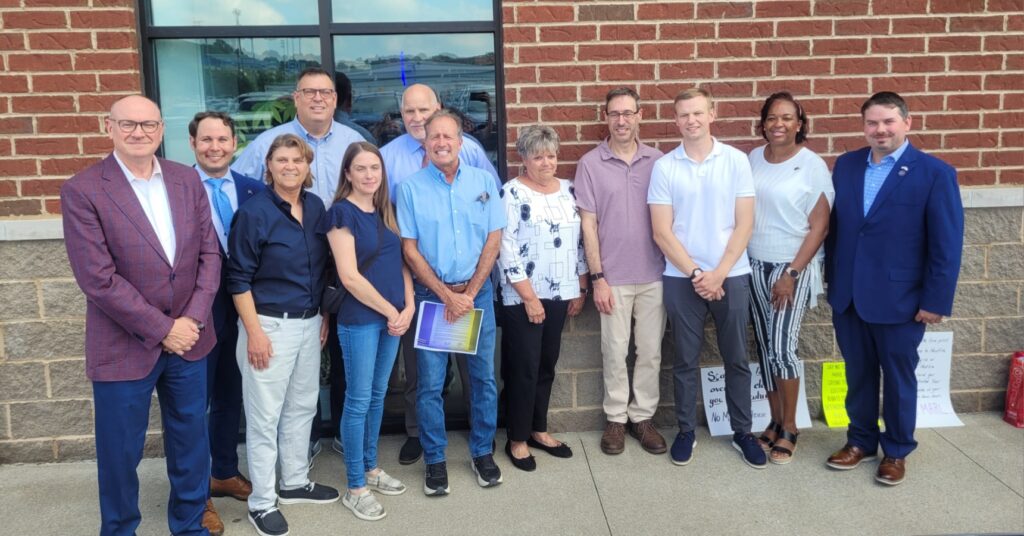
MORGANTOWN – “Hold on to this photo,” Monongalia County Commission President Tom Bloom joked Wednesday evening outside the Mon County Center. “It may never happen again.”
Regardless of what comes of the MidAtlantic Resiliency Link power transmission project in West Virginia, it’s already accomplished the exceedingly rare feat of unifying elected officials across political and jurisdictional lines.
A dozen such officials, including Republican and Democrat state legislators and county commissioners, as well as representatives from the city of Morgantown and the town of Granville, lined up for a quick photo prior to the West Virginia Public Service Commission’s public hearing on the MARL proposal.
They were already lined up in opposition to the project.
Proposed by Florida-based NextEra Energy Transmission, the MARL project before the PSC would run a 500 kilovolt transmission line across about 58.9 miles in West Virginia in order to pull power generated in Pennsylvania to Virginia.
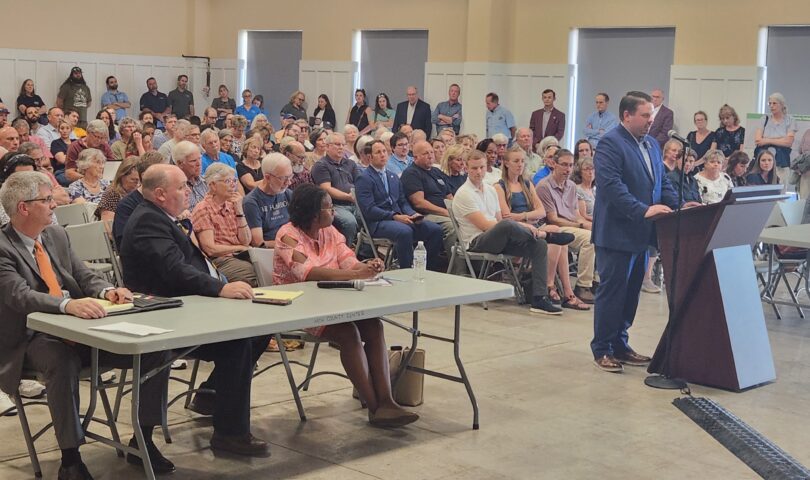
“Every project has impacts. The real question is whether those impacts are reasonable, necessary, and matched by real benefits for the people who bear them. That’s where this proposal falls short,” Delegate David McCormick, R-Monongalia 82, said, later adding, “If families are asked to live with the transmission corridor for generations. If businesses are affected and customers are expected to pay higher rates, then the benefits must be real, measurable, and directly tied to the people carrying those burdens. I have not seen evidence that this standard has been met. West Virginians have always done their part. We power this region. We contribute to America’s energy security. But we should not be expected to absorb the costs while others receive the benefits. It’s not fairness and it’s not good public policy.”
McCormick’s remarks followed the theme that ran through much of the commentary offered Wednesday by both politicians and members of the public – any benefits West Virginia sees in terms of tax revenue and temporary jobs is overshadowed by increased electricity rates and lasting impacts to the environment, public and private land and surrounding property values.
“It could lead to increased tax revenues. It could help stabilize the grid. But the problem is it will substantially increase electric rates for people across the state. And while my district is not going to be crossed by the line, everyone in my district pays electric bills and they’re going to be impacted,” Delegate Evan Hansen, D – Monongalia 79, said, recalling meetings with property owners along the proposed route. “I’m concerned about impacts to their property. I’m concerned about impacts to nearby communities – impacts to rivers and streams and forests and wildlife.”
Standing beside Morgantown City Councilor Louise Michael, Mayor Danielle Trumble said the MARL project is the latest example of West Virginia being asked to carry a long-term financial and environmental cost to the benefit of interests beyond its borders.
“One thing that former Governor Justice and I had in common is we believe that tourism is the future of West Virginia, and these areas must be protected,” Trumble said. “Equally concerning is the funding of this project. Our residents should understand it will be paid for through regional utility rate increases. Residents and businesses in our communities will be forced to bear the financial burden of a project that offers them nothing in return while causing irreversible damage to everything around them.”
Bloom noted the Monongalia County Commission is “adamantly opposed” to the project. The body has not only passed a resolution and penned letters to Gov. Patrick Morrisey and the PSC stating as much, it’s hired legal counsel to represent it as an intervenor in the PSC’s review of NextEra’s proposal.
“We did our research and we’re very concerned. We want to have our input,” he said. “I’ll be very honest with you – which gets me in trouble – but sometimes they make political decisions not in the best interest of the citizens of Monongalia County. What you’re seeing here is Democrats, Republicans, even people running against each other, coming together for one reason, and this is to oppose this project.”
Asked what he views as the worst-case scenario, Bloom responded, “It passes.”
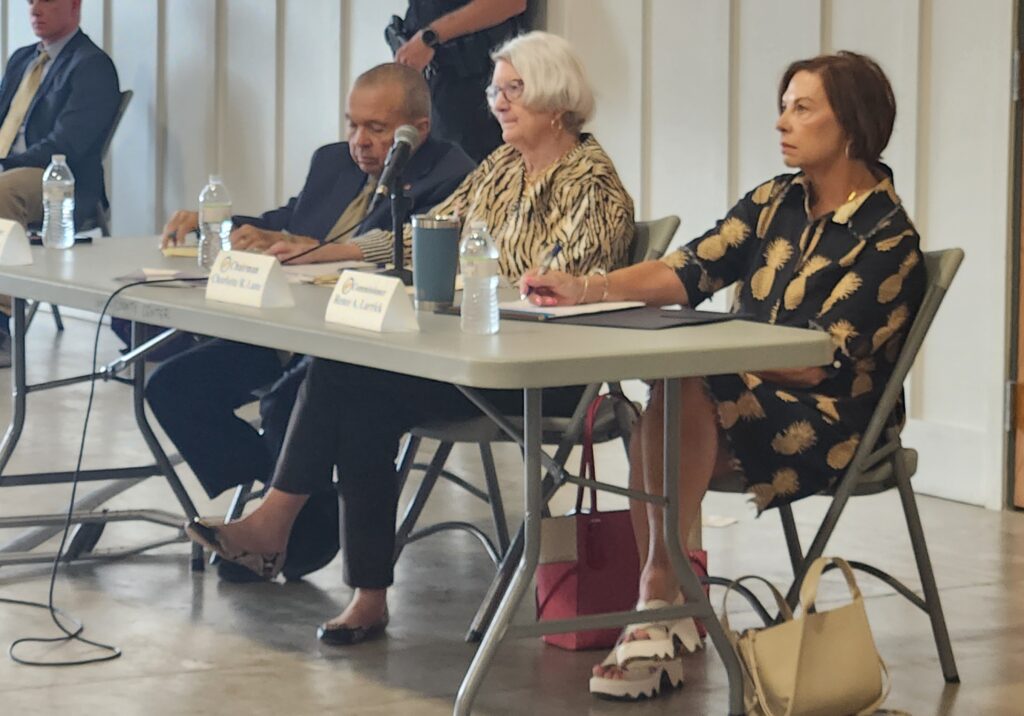
Standing together during a press conference prior to the public hearing, Senators Chris Rose, R-Monongalia 2, and Joey Garcia, D-Marion 13, considered that possibility.
“I would say, from a legislative standpoint, we’ll definitely apply a lot of pressure to the governor for a special session on this. You know, I’m good friends with the governor, but at the end of the day if the Public Service Commission makes this mistake, if they approve this project, we will be forced to call for a special session to address this,” Rose said. “If we are going to be eminent domained across. If they’re going to force this project on the people of West Virginia, then the people of West Virginia should be the ones that benefit from it the most. That’s one thing I will not stop fighting for because we have been taken advantage of by other states for too long. You’re seeing this is a bipartisan effort here. We’re not going to take it. We’re not going to accept ‘No’ for an answer. Our people will benefit or this project is not going to go through.”
Garcia continued the point.
“There has been a proposal that some people have been looking at in the legislature that we actually elect our public service commissioners instead of just having the governor appoint whoever he wants to appoint. I hope we don’t have more evidence pointing us in that direction. But if that’s the case, I think that’s something the legislature has to look at and say, ‘Who are the people that are not running for this office?”
The due date for a PSC ruling on NextEra’s application for a Certificate of Public Convenience and Necessity is March 2027.