
The height of fatherhood: How Frank Fumich got to be the ultimate (WVU) Mountaineer
Trending
KHUMBU, Nepal - Watch your step.
It's all kind of funny, the way Frank Fumich remembers it now.
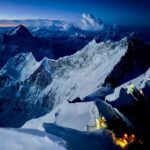
He was standing at the top of the world at sunrise last month - and he didn't have time to celebrate.
Not necessarily.
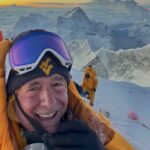
He had to grab a selfie with Dawa and Passang, the sherpas who had just helped him summit iconic Mt. Everest, which, breaking the clouds at just over 29,000 feet, is the tallest mountain in the world.
Then, he had to unfurl the West Virginia University "Let's Go" banner for another cell-snap, as Fumich is a 1991 Chambers college business grad - and sometimes a guy just has to represent.
He saved the most important, sacred duty for last.
Fumbling with heavily gloved hands, he reached into a pack and pulled out a container housing the ashes of Lilly Taxavidis, a 13-year-old cancer victim and daughter of one of his best friends.
"Bear with me, Lilly," he said, working to get the lid unfastened in the numbing cold. "We made it."
Mt. Everest is mystical, which means it just can't give it away.
Fumich then had to make like a pragmatic Sisyphus.
"You spend months and years working and planning to get to the mountain. Then, if you're lucky you climb it. And after you do that, you say, 'Well, now I have to get back down.'"
HARD WORK (EVEN IF GRAMMA DIDN'T APPROVE)
Readers of The Dominion Post first made their acquaintance with Fumich through his association with "Gramma and Ginga," his maternal grandmother Arlena Bashnett and aunt Genevieve Musci, respectively.
The curse word-spewing sisters from Clarksburg's North View neighborhood, who have since passed on, became viral sensations courtesy of the cellphone video of their often hilarious (and always PG-13) spats that Fumich would capture and post to Facebook.
National TV appearances and a well-received independent documentary from a California filmmaker would follow.
During the course of an interview with this newspaper, Gramma voiced her worry over her grandson's proclivity to do arduous, dangerous things - climbing mountains and the like - even if there was always a charitable component involved.
"I oughta kick that boy's ass," Gramma groused. "Before he gets himself killed."
STOP TELLING IT ON THE MOUNTAIN
Fumich would laugh. He has done dangerous things, and extremely difficult things, with a common good in mind.
He raises money for young cancer victims, such as Lilly. He competes in unfathomable physical contests to bring in dollars for communities and causes.
The man who just turned 58 earned every bit of his “Frank the Tank” nickname, his friends say.
Besides the massive peaks he's scaled, there are those Ultra Ironman competitions, where he'll swim 24 miles, pedal a bike for 1,120 miles and then run 262 miles (yes, really) in the same event.
Fumich, who grew up in northern Virginia and owns and operates a company that provides catered meals and other logistical support for all those regional airline carriers that fly in and out of the Washington, D.C., area around the clock, never places himself on the medal podium, however.
"I'm not really an 'athlete,'" he said, Thursday evening, with his feet planted in his living room after Everest.
"If I'm running or swimming, I'm getting passed by a lot of people," he continued.
"I'm not particularly talented, but I probably am the hardest-working guy out there. And if you're willing to put in the work, you can achieve. That's what I tell my girls."
Fumich and his wife, Chelsea, are the parents of twin daughters, Ava and Grace, who are now 16.
They're why he's getting out of the mountain-climbing business, he said. He's now climbed the Seven Summits — the highest mountains on all seven continents in the world — and Everest was last.
"I honestly never realized I was worrying them like that," he said.
"I'll still do the marathons and the triathlons, but I'm done with the mountains. I'm done with doing the things that might kill me."
MIGHTY LOGISTICS
Everest juts up on the border of Tibet in the Mahalangur, a craggy sub-range within the Himalayas.
The mountain arrived more than 60 million years ago in the tectonic collision of Earth's Indian sub-continental plate with its Eurasian continental plate.
It took until the mid-20th century for Edmund Hillary and Tenzig Norgay to finally reach the summit of the ancient Everest in 1953.
Base camp alone sits at 17,598 feet - and that's nearly four times higher than Spruce Knob, the tallest point in West Virginia.
THE EPIC ACT OF GETTING THERE
Just getting to Everest is a journey. All told, Fumich spent a good 36 hours in the air on the way.
Washington, D.C., to San Francisco.
San Francisco to Tokyo, including a 12-hour layover.
Tokyo to Kathmandu, followed by a series of helicopter shuttles finally to the mountain.
Finally.
At home in Virginia, Fumich slept in a pressured tent to simulate the altitude of Everest.
He hiked the Shenandoah Valley, shouldering a full backpack.
Fumich knew he was in the prime of physical condition, but he still struggled with breathing on Everest.
He came down with the dreaded "Khumba Cough," the respiratory condition common to high-altititude climbers breathing colder-than-cold air.
"I pulled muscles from coughing," Fumich said.
"I thought I cracked a rib. And I got frostbite on my toes. It's not as bad as it looks. I'm not gonna lose any."
FIERCE BEAUTY, POIGNANT TALES AND LILLY'S JOURNEY
Everest, the king of mountains, wears a crown. That signature band of yellow at its very top is prehistoric limestone.
There are craggy passes and fissures right out of an Indiana Jones movie. There are reminders of what Everest can do.
Fumich had to sidestep the preserved corpses of climbers who died while attempting the trek.
"I don't have the words to describe how that feels," he said.
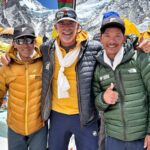
He'll always remember the warm smiles and calm assurances and Dawa and Passang, the sherpas.
"They're just 23 and 25," Fumich said. "I don't know how many times they've summited Everest but it's a lot. They're both amazing."
Dawa and Passang both took respectful steps back when Fumich tended to the matter of Lilly Taxavidis.
He had just completed a race in 2019 to race money for her cancer treatment when he learned she succumbed to complications from the disease.
Lilly's dad and Fumich's good friend Vasilis called and let him know. Fumich hopped on a plane and went to her funeral in Massachusetts. Lilly would become a traveling companion.
Fumich would honor the request of his buddy, who asked that he scatter his daughter's ashes during his global jaunts. Everest, as said, completed that mission.
"Here we go, Lilly," he said, loosening the contents one last time. "Fly high, girl."
He didn't begin to process the enormity of that until he got back home to Virginia. But then again, he said, that’s how Everest emotions go.
"I haven't gotten angry about anything since I've been back," he said.
"Things do 'hit' me differently, though. The other day I'm watching a clip of the WVU baseball team singing 'Country Roads' at the World Series and I'm crying like a baby."