
FAIRMONT – How many coal miners were harmed and it didn’t know it, during the recent Trump administration-led shutdown at the National Institute for Occupational Safety and Health?
It depends upon the person you’re asking.
J. Davitt McAteer, in the meantime, looks back to say that maybe it wouldn’t have been so deadly – were it not for that “black damp” coal dust hanging in the air like a mourning shroud.
The Fairmont native and assistant and secretary for the Mine Safety and Health Administration in the Clinton White House is talking about Monongah.
On the morning of Dec. 6, 1907, in the ragged coal camp within the borders of the Marion County town, what was already going to be a rough accident … turned into a catastrophe.
That was when a coupling on a trainload of cars laden with coal snapped, causing gravity to take them, clanging and banging like Hell’s roller coaster ride, back down into the portal of Fairmont Coal’s adjoining No. 6 and No. 8 mines.
Metal on metal in the ensuing crash created sparks.
And the sparks ignited the very air.
The explosions were an incendiary byproduct of that ever-present black damp dust.
When recovery crews were finally able to make an assessment of the disaster, some 500 miners, many of them immigrants hailing from the southern Italian village of San Giovanni in Fiore, lay dead.
Years after in San Giovanni, teenagers going out with friends would tell their parents not to worry, using an expression also sparked by that day.
“I’ll be fine,” they’d say, as McAteer would recount. “It’s not like I’m going to Monongah.”
Yes, they were referring to that Monongah.
McAteer was fretting over that black damp dust last spring after the Trump administration made sweeping cuts to NIOSH, including key labs and offices in Morgantown – as a move to right-size government.
It was a wrong-headed move, McAteer said then, and one that turned the clock back nearly 120 years, to erase hard-earned safety gains.
“With one wave of the hand,” he worried, “this administration is going to put us right back to where we were.”
On Wednesday, those Morgantown NIOSH researchers and scientists went back to where they were.
They were reinstated – along with their counterparts in Pittsburgh, Cincinnati and Spokane, Wash., who had also been ordered to leave last spring.
While United Mine Workers of America President Brian Sanson celebrated the callbacks, he did some worrying of his own Thursday.
Each day of the downturn, Sanson said, meant that miner went unprotected, increasing the likelihood of black lung.
NIOSH staff in Morgantown who were initially cut dealt specifically with the breathing of health of coal miners and others who toil in similarly dangerous professions – where particulate matter can hover in the air, before being lodged in lungs.
Same for Pittsburgh and Spokane, which did the same research.
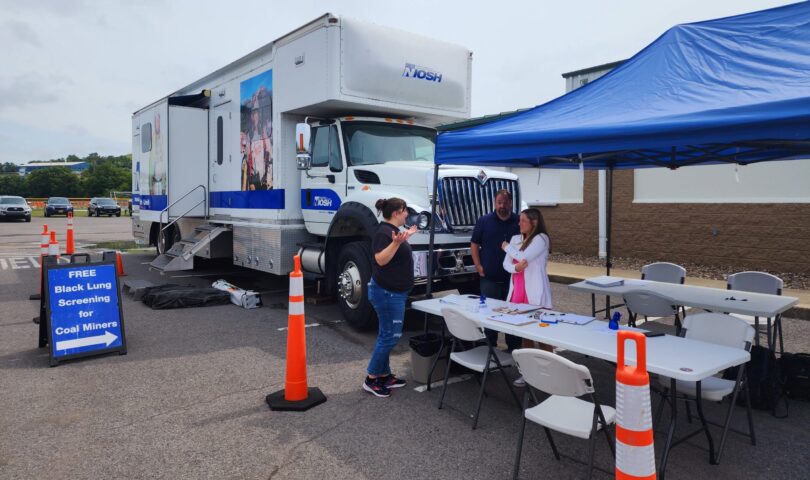
When NIOSH was down, the union president said, so was its signature mobile lab, which screens for black lung, or coal miner’s pneumoconiosis.
The condition inflames and scars lungs, thus making it eventually impossible to breathe.
From here on out, Sanson said, the UMWA will take in a lungful advocacy for NIOSH – all day and every day.
“While we are glad to see these positions restored, we are disappointed cuts were made in the first place,” he said.
“We’ll never stop fighting to keep all miners safe. A functioning NIOSH is a key part of that.”