
Public, private partnerships push development, infrastructure in 2025
Trending
MORGANTOWN - From big business to broadband, some of the top stories in 2025 involved the collaboration of public and private entities to improve services for residents and make Monongalia County more attractive for investors.
East End Village
A little over five years ago, the Monongalia County Development Authority purchased 9.5 acres of contiguous property adjacent to downtown Morgantown with a vision of advancing its first project within city limits, and possibly, the largest private investment project in the city's history.
It did so with the backing of city leadership, the Monongalia County Commission and WVU. Representatives of each joined with master developer Biafora Holdings to don hardhats in August 2024 and kick off the physical, and hopefully fiscal, transformation of the real estate.
While much of that story remains to be written, significant progress toward what's now known as East End Village was made in 2025.
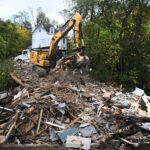
The year started with Reclaim Company pulling down the last of 58 old homes overlooking Richwood Avenue once rented to college students by the bedroom.
The year ended with the city receiving word from the West Virginia Department of Economic Development that the creation of a new TIF district - East End Village Redevelopment District No. 6 - had been approved.
The vision for East End Village is to turn a hillside of deteriorating houses into an array of modern, market-rate housing options sitting over retail suites and interspersed with standalone components - a grocery store and a boutique hotel have been offered as examples.
Russ Rogerson, president and CEO of the Morgantown Area Partnership, which includes the MCDA, said the establishment of the new TIF district is a critical step for the project.
TIF, or tax increment financing, districts represent one of the few tools available to government entities in West Virginia to spur economic development by leveraging future property tax growth to finance infrastructure improvements in a defined area.
Next steps for the East End Village include actions by Morgantown City Council to eliminate the existing Willey-Spruce-Brockway TIF created in 2014 and formally approve the creation of the new 73-acre district, which will encompass some of the same land.
Rogerson said MCDA is also working with the city to produce a developer agreement. Such agreements can be used by local governments and developers to formalize everything from development priorities to design standards to project phasing.
The East End Village project is expected to draw more than $100 million in private investment into the city when fully realized.
WestRidge
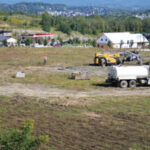
As the developer behind one of, if not the, most successful TIF districts in West Virginia, it's not uncommon for WestRidge to share news of businesses looking to invest, or further invest, in Monongalia County.
And it did so in 2025, most notably with the fall announcement that construction of West Virginia's second Dave & Buster's location was underway in the WestRidge Business & Retail Park near Menards and Academy Sports & Outdoors, the latter of which opened its doors in June.
Less expected was the news that broke in August that WestRidge Inc., WestRidge Land Holdings LLC and WestRidge Commons LLC had filed for Chapter 11 as defense against a push from lenders to have the entities placed in receivership.
The move certainly caught the Monongalia County Commission off guard. Commissioners noted the bankruptcy filing, while a setback to WestRidge and its principle, Ryan Lynch, was not reflective of the TIF district's performance.
In October, Commissioner Sean Sikora reported the district was coming off two of the three strongest months in terms of sales tax collections since the district's creation in 2016.
"Right now, we are trending about 28% ahead of last year's collections. We're projecting $14 million in collections on $236 million in sales," he said at the time, predicting an increase of about $2.5 million in collections over last year if sales held at that pace through the end of the year.
In an end-of-year update to the commission, Lynch said the decision to enter Chapter 11 wasn't taken lightly, but was necessary "to safeguard the long-term strength of the overall project, protect the interests of all stakeholders, and - most importantly - to ensure that the critical public infrastructure initiatives we are partnered on are not materially impacted or delayed."
Those public/private infrastructure initiatives, both of which also include the county, are the reconfiguration of I-79 Exit 155 and significant water and sewer upgrades.
In July, the West Virginia Division of Highways, Monongalia County Commission and WestRidge signed a three-way agreement spelling out how the $135 million overhaul of of Exit 155 will be financed - $67.2 million from the state, $54.3 million in federal MEGA Grant funding and approximately $13.5 million from WestRidge and the county.
According to Lynch, WestRidge continues to hold weekly meetings with the West Virginia Division of Highways on the Exit 155 project with the goal of completing the first design contract by September 2026.
As for the $14 million in water and sewer improvements, it involves $3,687,667 each from WestRidge, the county and MUB, plus $3 million from the West Virginia Water Development Authority.
This fall, MUB came to the county asking it to make good on $1,374,985.80 owed by WestRidge for the work, which is largely completed.
In his Dec. 17 update to the commission, Lynch said the developer made an $800,000 payment to MUB in November and had a $1 million payment scheduled "this week."
The improvements will support continued development in WestRidge as well as the Chaplin Hill area toward Mylan Park.
The sewer improvements include a lift station upgrade as well as 9,000 feet of force main and 1,200 feet of sewer line crossing beneath the Monongahela River at the Star City Bridge.
The water project includes an upgrade of the Chaplin Hill booster station as well as 9,625 feet of 12-inch water line and 1,100 feet of 24-inch water line crossing beneath the Monongahela River at the Westover Bridge. It also includes the construction of a new 859,000-gallon water storage tank.
According to MUB, the projects are substantially complete with the exception of the river crossing at the Westover Bridge in the area of Walnut Street.
Broadband
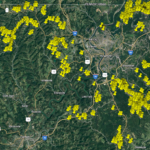
It took a little over four years, but the Monongalia County Commission's efforts to expand broadband access countywide started lighting up homes in 2025.
In November, Commissioner Sean Sikora said a public/private partnership with Frontier Communications had signed some 70 homes up for service.
The project in question saw the commission put up $791,421 (or 83%) of a $953,519 undertaking to install just over 11 miles of fiber to connect some 80 unserved and underserved locations. The expansion also makes connections possible for another 170 locations in the area.
All told, the commission dedicated approximately $8 million of its $20.6 million American Rescue Plan Act dollars to leverage more than $20 million in broadband expansion by partnering with Internet service providers Comcast and Frontier on five deployment projects - one with Frontier, four with Comcast.
The largest of the public/private endeavors was announced in June 2024, when the commission provided just under $6 million to pull in an $11.84 million investment from Comcast to connect more than 2,100 homes and businesses. While that project will hit areas across the county, it has a particular emphasis on the western end, which has the greatest number of dark zones.
Comcast also has smaller projects specific to areas of Stewarts Run, River Road and Gandalf Road (Snake Hill).
It was previously explained that many of these projects should start wrapping up by spring, but homes will be connected throughout the process as service reaches them.