
Trending
MORGANTOWN - The concept behind Hazel's House of Hope is somewhat revolutionary, at least for the state of West Virginia.
By turning a former Ramada Inn into a managed, rent-controlled hub for nonprofits and social service agencies, you allow those agencies to focus more of their resources on the community's most vulnerable while also providing a greater ability to communicate and attack issues along a coordinated front.
But its implementation came with an Achilles heel - transportation.
Hazel's House of Hope, or HHH, is located on Scott Avenue, four miles uphill along a major thoroughfare from the city's downtown.
Overcoming that obstacle has been a bit of a journey in its own right.
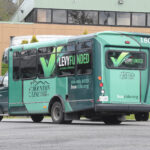
The Mountain Line Transit Authority took a number of immediate steps to offset the issue - first adding HHH as a regular stop on its Route 50 / Don Knotts run, then increasing the frequency of the route and extending its daily Don Knotts service to 9 p.m.
But the issue of cost remained. What about folks who need to get up the hill for food, shelter or other services but don't have 75 cents to cover the fare?
So, on Sept. 1, 2022, Mountain Line made every ride on the Don Knots route free, regardless of destination. The move was backed financially by a number of contributors, including the city of Morgantown and grant dollars through Morgantown Community Resources, the nonprofit that serves as facilitator and landlord for HHH.
Ridership exploded.
Under that setup, average monthly rides climbed from less than 2,000 in 2021, to 3,800 in 2022, to more than 7,000 in 2023 and 2024.
Mountain Line leadership argued the catch-all effort was completely inefficient and was becoming unmanageable. Further, as Mountain Line based the cost of continuing the free service on the previous year's ride totals, it was also rapidly becoming cost prohibitive, jumping from $25,000 the first year to at least $65,000 were it to continue in 2025.
In response, the city of Morgantown picked up the $5,470.50 monthly tab to keep rides free between July and November 2024 while city officials worked with Mountain Line and the Monongalia County Commission on an alternative.
In December, they rolled out a pair of complementary pass programs.
On the front end, the city purchases single-use Community Access Passes at Mountain Line's standard bulk rate of 67 cents each. The passes are good across the entire Mountain Line system and are available for free at various locations (public library, public safety building, etc.) and from city representatives (police, city ambassadors, etc.). The passes come with a handout detailing Mountain Line's routes in correlation to the area's various social service agencies.
In a recent update to the Monongalia County Commission, Mountain Line Executive Director Maria Smith showed that through nine months, the city had purchased 8,994 passes at a cost of $5,996. Of that number, 6,873 passes, or roughly 76%, have been collected in Mountain Line fare boxes.
The rest, Smith explained, are likely passes the city still has on-hand for distribution.
"Looking at trips by route, we want to take a look at where those community access passes are showing up in the system. There is not a route that has not seen one," Smith said. "No big surprise though, we're seeing a majority of the ridership with those passes on [Don Knotts]."
The one-use passes have provided more than 2,300 rides on the Don Knotts route, followed by the Purple Line (downtown to Suncrest Towne Centre) at 934 and Brookhaven (downtown to Sabraton to Brookhaven) at 915.
On the back end, the county is funding a pilot program in $5,000 increments to provide passes directly to nine social service agencies for distribution to clients.
Thus far, the county has purchased a total of 2,405 single-ride passes and 1,423 15-ride passes for a total of $15,833.
Of the 23,750 total trips represented by those passes, 20,963 have been taken, representing an 88% usage rate.
As would be expected, the Don Knotts route is seeing the overwhelming majority of county pass usage at 77.3% (18,677 rides). The Brookhaven route is next at 4% (970 rides).
As a requirement of the county funding, it's asking agencies to chart why the passes are needed.
Based on Smith's data, 22.6% are for disability services followed by temporary shelter (19.2%); food and meals (16.4%); medical appointments (10%) and employment (7.1%).
"People say, 'Are they being used?' Well, I wish everything we gave out, people would use 90%. That's a great number," Commissioner Tom Bloom said. "And it's being used for the purpose - that's important."
As for the overall usage on the Don Knotts Route, it remains well above 2022 levels, but appears to be creeping downward. Through October, ridership stands at 64,447, which is down from 73,632 and 71,237 through the first 10 months of 2023 and 2024, respectively.
"We really appreciate your support and the city's support through this. There's been a lot less funds expended. I think that the ridership on Don Knotts has been pretty well spread out, but it's a lot less than what we were looking at before with free ridership," Smith said. "At least on our behalf, we're very appreciative of this time to take a look at the data, and really get the information and drill into it."
Commissioner Sean Sikora explained the major push behind the data collection component is to allow social service agencies to plan for how many passes they'll need and incorporate those costs into their overall grant request to the county come budget season.
"Then we're out of the middle of it. We've basically just provided the data and the access for this pilot program to figure out how we get them making these decisions," he said. "So, that's kind of where we're at."