
Mon Power, Potomac Edison will seek PSC OK for a new gas-fired power plant
Trending
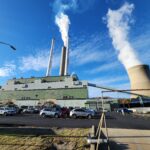
SHINNSTON - With the tall chimneys and cooling towers of the Harrison Power Station looming overhead, FirstEnergy leaders announced Thursday afternoon that subsidiaries Mon Power and Potomac Edison will be moving forward with their plan for a 1,200 megawatt natural gas combined cycle power plant to go online in 2031.
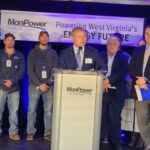
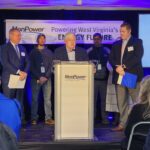
With legislators, local officials and business leaders gathered under a white tent, FirstEnergy President and CEO Brian Tierney talked about the Harrison plant, which came online in 1972.
"Harrison Power Station has been a cornerstone of reliable generation in West Virginia for more than five decades,": he said. "Today we honor that legacy and build upon it."
As The Dominion Post reported in early October, Mon Power and Potomac Energy filed their 10-year Integrated Resource Plan with the state Public Service Commission.
That IRP includes the natural gas plant. Tierney said the companies will file their plan to build the plant - at a site to be determined - with the PSC for its approval during the first quarter of 2026.
The plant will supply affordable, reliable and cleaner baseload power, he said, that will work in concert with existing energy structure "to create a a balanced and reliable energy mix that will leverage all of West Virginia's abundant energy resources."
The gas-fired plant will offer manageable costs for customers, a reliable supply during peak demand, and local investment and job creation. "It’s a promise to West Virginia families, workers and industries that FirstEnergy will be here for the long haul."
The companies are looking at two possible paths to build the plant, Tierney said. One is partnering with another company to build the plant and transfer it to FirstEnergy. The other is to build it themselves.
Tierney covered some of the potential economic benefits of the plant. According to WVU’s Bureau of Business and Economic Research, the construction phase would generate 3,200 direct and indirect jobs and $68 million in state and local tax revenue. Ongoing operations would generate 2,200 job and $86 million in annual tax revenue.
Among the jobs, he said, are 36 permanent technically advanced positions at the plant, plus hundreds of additional natural gas jobs.
Beyond that, "reliable around the clock power attracts high-load businesses such as data centers and manufacturers. ... We want developers and decision makers to see that West Virginia isn’t just adjacent to opportunity, West Virginia is the opportunity.
FirstEnergy is also partnering with other companies to bring major transmission infrastructure to West Virginia. And for 2025-2029 it plans to invest $5.2 billion in West Virginia in infrastructure enhancements, people, processes and facilities. Pending PSC approval of the plant, that’s another $2.5 billion investment.
While both coal-fired plants - Harrison and Fort Martin - are nearing retirement age, Tierney said they plan to keep both operating through 2035, evaluating them in five-year increments.
"Given the demand that we face for energy," he said in response to a question about the two plants from The Dominion Post, "I think retiring plants is a particularly bad idea right now, and adding new plants is a particularly good idea right now."
Tierney noted that the plan for this new plant fits into Gov. Patrick Morrisey’s "50 by 50" generation plan to increase West Virginia's energy capacity to 50 gigawatts by 2050 - an increase from the 15 gigawatts it currently produces.
And Morrisey was on hand Thursday to praise FirstEnergy’s plan.
He said he’s "laser-focused" to grow the state’s economic pie, lift the standard of living and grow the workforce. "Electricity demand in our country is soaring."
And we are in competition with China to feed the AI and other energy demands. "We know that PJM [the regional energy grid operator] is starving for energy resources and we know that West Virginia is better positioned than virtually any state across the nation to provide the energy to feed the power demands of the next few decades."
The companies’ plan, he said, is big news for gas and big news for the Mountain State, but not at the expense of coal.
He good-humoredly challenged FirstEnergy to go farther and double its output vision. "If you make that happen, we’re going to get you the customers, because we’re talking to the customers right now."
Brian Dayton, West Virginia Chamber of Commerce vice president for policy, also offered a few remarks.
"West Virginia can be an energy state, or we can be a poor state," he said. "But projects such as this ensure that West Virginia will always be known as the energy state.
"We know that the power demands of the future will be significant, as will the opportunities to attract more investment to our state," he said. "We are really at a great time here in the state and we have an exciting opportunity in front of us."
Tierney, in talking of the companies’ overall generation plans, noted they also are adding 70 MW of utility-scale solar by 2028. Their first two solar sites - at Fort Martin and Rivesville - are already online.
Among the legislators present were local Sens. Mike Oliverio, Joey Garcia and Jay Taylor; and local Delegates Joe Statler and George Street.
A combined cycle unit uses both gas and steam combustion turbines to generate electricity. In the gas combustion turbine, air is pressurized using a compressor, injected with fuel and ignited to generate high-temperature pressurized gas that expands to drive the turbine and generate electricity. The waste heat from the gas turbine is then used to generate steam to drive a steam combustion turbine for additional electricity generation.