
Commission hears pitch on license plate recognition cameras
Trending
MORGANTOWN - It all started with a trip to Lowe's.
Working a series of local thefts at the national home improvement chain, officers with the Monongalia County Sheriff's Department were granted access to the license plate recognition cameras positioned in the store's parking lot. Every Lowe's store in America has them. Walmart and Sheetz aren't far behind.
MCSD Detective Josh Ward said that experience put the cameras on the department's radar as an emerging force multiplier for law enforcement efforts.
The point was hammered home sometime later, when a detective with the MCSD closed the book on a murder case after a vehicle submitted to the National Crime Information Center passed by an LPR camera in Michigan.
Since then, Marion County has invested in a network of 20 LPR cameras. In the year or so they've been in place, MECCA 911 Director Jim Smith said, alerts from the system have helped solve some 200 crimes ranging from child abductions to large-scale drug trafficking. He said Marion County is currently discussing the placement of 20 more cameras.
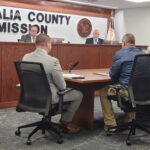
Ward and Smith were joined by Sheriff Todd Forbes, MCSD Administrator Mark Ralston, MCSD Detective Stephen Currie and Kyle Sappington of the Morgantown Police Department and Mon Metro Drug Task Force on Wednesday to propose the implementation of LPR cameras in Monongalia County.
They told the Monongalia County Commission that 20 cameras, plus the software and support from industry leader Flock Safety, comes with a $193,000 price tag - or roughly $64,300 annually across a three-year contract. The price would come down to $180,000 if the county signs on by Nov. 14.
"Everybody thinks they just read license plates. They don't. They can read the color, make and model of your vehicle," Ward said. "Say we get a child abduction, or an armed robbery, or really anything, and they say it was a red SUV. If we have a license plate reader in that area, we can say, 'Give me every red SUV that passed through that area in the last 5-10 minutes. It's going to capture an image and the license plate of every red SUV that goes through that area."
The Flock system is tied in with the NCIC - the national database created to facilitate the rapid exchange of information between federal, state and local agencies - as well as the Amber Alert and Silver Alert systems.
Additionally, officers would be keyed into emerging situations, like abductions and violent crime, but the day-to-day implementation would be more tailored to the specific cases being worked by individual officers, detectives and task force members.
"So, say we have 150 officers using this; everybody's can be different. I can have four or five vehicle descriptions that I'm personally looking for, and I'll only get the alerts for those, and then the Amber Alerts and that kind of big stuff," Forbes said.
Ward offered an example.
"There was a missing person that I worked. She was experiencing some psychiatric issues and some substance abuse issues. She left home and we searched for her for about two months. It turns out she'd left the county. She went up to Preston County where she was later found deceased," he said. "A license plate reader could have had our guys, in real time, tracking that vehicle as it was moving around our county, because weeks later, when I did get her cellphone data, it showed that she drove around our county for some time that day."
While receptive to the pitch, individual members of the commission raised a couple concerns.
One is cost.
In addition to potentially having local agencies assist with the bill at some point down the road, Smith said the system would also be an appropriate use of opioid settlement funds, noting that in conjunction with supporting those who are addicted, clamping down on the transport and distribution of drugs in the county is money well spent.
"I think it's programs like this where you start seeing actual results coming out of it. To try to stop those kids before they start using those drugs," he said. "Because if you get drugs off the street, they may not be there Friday night in a certain bar downtown where they would have been."
Additionally, Commissioner Tom Bloom said he has concerns about who would have access to the system. He provided a timely example of federal agencies using the local cameras to aid in efforts like immigration enforcement.
"I'm really worried about that part - sharing," he said. "There's a difference if it stays in the community, but what happens if, the next thing I know, we have to share everything at the federal level. I'm really worried about that, and potential abuse."
Ward explained that the system would be administered locally.
"So, if we are in control of it, we approve who gets access to it and for what reasons," he said.
"I can assure you, we're not doing this on behalf of anybody from ICE," Forbes added.