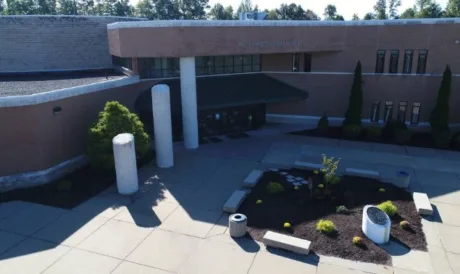
MORGANTOWN – What’s it going to take to close Grumbein’s Island?
The blessing of the West Virginia Division of Highways for starters, and likely more than $50 million worth of projects along Beechurst Avenue and other locations in and around downtown Morgantown.
Those were some of the findings of a recent study conducted in house by the Morgantown Monongalia Metropolitan Planning Organization.
The analysis was conducted as a companion to the MPO’s two-year Downtown Microsimulation Study rolled out by consulting firm Kimley-Horn last May. The study identified the closure of University Avenue through WVU’s downtown campus in the area known as Grumbein’s Island as a recommendation for improving traffic flow downtown.
The MPO supports it. It’s a Tier 1 priority in its Metropolitan Transportation Plan, which identifies transportation projects over the next 30 years.
So does WVU. President Michael Benson has said called it a priority of his administration.
But the traffic has to go somewhere.
“The Beechurst Avenue / 8th Street roundabout and Beechurst Avenue corridor improvements must be implemented before or concurrent with the Grumbien’s Island closure. Without these improvements, key intersections will degrade to [level of service] F with extreme delays,” the MPO report said.
According to the microsimulation study recommendations, Beechurst Avenue would become a “reduced conflict resolution corridor” wherein drivers approaching Beechurst from minor streets must turn right and make a legal U-turn at a designated median opening in order to cross traffic.
The Beechurst corridor improvements mentioned also include changes – potentially a second roundabout – at the University Avenue intersection at U.S. 19 (Pleasant Street / Westover Bridge).
All told, the projects along Beechurst / University are currently projected in the $31.8 million range.
It should also be noted that the data collected by the MPO assumes the other top priority recommendations of the microsimulation study – downtown signal timing and multimodal improvements ($3.18 million) and the realignment of US 119 (Willey Street) to connect with Snider Street ($15.9 million) — are already in place.
In other words, the closure of Grumbein’s Island is likely many years, and many millions, away – if it moves forward at all.
Asked when a decision should be made the project, outgoing MPO Director Bill Austin said that’s going to come down to getting the DOH on board.
Equally, he noted, it’s going to come down to getting local stakeholders and the broader community lined up behind the effort.
That’s been easier said than done in years past.
And it’s not expected to be easy in this case.
The $500,000 microsimulation study that grouped all these projects together predicted the initial level of public support as “negative.”
“You guys know it better than anybody – community consensus,” DOH representative Brian Carr said. “I can tell you that my superiors don’t like getting a lot of emails and phone calls and petitions and everything else with everybody trying to fight whatever project there may be. We’ve always tried to have our MPOs rally the troops and say, ‘This is best for the region.’ You guys have to band together.”
MPO Chairman Russ Rogerson said he believes progress has been made in presenting a more unified front to the DOH, and he sees this as another chance to meet that challenge.
“I think it’s an opportunity for this organization, this group, to really kind of set the tone and go through the processes necessary involving the right people, having that input and getting that out on the table ahead of time,” he said. “I’m confident, and I think we’ve shown very much improvement on that front over the last few years. I look forward to the journey.”