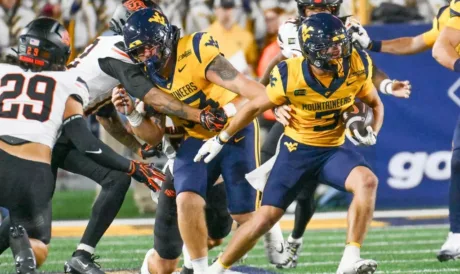
MORGANTOWN — The current state of college athletics has turned into an “arms race,” as West Virginia athletic director Wren Baker called it in April. It’s become who can generate the most money to pay the best players to compete for championships. And it’s happening in all sports.
Now, as college football legend Nick Saban said, it depends on where you spend the money, but as Rich Rodriguez recently said in an interview with ESPN’s Pete Thamel, it gets to a point where you can’t miss.
“When rosters get up to $50 million, $60 million, $70 million, they’d have to be idiots not to be able to get a really good roster with that, right?” Rodriguez told Thamel.
So, where does WVU stand financially compared to the rest of the Big 12 and the other athletic departments around the country? It depends where you look, but obviously, it can’t really compete with some of the big schools. It won’t have more money than Alabama, LSU, Ohio State or Texas Tech. Those are the teams that have +$20 million rosters and, at one point, could reach the $50 million mark.
It might not be to that clip, but WVU is slowly growing in revenue, especially from a couple of years ago.
“For about a decade there, our overall budget was fairly static,” Baker said. “We grew some, regressed some during Covid, but it did not grow at the clip that we really needed to. This year’s budget and next year’s budget will both exceed $150 million total, and so that’s probably a roughly 50% growth from where we were three years ago. That’s taken a lot of people to do that, and a lot of people at home have contributed to that.”
Generating that revenue has taken a lot, and Baker said most of his time is dedicated to being a salesman, instead of doing what he enjoys, and actually watching his teams in action.
The revenue has come from a couple of different avenues. There are the broadcast rights and then the money WVU’s making from partnerships and naming rights. Baker said he’s looking to explore more naming rights and utilize the new ruling, allowing teams to have jersey partnerships. Marshall announced its jersey sponsor will be Marshall Health Network.
Baker said the Mountaineer Athletic Club has 7,000 members. The MAC is WVU Athletics’ donation service. The all-time high is 8,000, and the goal is to surpass that.
“We need your help to do it from the people at home,” Baker said. “Get your neighbor, get your friend, get the person who sits by you at church, or at your kids’ summer games, to join the MAC. That’s really important.”
Baker said there have been some big donations already this year. Prior to this year, WVU had four gifts of five million or more, and it already has three this year. He said there are four more verbal ones that they are trying to get “across the finish line.”
“2009, prior to this year, was our best fundraising year ever,” Baker said. “I think our second best was two years ago, and we will surpass that this year. It’s just a matter of how much. I think this is going to be by far and away our best fundraising year ever. We’re very thankful and excited about that.”
The problem becomes, can WVU do this every year, with the cost growing every year? Baker seemed exhausted last offseason just trying to meet the revenue-sharing number of about $20 million. That’s why he gets paid the big bucks to make sure WVU can.
It’s still a challenge, and it’s not just a WVU issue. Every school, aside from a select few, is going through the same problem.
“Everybody is struggling to kind of stay where they need to,” Baker said. “We have been able to find a way to better position ourselves each of the last three or four years. I think going into this year, we feel the best we’ve ever felt in terms of resources and where our teams rank inside the Big 12.”