Latest News

Grant sought for Deckers Creek runoff project below Stanley’s Spot Dog Park

MORGANTOWN – The West Virginia Water Research Institute is looking to partner with Friends of Deckers Creek and BOPARC on a fecal coliform abatement project focusing on runoff from Stanley’s Spot Dog Park along Deckers Creek in downtown Morgantown.

“Deckers Creek is on the state’s impairment list for fecal coliform, which is a group of bacteria that is found in waste from warm-blooded animals. The Deckers Creek Watershed Base Plan, which was updated in 2015, makes the watershed eligible for projects to remediate non-point-source pollutants, which would include fecal coliform from runoff,” Water Research Project Manager Rachel Spirnak explained.

As opposed to a point-source pollutant, which would be something draining out of a specific pipe or pipes, a non-point-source pollutant is found in groundwater runoff over a broader area.

“Due to it being along a slope right next to the creek, there is a good potential for runoff coming from dog waste,” Spirnak said of the park. “Even though, of course, there are bags and signage, that doesn’t always happen and the runoff can still occur.”

It was noted during a presentation to BOPARC that one gram of dog waste can contain 23 million fecal bacteria, as well as parasites and nitrogen that harms plants and contaminates water.

The goal, Spirnak continued, is to apply to the West Virginia Department of Environmental Protection’s 319 Program for grant funding to engineer and construct a small runoff treatment structure directly below the 1.5-acre park located between the Pleasant Street and Walnut Street bridges.

“The Water Research Institute and Friends of Deckers Creek have both done extensive 319 projects dating back to the early 2000s,” she said. “We have eight active 319 projects right now.”

Elsewhere, Spirnak said grant funding was recently provided to construct a similar abatement project at a dog park in Huntington.

Water Resources Engineer Dave McCoy explained that if the project moves forward it would consist of either a fenced off subsurface flow wetland, which uses plant roots to absorb bacteria, or a drain trench directing runoff to a graduated stone and sand filtration system similar to a soil absorption system on a residential septic tank.

“Similar to a septic system, we have to do a percolation test to see how the water percolates down through the soils, because if you had clay or something there, it wouldn’t be ideal to do this option. You’d rather do the wetland option,” McCoy said. “Now, knowing that there’s limited space there, this one actually might be preferable if the soil type is suitable.”

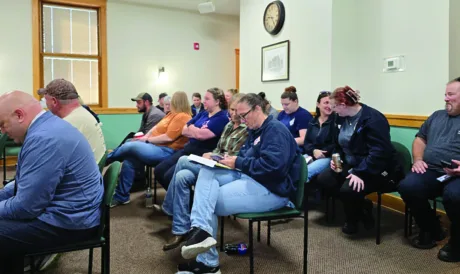
Given BOPARC’s consent, which is anticipated to come during a special meeting Wednesday, the Water Research Institute has a May 1 deadline to submit the grant application. The award announcement is expected this fall.

Should the grant funding be provided, “It would be a three-year project. The first year of the project would be some preliminary monitoring of the fecal coliform levels above and below the park in Deckers Creek,” Spirnak said, explaining construction would likely occur in spring of 2028.

The estimated cost of the project is $60,000 to $80,000, a portion of which would come through a local match that will be the responsibility of the Water Research Institute.

“I am just very interested in that water testing because I feel like the dog park is a drop in the ocean,” Morgantown Mayor and BOPARC Chair Danielle Trumble said, alluding to the numerous combined sewer overflow outlets along Deckers Creek. “I’m interested to see if the water quality is actually any worse above or below the dog park, because there’s lots of poopy in the creek. I just don’t know how much of it is dog poopy.”