
Trending
MORGANTOWN - Hindsight, they say, is 20/20.
Choices are made in the moment based on the circumstances at hand. Time tells you whether those choices were ultimately right or wrong.
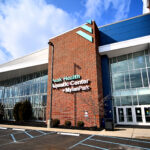
For the decision makers behind the Aquatic Center at Mylan Park - now the Peak Health Aquatic Center at Mylan Park - a meeting held in early 2020 has become a major point of reflection.
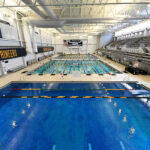
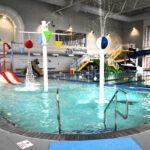
The 90,000 square-foot, state-of-the-art aquatic center opened to great fanfare on Nov. 1, 2019. A well-attended ceremony served as the starting gun for a facility aimed at serving both the competitive needs of West Virginia University and prep sports, and the fitness and recreation desires of the community.
The celebration was brief.
Within about four months, the pools, diving platforms, slides and splash pad were sitting unused as the rise of COVID brought on restrictions that made such public venues unusable.
"We had a choice. We either keep the facility open or we shutter the facility, meaning close it totally down - drain the swimming pools, everyone gets laid off and we start over," Mylan Park Foundation Executive Director Ron Justice said. "At the time, we couldn't predict if it's going to be three months or how long this all would last."
The decision was made to keep the facility staffed and operational.
"It ended up being between 18 and 24 months before all the restrictions were lifted and we were back to normal function. I think it was about nine months that we couldn't have anyone in the facility," Justice said. "Clearly, I think if we were all sitting in a room today and know what we know today, we probably would not have made that decision, frankly."
Just as a powerful start off the blocks is critical for competitive swimmers looking to build early momentum, for a brand-new facility with annual operating expenses that run north of $3 million, the hampered launch was devastating.
In order to offset losses during the downtime, a $6 million loan was acquired.
That amount was added to the $33 million initially financed to get the aquatic center constructed. Another $15 million of the overall $48 million project was provided by the Hazel Ruby McQuain Charitable Trust - its largest gift to that point - in support of both the aquatic center and neighboring track facility.
The aquatic center is owned by Mylan Park and operated through a Joint Use Management Agreement, or JUMA. It's governed by a board with four representatives each from Mylan Park and WVU, the latter of which ultimately serves as the financial backstop for the facility.
Per the terms of the agreement, WVU provides monthly payments. For the current fiscal year, those payments are budgeted at $867,000 total.
During the Feb. 20 meeting of the WVU Board of Governors, Interim Chief Financial Officer Barbara Weiss said the university has provided an additional $1 million in unbudgeted support for the facility in the first six months of this fiscal year.
When questioned about her level of concern over costs tied to the aquatic center, Weiss responded, "I do think we need to keep a very close eye on it."
Monongalia County Commissioner Sean Sikora, who serves as chair of the JUMA board, said the facility has operated at a loss each year since opening.
“We did a side pocket loan about five years ago to help where we thought we needed it at that time to really get through COVID, because expenses were going through the roof and there was no revenue. So, we’re still responsible for that. We’re still making debt payment on the main loan, and we’re making payments on that loan,” Sikora said. “If it weren’t for debt service, we’d probably be okay. We’d be sustainable.”
Justice explained the additional $1 million from WVU was used to offset losses in 2025 and help facilitate a June transition in venue operator from Centers, which specializes in the management of college and university venues, to Eastern Sports Management, which specializes in community-based sport and recreation complexes.
The move marked an early termination of the 10-year contract with Centers.
While Sikora said the relationship with the management company was solid, "It just wasn't a good fit."
"One of the issues with the previous management company is we wanted them to be more entrepreneurial and bring more ideas to the table, but that's not really their business model. Their business model was more managing facilities for universities where you have an overall benefactor that's going to deal with all the ups and downs," he said. "They weren't out there pushing sales. They were more just facility management."
Justice said the aquatic center is somewhat unique in that its financial success involves striking a balance between governmental-type partnerships, like the one in place with WVU, and revenue generated through community use - memberships, daily passes, party rentals, etc.
He said he's optimistic Eastern Sports Management will be able to help in that regard.
Asked if there's any concern that the facility ultimately won't make it, Justice said no.
"We've got a great partnership between WVU, the county, Mylan Park and all the folks that supported us. That absolutely will not happen," he said, later adding, "It's not going to happen overnight. It's probably going to take a two or three-year period of time to get it totally righted, but we're working really hard right now ... I do think there's a lot of optimism that by doing some things in a different way, whether that be refinancing and going after a lower interest rate or looking at additional revenue sources - all those things - I do think there is absolutely a path forward."