
A PRT looks at 50: WVU’s ‘Ride of the Future’ still moving people
Trending
MORGANTOWN - They would never admit it, but the folks responsible for keeping West Virginia University's little blue Personal Rapid Transit cuboids (PRT) plugging along must certainly be embroiled in a kind of love-hate relationship.
One of those, 'Sure, he can be a cantankerous jerk, but he's OUR cantankerous jerk,' kind of deals.
I mean, what do you say about a one-off system built 50 years ago for which you must source a very specific hydraulic pump designed for a very specific Vietnam-era helicopter?
And what do you call a system for which the most common wear points are spring-loaded collector arms manufactured specifically for the PRT by a single maker based on an original pattern utilized solely in overhead gantry cranes?
Well, if you're WVU Transportation Director Jeremy Evans, you call it an icon that remains critical to the daily operations of the university.
"It's both, but moving people is still where the real value is. We still move 12,000 people a day when school's in session. So, if you imagine those 12,000 rides being in cars or on buses every day, we couldn't do it, and it gets more and more each year. We hope enrollment grows, right? So it's going to continue to be needed," he said.
You could also call it expensive - roughly $125 million for what was envisioned as a 10-year experiment.
The PRT's construction throughout the 1970s cost the modern equivalent of $600 million to $1 billion in today's dollars depending on whether you're tracking inflation from the start of Phase 1 or the end of Phase II.
Either way, it's a far cry from the $18 million figure originally floated when the political stars lined up behind the project citing the daily gridlock that began to grind America's urban centers with the meteoric rise of the personal auto, and related concerns over the growing influence oil dependence had on daily life made clear by the 1973-1974 oil embargo.
Arthur Hitzman, Boeing Aerospace Company's lead manager for "The Morgantown Project" explained in the 1977 short film "Come, take a ride of the future," currently available on YouTube.
"The Morgantown Project is the first demonstration project sponsored by the Urban Mass Transit Administration. Its purpose is to evaluate the technological, operational and economic feasibility of a personal rapid transit system in a real-world, urban environment."
Evans said the fact that the PRT remains a critical means of transportation across WVU's campuses is a testament to the original design, the commitment of the university and the care provided by the employees who have monitored, maintained and managed the only on-call, direct to destination system of its kind in the world.
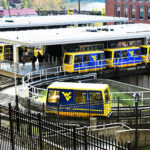
The cars, built on 1970s Dodge Power Wagon frames, are regularly cycled through at intervals for varying levels of maintenance. One car currently in rotation has covered 750,000 miles, traveling there and back again - again and again - to the five stations along the eight-plus-mile guideway.
"There's kind of a big urban legend around the PRT, that it doesn't run well. That's not true," Evans said. "If you look at what our availability numbers are, which is what we measure, we're over 98.5% for the past five or six years. That's a testament to all the hard work that our maintenance staff put into maintaining the vehicles and the work our central control staff does to make sure that when there is an issue, it's identified and quickly resolved."
The system has evolved over the years from a hard-wired circuit monitored by individuals flipping switches and pulling toggles in response to the movement of blinking lights, to an autonomous, wireless train control system on par with the New York subway system in terms of technology.
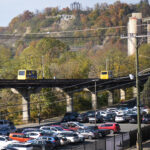
As part of that evolution, area residents likely noticed the removal of the white panels that once adorned more visible sections of the guideway. Assistant Director of Transportation Stephen Vozniak said the one-ton panels were not only adding tremendous load to the raised platform, but trapping moisture by restricting airflow to the weathering steel that supports the structure.
"That was just an aesthetic. It was sort of the 60s, 70s Jetsons look - a futuristic kind of vibe, but they were actually fairly detrimental to the system," he said, explaining form has given way to function as preserving and maintaining the aging infrastructure became the top priority.
The PRT operates on an annual budget of roughly $7.5 million these days. Additional upgrades to the stations and guideway are in progress via $6.4 million in federal transportation dollars - $8 million total including the local match.
As the first and only of its kind, the story of the PRT could fill chapters.
Its inception, starting with Professor Samy Elias, was inspired. Its construction, at times, seemed impossible. Its endurance is all but miraculous.
It's estimated the system has provided 100 million trips over the years.
The memories are harder to quantify.
Morgantown Monongalia Metropolitan Planning Organization Executive Director Bill Austin said he was a teenager in the 1970s when mention of the PRT in a Time Magazine piece on Senator Robert Byrd sparked his imagination.
In the years since, Austin said he's come to realize the PRT travels two paths - one physical, one emotional.
It's a means to an end, but it's also a unique symbol of WVU and a touchstone for those who've spent time at the university and in Morgantown.
"I'm sure that many WVU graduates remember their time 'packing the PRT car' as well as their rides to class and their discussions with their friends on the PRT," he said.
So, what can be said about the PRT?
In short, it moves people.