
Intermed Labs, Vandalia Health collaborate to advance technology to improve heart attack response care
Trending
dbeard@dominionpost.com
MORGANTOWN - A patient suffering a heart attack, riding in an ambulance on the way to the hospital, wants the best possible communication between the crew and the emergency room staff awaiting the patient’s arrival.
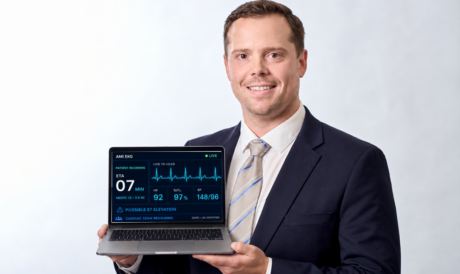
Dr. Marc Dotson, an emergency medicine physician at Vandalia Health’s Charleston Area Medical Center thought up a way to do that. He’s been working with Vandalia and medtech innovation firm Intermed Labs to make the idea a reality and bring it to market.
The creation - software with a mobile and web app - is called AMI EKG Reading, named for his mother, Amy, he said.
Intermed, with Dotson and Vandalia, has brought AMI to its final prototype stage that will lead to commercialization.
"Working in the emergency department, I just see this need for better communication between consultants and specialists," Dotson said.
Currently, the EMS crews are using phones, test messages, messaging systems to communicate with the emergency department, he said. Verbal communication has its limits. "A lot of times it’s better for them to have the image."
And an image sent to the ER, he said, is always a picture of the physical form, not the actual EKG or scan. There’s a question of image quality. And someone has to go over to a computer to login and look at the reproduction of the image.
The communication gaps, Intermed said, can slow specialist review, delay cardiac cath lab preparation, and reduce valuable treatment time when every minute can impact patient outcomes.
Dotson expanded on that. "All of these things take up time, they eat up minutes. Specifically when it comes to heart care, the minutes really matter a lot. So all of that together, I just thought to myself, there has to be a better way of doing this and serving the people in the community, where we can shave off minutes."
With AMI, the EMS crew, the ER and on-call cardiologists can securely share critical patient information before the patient arrives at the hospital, Intermed said. The AMI platform delivers field electrocardiograms (ECGs), ambulance location, estimated arrival time, and clinical updates through a real-time mobile workflow.
The EMS crew sends it, Dotson said, the hospital pulls it up and uploads to the AMI dashboard that can be accessed by anyone who has login credentials - such as the ER staff and physicians. AMI can even send notifications to someone’s mobile device.
If the ER doctor sees a case and wants the cardiologist to look, the ER doctor send a notification to the cardiologist’s cell phone. The cardiologist can click onto a secure link and get into the dashboard.
Dotson said his family lives 30-40 minutes outside Charleston, and that distance helped inspire him. "Even though I can’t cut off that transport time," he thought, "how can I ensure that they get the quickest care possible?"
Dotson originated the concept. Intermed Labs, working with Dotson and Vandalia, said it has provided commercialization strategy, product development guidance, prototype design, intellectual property support, and market validation to transform the AMI clinical concept into a scalable healthcare technology - leading to this final prototype phase before commercialization.
AMI has been almost two years in development, Dotson said. They’re working to secure a pilot process with hospitals and EMS agencies.
Intermed Labs originated in Morgantown in 2020 with what was then Mon Health System - it’s housed in the WVU Innovation Corp. building - and in 2023 formed a partnership with Marshall University and Marshall Health System.
Ashok Aggarwal, Intermed Labs cofounder, said, "The best healthcare innovations begin with clinicians who understand the challenges of patient care because they live them every day. Our role is to help transform those ideas into real-world solutions by providing the structure, expertise, and commercialization pathway needed to move from concept to market.
"This project with Dr. Dotson," Aggarwal said, "is another example of how physician-led innovation can create technologies with the potential to improve care delivery across the healthcare system."
Intermed explained that it works with physicians, researchers, health systems, and entrepreneurs to identify unmet clinical needs and guide innovations from idea through commercialization.
Through its venture studio model, the company provides strategic support across product validation, intellectual property, prototype development, regulatory planning, business strategy, and commercialization, helping accelerate the adoption of technologies that improve patient care and healthcare operations.