
Trending
MORGANTOWN - FirstEnergy sisters Mon Power and Potomac Edison continue moving forward on their planned combined cycle gas plant. It will be the first major power plant in Monongalia County since 2011, and FirstEnergy’s first plant since 1972.
Pending Public Service Commission approval, it will go up at their Fort Martin site outside Morgantown - adjacent to their coal-fired Fort Martin plant and their solar facility.
The companies filed in February with the PSC for prior consent and approval and for a certificate of need and necessity for a 1,200 megawatt combined cycle gas turbine plant along with 70 MW of solar capacity at three other sites.
The approval process has been ongoing, with the companies responding to discovery requests from parties that have intervened in the case.
So far, only nine letters of protest have been filed with the PSC. For perspective, Mon Power serves about 395,000 customers in 34 West Virginia counties. Potomac Edison serves about 285,000 customers in seven counties in Maryland and 155,000 customers in the Eastern Panhandle of West Virginia.
FirstEnergy first alluded to the possibility of building a gas-fired plant in March 2025. FirstEnergy President and CEO Brian Tierney broadly alluded to the possibility in a webcast.
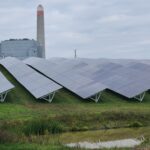
Both of its coal-fired plants are aging. The 1,098 megawatt Fort Martin plant in Maidsville was commissioned in 1967. The 1,984 MW Harrison plant in Haywood was commissioned in 1972.
Mon Power and Potomac Energy fleshed out the plan a bit in their 10-year Integrated Resource Plan filed with the PSC in October.
They say they plan to keep both coal-fired plants open through 2035.
A combined cycle unit, they said, uses both gas and steam combustion turbines to generate electricity. In the gas combustion turbine, air is pressurized using a compressor, injected with fuel and ignited to generate high-temperature pressurized gas that expands to drive the turbine and generate electricity. The waste heat from the gas turbine is then used to generate steam to drive a steam combustion turbine for additional electricity generation.
The IRP spans 447 pages. The companies said that they examined various scenarios considering customer load requirements, commodity prices, and supply side alternative costs - including fossil fuels, renewable resources and advanced generation alternatives - to come up with a "preferred plan."
"The companies' preferred plan balances reliability, affordability and positive local and environmental impacts while providing flexibility to adapt as market conditions and regulations evolve," they said.
Power demand is growing. They noted that their most recent summer and winter peaks are the all-time highest recorded peaks in both cases. Over the IRP forecast period of 2026-2035, they project the residential customer count increase at a rate of 0.7% per year and retail sales to grow 0.4% per year.
"Also, should additional data center growth occur, this forecast could change drastically as the load requirements of most data centers are significant," they said.
The IRP comments on the evolving power supply mix, where coal and nuclear have been the go-to baseload energy sources. But intermittent generation - solar and wind - is growing while "new coal and traditional nuclear plants are no longer economically feasible due to evolving regulations and customer needs."
So the IRP doesn’t include new coal or traditional nuclear, they said. "In their place, the natural gas combined cycle resource type is considered as an intermediate power plant that has the ability to adjust its output as electricity demand fluctuates."
In November, with the tall chimneys and cooling towers of the Harrison Power Station looming overhead, FirstEnergy leaders formally announced their plan to build the new plant. And in February they filed for the PSC OK.
Pending PSC approval, the companies said construction on the gas-fired plant would begin as early as 2027 and it would go into operation by Dec. 31, 2031. They project the total cost for the plant to be $2.476 billion, beginning this year and running through 2033.
The three proposed solar sites are at Wylie Ridge in Hancock County, Davis in Tucker County, and Valley Point in Preston County. Their total projected cost to build is $182 million.
"Taken as a whole," the companies said, "the projects will remedy the companies' capacity and energy deficiencies, support continued delivery of reliable, low-cost electricity for years to come and provide long-term customer and economic benefits. These benefits include meaningful rate stability, strengthened local and statewide economic development opportunities, and increased energy supply resilience for the Companies' service territory."
The companies told the PSC that they are considering two types of plant technology: one would have a 1,200 MW gross and 1,050 MW net output. The other would have 1,350 MW gross and 1,200 MW net output. The higher-capacity plant would cost an additional $100 million.
The newer coal-fired plant mentioned above is Longview Power, just across the street from Fort Martin. It was commissioned in 2011.
And Longview has its own gas-fired plans. In November 2024, the PSC granted two Longview Power subsidiaries an extension on the timeline to start and complete construction of a combined-cycle gas-fired power plant adjacent to the Longview coal-fired plant.
Mountain State Clean Energy and Mountain State Renewables (originally Longview Power II and Longview Renewable Power) filed for the extension on Oct. 9.
They have until April 3, 2029 to start construction and April 3, 2034 to complete the job.
In April 2020, the PSC granted Longview Power a citing certificate for then-Longview Power II to build a 1,200 megawatt combined-cycle gas-fired power plant.
Longview Renewable planned a 70 MW solar facility, with 20 MW of that to be located at the Longview site and the other 50 MW in Pennsylvania.
The PSC gave the companies five years to start construction and 10 years to begin operation. Construction was to start by April 3 this year, and the citing certificate was set to expire April 3, 2025.
But the companies experienced several delays and in October 2024 they asked the PSC for extensions to start and complete construction, after economic conditions provided a "build signal" for new power generation projects.