
Trending
MORGANTOWN - The vision for the future of Deckers Creek is getting clearer by the day.
Thanks to the efforts of federal, state and local agencies, area nonprofits and a legion of volunteers, the water is, too.
Once a waterway to be avoided; its banks littered with trash and water running orange with toxic acid mine drainage, the scenic Monongahela River tributary is now bubbling with promise, capable of supporting new life and emerging as a recreational corridor meandering through Morgantown.
The resurgence has been a decades-long vision for groups like Friends of Deckers Creek. It really began to take focus two years ago this month with the start of operations at the Richard Mine acid mine drainage treatment plant.
Prior to the treatment facility, the old mine site was leaking out 200 gallons per minute into the creek, annually depositing 730,500 pounds of acidity, 140,000 pounds of iron, 59,000 pounds of aluminum and 3,200 pounds of manganese into the stream, killing aquatic life in the six-mile stretch to the Monongahela River.
Within six months of the plant’s opening, small fish were spotted in the formerly uninhabitable water near Marilla Park.
"Lower Deckers Creek has improved dramatically in the past year and a half or so and is in the process of recovering the food web or food chain that all healthy streams have - insects, other invertebrates like crayfish, salamanders, native and non-native fish from the Monongahela River, riparian birds like kingfishers and green herons - all returning to what was a dead stream in Morgantown," Rick Landenberger said.
You can add trout to that list.
Though, in all transparency, the trout were placed there.
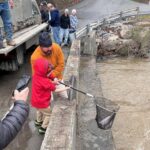
On March 27, a group of individuals gathered at the bridge near the entrance to BOPARC's Marilla Park to place 25 rainbow trout, each about 2.2 pounds, into the creek with the state's blessing.
Landenberger serves as a board member for Friends of Deckers Creek and the Mon Valley Green Space Coalition, two of the groups behind the trout release. Other supporting agencies included BOPARC, MainStreet Morgantown, the Morgantown Utility Board, the city of Morgantown and the Greenmont Neighborhood Association.
"Trout are an indicator of high water quality ... so this is the type of thing everyone in Morgantown should know about and celebrate," Landenberger said. "Healthy streams in our area are actually a rare thing despite their incredible values and benefits."
Friends of Deckers Creek welcomes local anglers to try their hand at trout fishing this weekend in conjunction with the nonprofit's annual Make It Shine cleanup event scheduled for 9 a.m. Saturday morning. The efforts will originate from FODC's Outdoor Learning Park behind the Sabraton Kroger.
As Landenberger explained, the return of life to the one-dead waterway is clear evidence that Deckers Creek is on the rise and worthy of investment.
The West Virginia Department of Environmental Protection is buying that stock.
"Long story short, since they put in the Richard AMD treatment facility up there the DEP has been monitoring, and they felt like it was good idea to try to, since the water quality is good enough to promote fish and bug survival, they want to do something to increase the habitat," AllStar Ecology's Ernie Smith said.
Smith will serve as the project manager for a Deckers Creek stream restoration project to run about 14,000 linear feet from the Richard treatment facility to Marilla Park. The Fairmont-based environmental consulting and contracting firm was selected by the WVDEP Office of Abandoned Mine Lands and Reclamation for the work.
"We want to just enhance natural features. One of the big structures that we're proposing are called boulder clusters. The big problem with Deckers Creek is it's lacking a lot of stream bed diversity. It's almost like just one big, flat riffle. There's not a lot of variation and not much pool habitat," Smith explained. "So as a simple fix to provide pocket pools within the existing stream, we create these boulder clusters that will give us little pocket pools and increase habitat."
In addition, Smith said significant efforts will be made to address erosion at various points along the creek using natural toe wood and root wad structures to provide structural stabilization and further enhance natural habitat.
Those interested can learn more about the project from 5 to 6 p.m. Wednesday at the Marilla Center in lower Marilla Park.
Smith said the goal is to begin work by the end of summer.
"This is an exciting project for us, for sure. It's in our back yard, Deckers Creek. I've kayaked Deckers Creek. I've fished in it. So, it was kind of near and dear to my heart, and my boss' as well," he said.
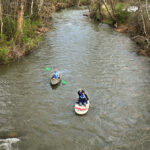
It's also near and dear to Mark Downs, who admitted to playing in the orange waters of Deckers Creek as a kid.
"The potential is great, but it's really more than potential," he said of the creek's future.
Downs has spent years advocating for the waterway and adjacent Deckers Creek Trail as a city resident, member/president of MainStreet Morgantown, volunteer with groups like Morgantown Forward, and, more recently, a member of both Morgantown City Council and the Morgantown Utility Board.
"We're actively pursuing opportunities to develop and pursuing development along that corridor to build connectivity, whether it's at Marilla Park, or at Valley Crossing with the BMX pump track, or across the creek in lower Greenmont with the green space and pedestrian bridge that's being put in, or down into South High Street area where Morgantown Forward has worked really hard to clean up. From there, it ties right into the riverfront and the Ruby Amphitheatre," he said.
But for all the work that has been, and is being, accomplished, there remains a significant hurdle if the creek is to become a true recreational destination - combined sewer overflows.
A combined sewer overflow is a byproduct of a combined sewer/stormsewer system. If the system becomes overwhelmed by rain, it discharges both, untreated, into a body of water.
MUB has 22 CSO outlets along the banks of Deckers Creek.
While the discharge rates vary significantly by location, the utility cautions against being in the water for 72 hours following a rain event.
The CSOs were identified as "the elephant in the room" in summer 2024, as a six-month feasibility study was underway to determine whether Deckers Creek between Sabraton and the Monongahela River could support a recreational amenity - think lazy river or laid back whitewater.
MUB notes CSOs are a part of hundreds of legacy systems across the country.
The scope and cost of a project to fully separate MUB's system is difficult to calculate.
"While MUB would love to eliminate CSO's from the local system, doing so is not financially realistic. The cost of eliminating CSOs themselves would easily run into the hundreds of millions of dollars. Of course, this would require borrowing money which would increase sewer rates incomprehensibly," the utility's website states.
But that's not to say work isn't being done incrementally toward that goal.
"There hasn't been any new combined sewer piping constructed for many decades. Every new development is required to have completely separate sanitary sewer and stormwater systems," MUB Communications Director Chris Dale explained in October. "When MUB undertakes any sanitary or storm project that includes an extension of service, replacement, repairs, etc., separation is considered and incorporated into the project if it is feasible to do so."
Further, MUB is currently undertaking the years-long process of updating its Long Range Control Plan, which began in January 2020 with the installation of flow meters throughout the system.
Minimization of CSO discharges is the goal of the federally mandated control plan.
Asked if the CSO outlets along Deckers Creek can be addressed, Downs said he believes they will be, eventually.
"The answer is absolutely yes. It's not going to be cheap, but, you know, we don't really have a choice. It has to be dealt with," he said. "If we could go back 200 years and do something differently, that'd be great, but we can't. And we can't just dig it all up and rebuild either. That's not feasible. What is feasible is dealing with it incrementally and gradually over time. MUB has been doing that ... You know, 85% capture is where MUB is required by EPA to be and we're gonna get to 85% or better. I think we can get to 90%."
Ultimately, he said, Morgantown's future is worth the investment.
"Deckers Creek is more than water moving through Morgantown. It really is a thread that ties our community together and pulls our neighborhoods together. It represents our history," Downs said. "So many organizations have come together to invest and improve our community along that corridor. It's a testament to the potential that is there. It's clear and obvious to everybody."