
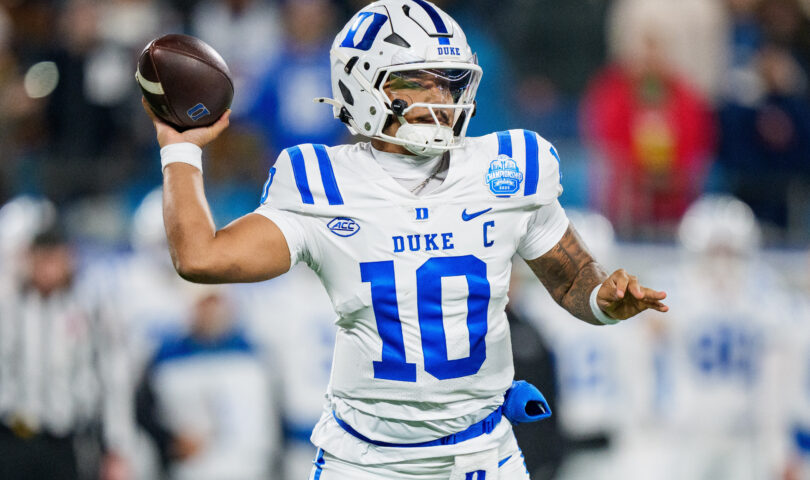
MORGANTOWN — The Darian Mensah case is settled, at least that’s what the headlines tell us today. In reality, nothing could be further from the truth, because all that happened with the Duke University vs. Mensah situation is it poured another can of gasoline onto what’s already a raging five-alarm fire.
The basic facts: Mensah transferred from Tulane to Duke last season and took over as the Blue Devils’ starting quarterback and led them to an unexpected ACC title. In transferring to Duke, he signed a two-year contract that gave Duke exclusive rights to Mensah’s Name, Image and Likeness (NIL).
Mensah wanted out after the first season so he could transfer to Miami, where we assume he’d earn more as a college football player than he did at Duke.
Duke threatened to block the transfer. Mensah received an injunction to allow his name to go into the transfer portal. Both sides came to an agreement, of which terms were not disclosed. Mensah will be at Miami as soon as he can get a flight out of Durham.
The hypocrisy of the entire situation covers more angles than a year’s worth of geometry class, and if you were somehow still searching for a sign that college athletics is headed for hell in a handbasket, this has to be it.
The biggest issue at hand: Why are NCAA institutions even bothering with signing an athlete to a two-year contract to begin with?
It’s a rhetorical question, I know. The saddest part of it all is you now have these same institutions of higher learning inking multiple-year contracts with certain college athletes and in the same breath they still try to spew out absolute nonsense about the said athlete not being an official employee of the school.
And they say it with a straight face. That’s a huge problem. And that’s angle No. 1
Angle No. 2 is on Mensah, who is obviously nothing more than a gun for hire. He’s not alone on that boat in the college game, not by a long shot.
This is where college basketball comes into the conversation, because you’ve obviously heard by now the stories of Baylor forward James Nnaji and Santa Clara’s Thierry Darlan or even BYU’s Abdullah Ahmed.
They are all foreign-born athletes who at one time decided to bypass a college career with the hopes of making millions in the NBA.
Nnaji was even drafted back in the day, the No. 31 pick of the 2023 draft by the Detroit Pistons. His rights were traded twice, first to Charlotte and then to New York, which was also part of the same deal that sent All-Star Karl-Anthony Towns to the Knicks.
None of the three actually played in the NBA. They never made it further than the summer league and then the G-League or playing professionally overseas.
Yet all three earned professional paychecks in some fashion, just not big ones, and then suddenly realized there was good money to be made in college athletics through NIL deals.
And the NCAA gave them clearance to do just that.
Now, the basketball guys don’t have the same story that Mensah does, just the same motivation. For decades, we’ve heard how college athletics is big business, but even way back when, no one saw this type of stuff coming.
Former pros are now on college rosters. Schools are now announcing contract deals with quarterbacks, as if it were a sponsorship deal with a mulch or liquor company to become the official company for School X.
And I realize WVU fans are sick of hearing about the term “buyout clause,” but these NIL contracts are so official that they contain just that. It was Mensah’s buyout clause – we can only assume in the Duke case – that the school was looking to enforce in wanting to block his transfer in the first place.
In their agreement, Duke probably received full payment of that clause to allow him to transfer to Miami.
You haven’t even heard the crazy part, yet. The craziest part of all is this could all have been avoided. In order to do that, though, would require some simple admissions on the part of the NCAA and its member institutions they continue to scratch and claw to hold onto in order to keep from admitting.
For years they called themselves an amateur model. Since the creation of NIL and then revenue sharing, the big wigs now refer to it as the college model.
If they would just call it what it is – a smaller professional game, meaning athletes are official employees – and then got together to set up the framework for guidelines to handle free agency, contracts, revenue sharing, as well as health insurance and the formation of some type of a players’ union, hardly any of these stories would even be newsworthy.
Why won’t that happen? Well, to call a college quarterback an official employee of the school would cost so much more than the millions in an NIL deal. It would require the athlete being fully covered by the school’s health insurance and setting up retirement plans with matching benefits for, literally, thousands of athletes at each school, just like universities have in place with its professors, maintenance workers and the likes.
That’s not cheap.
What the schools don’t see, though, is just how much the overall product improves with the fact that college athletes are no longer chomping at the bit to get out of college. In fact, just like in the case of Ole Miss quarterback Trinidad Chambliss, they’re fighting like all heck to remain in college.
An improved product means more money for everyone. A lot of it. Suddenly those TV deals with ESPN, FOX, CBS and whoever else aren’t negotiated as a college product. It would be a professional product, maybe one that doesn’t exactly rival the NFL or NBA, but is at least in the general neighborhood.
So, until the day comes when we admit college athletics is no longer amateurism in the slightest, situations like Mensah’s are only going to get worse. Soon, the biggest battles won’t be on the field. They’ll be in courtrooms.