
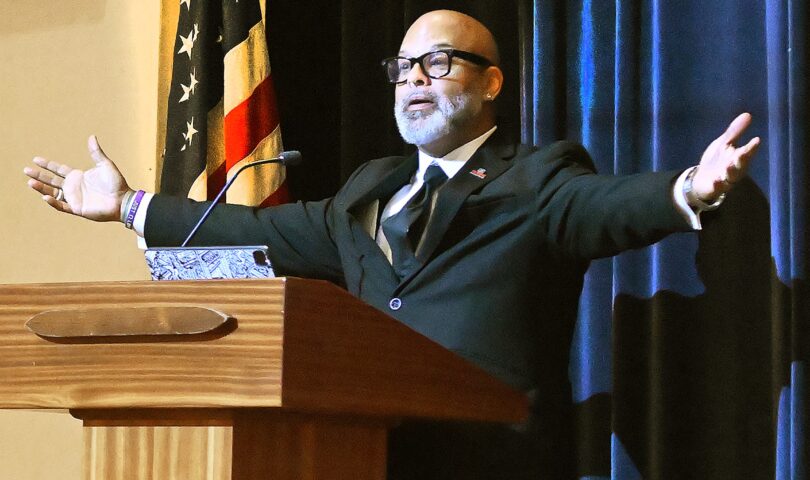
MORGANTOWN – In do-or-die Bedford-Stuy back in the 1980s, nobody cared, necessarily, if you were a bright Black kid with all the potential in the world.
Nobody cared, necessarily, if you were in gifted classes, where you raised your hand and read books because you simply, profoundly, wanted to – and not because they were assigned as homework.
Jack Monell, Ph.D., was one such kid who came up in Brooklyn’s Bedford-Stuyvesant neighborhood.
And really, he said, it’s not that people there chose not to care. They were just too busy trying to survive.
Bedford-Stuy was a once-proud, Brooklyn bastion of racial diversity and economic prosperity – especially for Blacks in the borough – but by the time Monell was a little boy and entering his teens, the place had unraveled into an urban cautionary tale of crime, poverty, drugs and despair.
No matter, as he told a Saturday audience in Morgantown at the annual Dr. Martin Luther King Jr. Unity Breakfast: His mother and father were dogged and determined.
They were going make sure their bright kid got away, the right way, from the Roosevelt housing project.
On the other side of his bedroom window, police and ambulance sirens sang Monell to sleep every night like a lullaby.
On the other side of the relative safety of the door to his family’s apartment, the hallways – and he can still smell them – reeked “of urine and hopelessness.”
Young Jack, though, was going to do better. And he did. Until he didn’t.
When he was 12, the streets caught him.
He went from an academic star in the front row to a budding criminal with a burgeoning rap sheet, perched on the stoop of a boarded-up building and ready to commit mayhem.
Two years later, his dad died.
And a year after that, when he was 15, part of him died, too.
He was handcuffed and shackled in front of his mother, and sent upstate to a juvenile detention facility – prison for kids.
“Just like that,” he said.
‘Who do you think you are?’
Monell is a now a professor of justice studies at Winston-Salem University, where much of his teaching and research centers on the Black dynamic in society, from police encounters to notions of masculinity.
His academic mission, and his credo of how we can do better – and why we should do better – has taken him from America’s inner cities to across Europe and Asia, as he’s offered up his experiences in locales with their own sets of sociopolitical challenges.
West Virginia University’s Center for Black Culture and Research hosts the community breakfast every year in honor of King, the clergyman and civil rights leader felled by an assassin’s bullet in Tennessee in 1968.
Monell delivered keynote remarks at the breakfast during the morning, which also included the presentation of the Dr. Martin Luther King Jr. Achievement Award.
Recipients of the center’s highest recognition of service over the years have included Joan C. Browning, a former Freedom Rider now residing and working as a writer and editor in Greenbrier County; and Ron Rittenhouse, the chief photographer of The Dominion Post.
Whenever Sharon Smith Banks, the 2026 recipient, sees a newspaper photograph or TV dispatch of the nation’s current civil unrest, she immediately finds herself in a time machine – in a do-or-die sojourn she’d rather not have to remember, as she says.
She’s immediately transported back to her teenage years in her hometown of Nashville, Tenn., where, in 1964, not even Jefferson Street was immune to the rioting.
Jefferson Street, then as now, was brimming with Black-owned businesses, including restaurants and music venues.
That May, Dr. King had spoken at Fisk University, the historically Black liberal arts school right down from Jefferson founded in 1866, when the South was still in ruin from the Civil War.
King urged residents, through nonviolent protest, to make segregated Nashville an “open city,” as he put it.
Official Nashville didn’t get the message, as Banks recounted in the minutes before the start of Saturday’s breakfast.
Police clashes left protestors bloody. Even, as she said, shaking her head, on Jefferson Street.
After “I Have a Dream” and the Edmund Pettus Bridge, and after the Voting Rights Act and the Lorraine Motel, America’s current 21st century resurgence of social unrest in Minneapolis and elsewhere – well – couldn’t be more jarring in its shock of recognition, she said.
“It’s like hitting the rewind button,” said Banks, a retired professor and administrator at West Virginia State University. “We’ve brought it right back around to the 1960s. All over again.”
At State, Banks’ speech communication classes were legend, where she was affectionately known, by students of color and otherwise, as “Mama Banks.”
The professor was just as renowned as a tireless advocate of campus employees during her tenure on staff council at the school, where she would sometimes get the “Just who do you think you are?” question.
“I’m Sharon Smith Banks,” would come the reply, with a smile.
Awake (and Dreaming)
Jack Monell found out who he thought he was in juvie.
He read every book in the facility library and aced his GED. When he got out at 19, he wanted to go to college, but couldn’t afford tuition.
The vice principal of his old grammar school wrote a check to help get him started.
“Pay it forward, Jack,” said the educator who remembered a bright Black kid with all the potential in the world.
“I hugged him, tears streaming down my face,” Monell said, “and I’ve been doing what he told me to ever since.”
In these days, he said, “protest” often means reaching out, as his old principal did for him. It means education, he said, be it in the classroom or voting booth.
“I’m not here to profess that there is one way to speak out against injustice,” he said. “Just find your lane and do it.”
Fully realizing the Dream, said Olivia Robinson, a Criminology and English major from Waldorf, Md., and president of WVU’s Black Student Union, means being fully awake and aware.
“Today, democracy is dying right before our eyes,” she said.
“The principles of freedom and justice are time and again blatantly ignored by those in power to serve their own fraudulent and morally reprehensible agenda,” she continued.
“As a community, we must do more. There is no excuse for political and media illiteracy.”