
1985 Election Day Flood: Of buried firetrucks, unaware goldfish and a mission bigger than it all
Trending
JBissett@DominionPost.com
ROWLESBURG - Rick Felton worked for the railroad and was used to hearing metal on metal.
Still, the CSX brakeman was sonically unprepared for what shrieked across the night before the Election Day Flood of Nov. 5, 1985.
That's when people started realizing they were in for it. That's when Hurricane Juan decided it wasn't going gentle.
A once-and-former weather-maker was still stirring water and clouds from its original path in the Gulf.
Juan by then had spiraled down to a tropical depression.
It was about to make a comeback.
The melding with another storm system over the Mid-Atlantic would result in the bodies of 47 West Virginians being pulled from the rivers and the rubble of ruined towns.
The cost in damages in the Mountain State alone would exceed $700 million.
And the evening before the height of the renewed storm's powers ... Felton's hometown never had a chance.
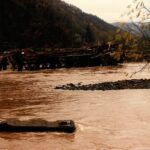
The Cheat had slammed into the supports of the CSX railroad trestle that bisected Rowlesburg.
All that water, churning fast and loaded with debris, knocked the very structure off to one side.
It couldn't get any worse.
Except, it just did.
The ruined trestle had just been rendered into a kind of twisted-metal levee, diverting raging waters right into Rowlesburg's very heart.
Felton, who lived in a house on a hill up from town with his wife and two children, instinctively jerked his head in the direction of the girder-yowl.
"It was like you could hear steel 'stretching,'" he recalled.
He and his wife were quickly able to scurry their kids and dogs out to higher ground when the water started hitting their house. First, the basement.
"So, you had six inches of water, then a foot," Felton said. "Then six more inches of water, and another foot. You weren't gonna stop it."
A last look at his house turned incongruous.
Water was coursing from the electrical outlets in the living room.
And pet goldfish (missed), was still swimming in its bowl on an end table, seemingly oblivious, as the wake on the other side of its world continued to rise. Felton had to reluctantly leave it.
Right there the whole time
The railroad man, for a time thereafter, was coexisting in two distinct worlds.
With the loss of his home, he was a victim. With his railroad job, he helped enable Rowlesburg's recovery. He spent the next several weeks on crews rebuilding the CSX line.
Others leapt in, too, adding their own outreach.
Dan Ulrich, who founded a demolition and salvage company with his brother, was manning the levers of a massive bulldozer near the town on a cleanup detail. He was digging 11 feet down when it happened.
"Metal," he said. "I kept hitting metal. All of us were trying to figure out what the heck it could be."
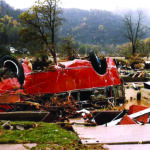
A whole firetruck, as it turned out - swept some 10 miles downriver.
The first time Ulrich regarded the railroad trestle, he was standing there, gaping, when a couple of townspeople walked up.
"They said, 'Yeah, we couldn't believe it either.'"
No paddling left on red
The only thing Frank Jernejcic heard in the pre-dawn hours of Nov. 5 was the sound of his oars lapping the water.
A biologist by training and now-retired officer with the state Division of Natural Resources, Jernejcic is a river expert, renowned for his knowledge of the Cheat, especially.
He drove all night to check on the health of the aquatic ecosystem.
The river authority steered his four-wheel-drive vehicle miles out of his way - across roads that were no longer there.
When the sun came up over flood-ravaged Parsons, he was employing a wholly different mode of transportation. He kayaked down Main Street, making sure people were OK.
"I was just glad to be able to help in that regard," he said.
A box lunch and tetanus shot, to go
Lyn Dotson, who was then vice president of Institutional Advancement of West Virginia University, was also wondering about Parsons.
His grandparents were from there. Growing up, he spent most of his summers at their house.
The administrator was thinking about the people in Parsons he still knew, which started him thinking about people he didn't: the multitudes across the flood path who were still hurting.
He helped set up a relief network of volunteers and medical professionals, at the ready, from WVU. A crisis hotline was set up in the Mountainlair, staffed with counselors from the Department of Medicine.
Buses churned out to Moorefield, Albright and other drenched locales, shuttling students, staffers and academics, all simply showing up to help.
"If you boarded a bus, you got a box lunch and a tetanus shot," Dotson said. "That was the deal."
WVU, by the time the work was complete, spent $1 million - more than $3.1 million in today's dollars - for its flood outreach campaign.
"That," Dotson said, "is what a land grant university is supposed to do."
A river runs through it - the other way
George Racin just remembers being awed in the aftermath by the unbridled power of the storm, having seen for himself what was left - and what was swept away.
He's a civil engineer and was working with what is now the National Resources Conservation Service.
Racin and his colleagues were tasked with some river rehabilitation along the Potomac. Heavy rehabilitation. Flooding caused the Potomac's North Fork branch to cut a whole new channel through aptly named Riverton.
That meant material from the original channel bed had to be extracted to make a new berm for the river. It was exacting work, and muscle work, at the same time, the engineer recalled.
And, like the storm that caused it, the job was relentless.
"We did the equivalent of five years' work in one year," Racin remembered.
It wasn't easy. There were circulating stories of people, emotionally inundated, like all those houses and buildings, and all that land.
Work crews weren't immune, either.
One person on one of them had a heart attack.
Another suffered a nervous breakdown and a gun was pulled during an argument in another instance.
Distraught property owners sometimes railed at the crews and engineers.
"You had to think about everything they had gone through," Racin said.
"We did what we could to restore some sense of 'normal' to their communities. I felt so gratified to be a part of that. We were part of something that was bigger than all of us."