
COLUMN: Not getting Cam Vaughn more involved early proved costly for WVU against TCU
Trending
MORGANTOWN — It may have been one of the most amazing stats, if not a telling one, that has come out of a WVU football game in some time.
TCU senior receiver Eric McAlister walked out of Milan Puskar Stadium on Saturday night with 18 targets in his hip pocket. Obviously he didn't catch them all, finishing with nine receptions for 124 yards and a touchdown in the Horned Frogs' 23-17 victory. His final target was a killer, a 21-yard gain on third down with two minutes left that set up TCU taking knees to run out the clock.
Of course, that same play also saw McAlister fumble the football, but the ball bounced right to teammate Major Everhart. TCU got plenty of bounces on this night, and even a questionable call from the refs on an onside kick attempt by WVU.
WVU linebacker Ben Bogle came out of the scrum with the ball. The refs still pointed TCU's way. It was that type of game for the Mountaineers, who seemed to take a positive step forward under Rich Rodriguez.
But, we get back to those targets. There are plenty of talented guys who play on Sunday who would kill for 18 targets in one game. Heck, McAlister just may be one of those guys next year.
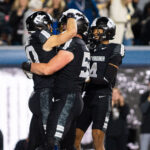
We bring this up, because on the other side was, well, the other side of the story. That's where WVU receiver Cam Vaughn found himself almost a forgotten guy over the first half.
If it had not been for an early kickoff return, Vaughn touched the ball over the first 30 minutes of action just as much as the tuba player in the band. He was not on WVU's lengthy list of walking wounded. We promise, the sophomore was out there, it just didn't seem like it.
TCU's 17-7 halftime lead, it could be argued, was because the Horned Frogs made a commitment to get its best playmaker the ball and WVU did not.
Now, that statement comes with one giant asterisk, which is to say there is a major difference between TCU's offensive situation and where the Mountaineers (2-6) currently find themselves.
TCU (6-2) has an offensive mastermind in Sonny Dykes as a head coach, known for exploiting mismatches like The National Enquirer exploits the Kardashian family.
The Horned Frogs have a seasoned quarterback in Josh Hoover and McAlister is a seasoned receiver, having played a lot at Boise State before he transferred to TCU last season. They play in a wide open offense that led TCU to a shot at the national championship a few years back.
WVU's situation is on the opposite end of the spectrum, as we all know.
Scotty Fox Jr. is a true freshman. He made his second career college start on Saturday. He was fine, especially while playing the bulk of the second half on a sore knee. He finished 28 of 41 for 301 yards, two touchdowns and no interceptions.
Vaughn may one day be "the man" McAlister is today. For now, Vaughn is but a sophomore who spent his freshman season at Jacksonville State and is playing Big 12 football for the first time.
Having said that, football is not all that complicated. You get your best guys the football. Vaughn was used as nothing more than a decoy or a downfield blocker over the first half. McAlister was used the way he was supposed to be used.
There are two reasons the point needs to be made about Vaughn's usage.
No. 1: TCU does not have a great pass defense. Like, it's really bad at defending the pass. Baylor's Sawyer Robertson threw for 318 against the Horned Frogs last week. Arizona State's Sam Leavitt and Kansas State's Avery Johnson combined for five passing touchdowns in TCU's two losses this season.
If there was ever an opportunity to show Vaughn's abilities off, this was it for WVU. Because the Mountaineers are not scheduled to play Oklahoma State this season, WVU may never get a better opportunity than what it had Saturday night to really get Vaughn involved.
"The other guys were open more, I guess," Rodriguez said following the game. "If he gets in a rhythm, he gets pretty hot. He's a talented guy. We tried to get it to him, but it's also, some of the time, the way they're playing us."
No. 2: Once WVU woke up to the idea in the second half of getting Vaughn involved, a lot of good things happened for the Mountaineers' offense.
Vaughn did finish with 12 targets and that is a lot. Eleven of them came in the second half. He caught six passes for 85 yards.
Fox threw for 108 yards in the first half, 193 in the second. That's the type of difference Vaughn can make on this WVU offense if given the opportunity.
He drew a big pass interference call when he didn't catch the ball. He spun out of tackles when he did have it.
Not only that, but getting Vaughn involved opened up the entire offense. WVU receiver Jarod Bowie found some open holes. WVU's tight ends got involved in a major way.
There were positives to speak of following this loss, but not getting Vaughn involved early ended up being one giant negative that may have cost WVU a chance at really making this game interesting.