
WVU’s Purinton House a part of university, American history
Trending
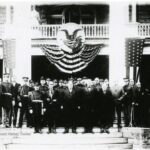
MORGANTOWN — On Nov. 2, 1911, President William Howard Taft stood on the front porch of West Virginia University's Purinton House and delivered his "World Wide Speech," in which he attempted to shore up foundational support for his administration's foreign policy.
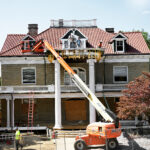
As we approach the 114th anniversary of that address, it's the Purinton House itself - now home of WVU's Office of Global Affairs at 1505 University Avenue - that's getting some much needed shoring up.
Veritas Contracting is in the midst of a roughly $1.3 million project to do just that with input from the West Virginia State Historic Preservation Office.
Prior to the start of construction, the front entrance and porch had been blocked off since June 2023, when temporary shoring was put in place to reinforce the front porch roof.
John Thompson, WVU executive director for planning, design and construction, said the front porch had begun to settle, raising concerns about the building's structural integrity.
"We were concerned it was becoming unstable. It was all wood framing, original wood framing, that had deteriorated. So, that was a big concern. Some of the porch was wooden, and it's actually on stone foundations," Thompson said. "So the scope of the current project is to replace the entire first floor porch, all the railing, and rebuild the portico. The framing of the portico is now steel. It'll all be behind wood. So you'll never know it's steel back there. The decking on the porch is now synthetic wood decking, but it's all being done in keeping with the historic appearance."
Upon becoming president of WVU in 1901, Daniel Boardman Purinton commissioned the construction of the house on land purchased from noted geologist Israel Charles White, a faculty member at the time.
According to information available at history and culture website theclio.com, Uniontown's John Charles Fulton - who'd previously helped design the Monongalia County Courthouse and Brick Row (now 123 Pleasant Street)) - was the architect behind the project.
Purinton House was constructed in 1904 and served as the university's presidential residence until 1965.
The building was listed on the National Register of Historic Places in 1985.
Shauna Johnson, WVU's executive director of strategic communications, said the restoration project is being funded through a grant for deferred maintenance projects from the West Virginia Governor's Office administered through the High Education Policy Commission.
It's expected the project will be completed by Nov. 21.