
Rich Rodriguez, Travis Trickett emphasize downfield blocking in WVU’s first day with shoulder pads
Trending
MORGANTOWN — There are three levels to a successful run play in the open field. There's the initial block from the offensive line on the defensive line to create the hole, then there's the lineman who goes up to block the linebacker in some cases, and then out on the perimeter, where the wide receivers are holding off the secondary. If all three of them do their job, it's a touchdown.
Blocking is important in Rich Rodriguez's run-heavy blocking, and one of the overlooked parts of the run play is the downfield blocking by the wide receivers and other skill position players.
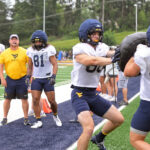
Friday was the first day West Virginia practiced in "shells," or shoulder pads, slowly moving toward full pads. Once the shoulder pads come on, it's easier to block with more surface area, and more "thuds" are made on the practice field.
In the first practice in shells, Rodriguez quickly worked with his offense on downfield blocking.
"We’ve got to be good perimeter blockers, our wide receivers, tight ends, running backs, all of our skill guys," Rodriguez said. "We demand a lot out of them from a downfield perimeter blocking standpoint. Today, I thought we got some of that work done, but there’s a lot of work to do with it, and they’re not used to doing it. A lot of today, offensively, was working on some of that downfield perimeter blocking with the offensive skill guys."
If you watch a Rodriguez offense in the past, or just last year at Jacksonville State, you'd notice even if it’s a run play, all 11 players are involved, including the wide receivers. Once the run breaks, the wide receivers are running downfield, looking for a helmet to flatten to take the run from 10 yards to a touchdown.
"If you watch college football from the last 15-20, years, the best offenses, especially doing what we do as a spread offense with three receivers or more, the best offenses are physical perimeter blockers," offensive assistant Travis Trickett said. "Every single one of them. Like, it doesn’t matter, if you go back and you watch the film like they get after your ass, period."
Trickett said laying a block doesn't matter, the size or position either. As an extra set of eyes for Rodriguez, Trickett is looking for some fight in every player to put their body on the line to block someone.
"As long as you’re fighting, that’s all that matters, and you’re in good position with fundamentals," Trickett said. "We have some emphasis on that in practice. That is a major part of the physicality in our program. It goes from offensive line to tight ends to receivers to running backs, even quarterbacks. I mean, heck, quarterbacks may have to get in there and mix it up a little bit."
Blocking isn't easy, especially for receivers and skill position players who have other responsibilities.
Trickett said there are three parts to successfully blocking someone. The first thing is that the player has to have the mindset that they are the hammer and the person they’re blocking is the nail. But you can't be too "amped up" and miss the block because you weren't settled. Then, you have to be fundamentally sound.
"There’s all that aspect to it, but then the physicality, and then also the technique, because if your hands are outside, guess what?” Trickett said. “Holding is called. Minus 10, right?"
A successful block can be the difference in a play going for a couple of yards or a game-winning touchdown. Blocking fits into the moving bodies part of playing with a "hard edge." It's an important piece to Rodriguez's offense.
After three days of camp, the blocking is still a work in progress.
"I like the effort," Rodriguez said. "I didn’t think the technique was very good for the most part, but I think the effort was. That’s a big part, I think, one of the reasons we’ve been able to run the football at times in different places. We had really good running backs, quarterbacks that could run, but we had really good downfield blocking and guys taking a lot of pride in that."