
Randy Meador became a fixture at WVU as the man no one wanted to see
Trending
MORGANTOWN — For 41 years, Randy Meador was the guy within the WVU men's basketball program, no one wanted to see.
"Tough would be a good word to use," said Meador, who officially retired as the WVU men's hoops Head Athletic Trainer on Monday. "You'd walk into the coach's office and they would say, 'Here comes the bearer of bad news,' things like that. Yeah, there were definitely tough situations you had to deal with when it came to injuries and whether or not guys could play."
But here's the thing, that was just one aspect to Meador's journey at WVU, a small one at that.
Nicknamed "Doc" by the coaches and players, Meador's 41 years at the school represents some of the most fascinating eras in the athletic department's history, from the old Atlantic 10 days through the Big East and Big 12 and from Gale Catlett to John Beilein to Bob Huggins and beyond.
"The travel and locations definitely come to mind," he said. "I remember those old locations in the Atlantic 10 in places like Rhode Island and St. Bonaventure. Then you move to the Big East and then the Big 12.
"It's really amazing how much has changed over the years. When I first began, there was no way you'd think college athletes would be getting paid by the schools. Now, they're getting paid and they're getting NIL. It's like the whole face of college athletics changed right in front of me."
"How's Doc doing?"
Truck Bryant is quick to recall Meador as "one of the guys."
"The relationship players had with Doc was great, but it was different," said Bryant, a WVU standout from 2008-2012. "Spending time with Doc meant something bad had happened. You pulled a hamstring or twisted your ankle. You never got to hang out with him over good news.
"But, I'll say this: Doc did an amazing job of taking care of the players and he gave WVU everything he had. He was just as much a part of the team as anyone else."
It was that camaraderie that made the job less of a job for Meador.
"Guys came to me broken," he said. "That's kind of a bad way to put it, but I understood that no one really wanted to see me.
"Then you start putting the pieces back together. That was my job. You'd put in long hours with players. You get to know them and know who they are and then you play a part in them getting back on the floor and helping them get back to realizing their dreams. That's the most satisfying feeling."
That feeling never diminished over 41 years, even as his list of patients continued to grow season after season.
"I can't tell you how many times former players come back to town for a visit and one of the first things they ask is, 'How's Doc doing?' " said Bryan Messerly, the sports communications director for WVU men's basketball who spent 25 years working with Meador. "I think he's built extremely good relationships with players and coaches over the years. He's earned a lot of respect."
That respect was built from Meador going above and beyond just simply being the guy to tape up a sore ankle or wrapping up a tight hamstring.
A great example may have come in the days before WVU played in the 2010 Final Four.
Bryant had broken the fifth metatarsal bone in his right foot the week before and surgery required screws being inserted into his foot to hold the bone in place.
In the days before the Mountaineers traveled to Indianapolis to face Duke, Meador was driving to North Carolina to meet with specialists who had developed a prosthesis that may have helped Bryant play in the Final Four.
"It ended up not being exactly what we needed," Meador said. "That one was tough. We tried everything we could to get Truck back out on the floor, but we just couldn't get that one to go."
Bryant missed out on the Final Four, but came back healthy for his junior and senior seasons and then a nine-year pro career overseas.
"To me, I would trace my ability to play nine years professionally back to Doc," Bryant said. "The work we did in rehab is what allowed me to keep going.
"Even when I was playing professionally, I'd still come back to see Doc. If it was something to do with treatment, I'd go to Doc and he always welcomed me with open arms."
An extended stay
A native of Oxford, Ohio, Meador first came to Morgantown for a year of graduate school at WVU.
"My wife tells me all the time how I'd told her one year in Morgantown and then we would head back to Ohio," Meador said. "That was 41 years ago. We enjoyed it here. We grew with the town and the town grew on us."
Chances are you've seen Meador, either sitting down at the end of the Mountaineers' bench inside the Coliseum or sprinting out to the floor whenever a player was injured.
That doesn't come close to covering who Meador is, though.
"Doc was always kind of a quiet guy," Bryant said. "He would talk to you if you talked to him first. He has a very funny laugh.
"What I remember the most is he would work out in the weight room just as much as the players. He was on the treadmill more than I ever was, and Huggs had me on the treadmill a lot."
Meador is a Hall of Famer, having been inducted into the Mid-Atlantic Athletics Trainer Association and West Virginia Athletic Trainers' Association Halls of Fame.
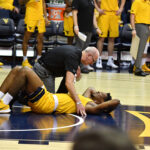
And he is associated with possibly the most painful and gruesome moment in WVU basketball history, when star player Da'Sean Butler went down with a knee injury in that Final Four loss against Duke.
"I think I knew it instantly," Meador said. "That was absolutely heartbreaking. There's not much more you can say other than it was heartbreaking. Da'Sean had done so much to get to that point and then that happened."
Over those 41 years, the athletic training field changed, college athletics changed, and Meador admits heading into retirement now is somewhat bittersweet.
He recalls a time, in the early days, when injuries were between the trainer, player and coach.
It's not exactly like that anymore, Meador admits, as college athletics have trended more to becoming professional, it's also opened the door to agents and handlers also having their say about injuries.
Is that why Meador retired? Not really, but the notion is inferred that maybe he was getting out at a really good time.
"I don't know if that's true or not," he says. "For me, I still have a lot of energy and a lot of passion for what I did. Yeah, it has changed quite a bit. There are a lot more people involved now than there used to be and the athletes come and go year to year.
"It just seemed like the right time for me. It's time for someone else to have their turn."