Men's Basketball, WVU Sports

COLUMN: D.J. Thomas’ transfer presents interesting question for incoming freshman Miles Sadler

MORGANTOWN — Under normal circumstances, the process isn’t to go too deep on a dive into social media reactions whenever a WVU athlete surprisingly enters into the transfer portal.

For some reason, when the announcement came earlier this week that WVU men’s basketball forward D.J. Thomas put his name into the portal, my interest in the comments peaked.

One of them really stuck and it came in the form of a simple question: If WVU can’t retain an underrecruited freshman like D.J. Thomas, how can it expect to retain a freshman like Miles Sadler if he lives up to expectations?

There are but two simple answers, either it can’t or more money.

Neither one is exactly a fantastic option for WVU head coach Ross Hodge, which we will get into in a moment.

First some thoughts on Thomas, who you may remember was a 3-star kid out of Allen, Texas, who wasn’t showered with a lot of love from the major programs coming out of high school.

He signed with Hodge at North Texas, then was granted a release and followed Hodge to WVU. Thomas showed promise early and continued to show flashes of potential throughout the season.

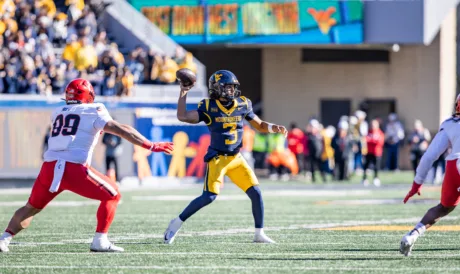
During the first half of WVU’s 79-71 victory against BYU in the regular season, it was Thomas who was the best freshman on the floor and not BYU’s A.J. Dybantsa. In the semifinals of the College Basketball Crown, Thomas’ 20 points in 21 minutes of action led the Mountaineers past Creighton and into the finals.

This was never said by Hodge, but the best guess as to why the program slammed the brakes on senior forward Jackson Fields returning to WVU’s rotation midseason and then seeking a medical redshirt for Fields was because of Thomas’ development.

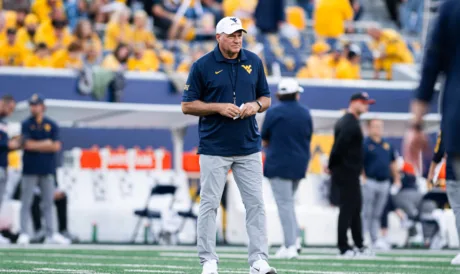
As to why Thomas put his name in the portal, you already know that answer. Speaking in generalities, Hodge addressed the situation before the team left for Las Vegas.

“I don’t think you can necessarily read into anything if people don’t come back anymore,” he said. “Sometimes it’s not even a negative experience. The coach didn’t have a negative experience with the player. The player didn’t have a negative experience with the program or the university, but there’s not an infinite amount of resources at everyone’s disposal. That’s just kind of the time period we’re in.”

Here’s how it works. Thomas, just like the majority of other WVU athletes and other college athletes around the country, has an agent or some type of representation for Name, Image and Likeness (NIL) purposes. When Thomas went out and had himself a game against Creighton, that representation, or even members of his family got flooded with calls and text messages filled with offers if Thomas were to transfer.

WVU likely can’t match those offers, so Thomas transfers. It stinks, but it’s really that simple.

Which brings us back to the original question. For those who may not know, Sadler is the incoming freshman point guard from Bella Vista (Scottsdale, Ariz.) Prep, who just led the Bears to the high school national championship.

He’s a top 30 recruit in the 2026 national rankings, a high-school All-American in many circles, and carries just as much hype and hope with him to Morgantown as did former WVU hoops players such as Oscar Tshiebwe, Devin Ebanks and Johnathan Hargett.

In terms of financial expectations, Sadler will command a larger piece of WVU’s NIL pie than Thomas ever would, and maybe deservedly so.

For the sake of the argument, let’s go ahead and forecast a solid freshman campaign for Sadler. He’s named an all-Big 12 freshman. He’s one of the Mountaineers’ top players, but maybe not quite ready to make the leap into the NBA Draft.

Can you imagine what types of offers his agent or his family members would receive if all of that came true? What do you think, three million, four or five? And that would probably just be from LSU, where Tigers’ head coach Will Wade is famous for making “strong-ass” offers.

The only saving grace for WVU in this situation is that Sadler is from Canada, and so we assume he is in the United States on a F-1 visa, which limits the NIL opportunities for international athletes playing college sports in the U.S. Basically, international athletes are not permitted to earn passive income – think endorsement deals – outside of the basic royalties – think jersey sales – and revenue sharing plans that universities offer. 

The visa situation for international players and making better NIL money is currently working its way through the legal system through a federal lawsuit filed in 2024 by former Arizona State women’s basketball player Last-Tear Poa, who is Australian.

No timetable has been given on when a decision may be handed down in that case.

Still, in theory, it presents the rock-and-the-hard-place scenario Hodge now finds himself in. To be accurate, WVU is not a sister of the poor when it comes to NIL funds, yet it also does not have an infinite amount of resources found at the major schools inside the SEC and Big Ten.

If Hodge can’t retain a developing 3-star freshman like Thomas, how is it possible to retain a high school All-American like Sadler or whoever may follow?

It’s one heck of a question and an unfortunate situation for Hodge.