
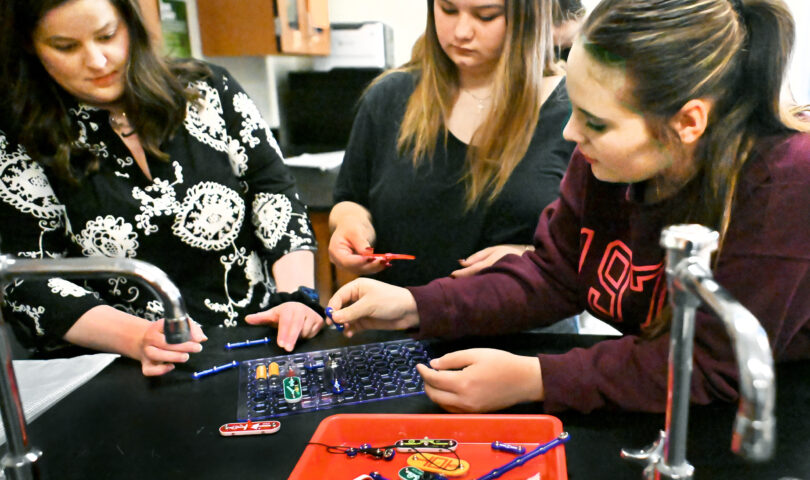
MORGANTOWN – With their like-sounding names, Bayleigh Hartley and Shayleigh Boring were twin power plants of resourcefulness Thursday morning at University High School.
“There’s the light,” Bayleigh said as she flipped the switch to power the mini-lightbulb on the electric circuit she just assembled with her lab mate.
“And there goes the fan,” Shayleigh said.
Literally.
The plastic blade assembly that was also part of the project whirled itself off its moorings and skittered across the bench.
“Just like we planned it,” Bayleigh said, grinning.
“Absolutely,” Shayleigh said, playing along. “That was definitely supposed to happen.”
Well, OK … it wasn’t.
But that was part of the fun for the morning in teacher Victoria Matkins’ science lab at UHS.
Matkins, who possesses a Ph.D. in cellular biology – more on that – opened her classroom’s doors for the day to West Virginia University and its Technical Assistance Center for Science, Technology, Engineering, Arts and Mathematics.
The program is known as STEAM-TAC, for short, and it’s powered by the West Virginia Public Education Initiative, with help from WVU and the state Department of Education.
And road trips rule.
STEAM-TAC is staffed by a roster of specialists (usually former classroom teachers) who fan out across the state, bringing immersive science experiments to schools from the coalfields to the urban climes.
The specialist for this day at UHS was Melissa Bane, a veteran educator who formerly taught kindergarten and middle school math, designing classes in that subject with a science and technology component along the way.
She’s also a U.S. Navy veteran who attended Nuclear Power School through Naval Nuclear Power Training Command during her time in the service.
Bane appreciates the interest female students are now showing in such subjects and careers, as she and Matkins did, she said.
Related, fliers were also handed out detailing this year’s edition of Space Trek, which will be in July on the campus of West Virginia Wesleyan College.
Space Trek was founded at Morehead State University in Kentucky. It’s geared to girls and young women across Appalachia – in grades 9-12 or about to enter their first year of college – who are interested in aerospace engineering and all other things interstellar.
Fairmont’s TMC Technologies firm is helping coordinate the West Virginia gathering.
Contact TMC’s John Dahlia at 304-276-3161 or john.dahlia@tmctechnologies.com for more information.
In the meantime, Bane enjoys her STEAM-TAC role, she said, because she daily gets the positive payoff all teachers crave: Because the students like the subject matter, they like her too.
“There’s nothing as good as going into a classroom with kids being happy that you’re there,” she said. “That’s gold for a teacher.”
STICKING WITH IT
With that, she went into the second part of the learning activity.
Students in that exercise were tasked with using their new knowledge of circuitry to construct a mini-robot to help rescue a fellow astronaut on Mars.
Materials available were odds and ends from the same kit used to construct the earlier circuitry in the first part of the activity.
Said bot had to be able to travel in a straight lane. Reasonably straight.
“Think like an engineer,” she instructed. “We’re scrounging parts.”
Oh, yeah, she added. Something else.
“Tape,” she said, “is not structural material.”
From the back of the room, another student gave a grin of his own as he whispered an aside to his lab buddy.
“Duct tape is.”