
Rose on Flock: An outright ban is on the table
Trending
MORGANTOWN - West Virginia Sen. Chris Rose, R-2nd District, doesn't mince words when asked what he envisions in terms of the looming legislative discussion on artificial intelligence-powered Automatic License Plate Reader cameras like those on offer from Flock Safety and other vendors.
"A full ban is certainly on the table," Rose told The Dominion Post. "At a minimum, the legislation is going to include strict guardrails. There's an appetite from a huge pocket of legislators, myself included, for a full ban to protect the Fourth Amendment. There are a lot of Fourth Amendment concerns, and concerns about data collection and, quite frankly, the selling of data."
The last year has seen discussion and debate about Flock-style cameras pick up significantly across the country, state and county.
In November 2025, the Monongalia County Commission met with representatives from the Monongalia County Sheriff's Department and MECCA 911 regarding a request to utilize directly allocated opioid settlement dollars to fund the placement of Flock ALPRs in the county.
Later that month, the commission approved $60,000 annually over three years - $180,000 total - for the placement of 20 cameras.
A couple weeks later, the commission heard from one resident, who asked the body to reconsider what he described as "a massive overreach," voicing concerns over the constitutionality of mass surveillance and the security of data being collected by a private company.
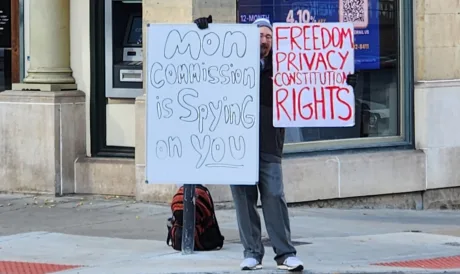
After several months of silence on the issue, the public pushback locally took off over the summer, when an organized campaign drew a crowd to the commission's July 1 meeting.
In fact, you'd be hard pressed to find a single weekly session since July in which the body didn't hear from at least one constituent asking it to cancel the Flock contract.
In recent weeks, the commission has pushed the public comment portion of its meeting to the end of the agenda after multiple clashes between public speakers and Commission President Tom Bloom over the nature of some of the comments.
Following the most recent meeting, Bloom said he believes the meeting regulars would be better served sitting down with legislative representatives.
"It's in their hands now," Bloom said of state lawmakers.
Rose, who attended a July information session put on by the Monongalia County Sheriff's Department for representatives of the local media, said he shares some of the concerns voiced during those commission meetings.
"We've met with Flock in the Joint Gov Organization Committee, and they have not addressed our concerns at all about who actually owns the data; do they sell the data; and can anyone else access the data without the current customer's permission," Rose said. "They've lied under oath to us. They've lied under oath in other states."
Rose said he supports law enforcement and fully expects there will be strong pushback on efforts to ban or restrict the technology.
"While I appreciate what our local law enforcement is trying to do with it, and I do want to be pro-law enforcement and back the blue, I don't want to do so at the expense of your individual liberties," he said. "I agree that our current sheriff is using it the right way, but as a legislator, I have to think about a sheriff in the future and have to take into account these abuses of power that have happened with this technology around the country. Plus, I don't just represent Monongalia County. I have six counties, and while I have good sheriffs today, I'm one election away from having one that may abuse this type of power without strong guardrails at the very least."
As for what those guardrails might look like, commissioners have said they expect the legislature to put protections in place that parallel how the technology is being used in Monongalia County.
"We do have the strongest safeguards that I'm aware of on the use of these cameras," Commissioner Jeff Arnett told The Dominion Post in August. "Our rules and regulations that we've set are actually, from what we understand, what is being modeled on a statewide basis as the legislature is looking into codifying rules and laws as to the use of these cameras. I feel pretty confident that what we have set up is as protective as can be with the use of these cameras."
While jurisdictions across the state are looking to see how the Flock question ultimately shakes out in Charleston, some are choosing to take action in the meantime.
Earlier this week, Morgantown City Council finalized an ordinance regulating the use of surveillance systems by city employees and on city property.
The new law says the city and city officials will not use, install or maintain surveillance technology, nor allow any other person or entity to use, install or maintain surveillance technology on city property - unless done in accordance with the procedures spelled out in the law.
In short, for such technology, including things like Automatic License Plate Reader cameras and cameras with facial recognition capabilities, to be used by a city agency or on city property, a public hearing and the approval of city council is required.
Preexisting uses - like the vehicle-mounted ALPR cameras utilized by the Morgantown Police Department - must be submitted for the approval of council within one year of the law's passage.
Any such technology approved by council under the law, must be reviewed annually.
The law takes a step toward regulating use of the technology by the city and on city property, but it does not ban its use outright within municipal boundaries.
It does not govern private property or property of other government agencies, like state-owned rights of way running through the city.
Further, the process only applies to "real-time" use and leaves exceptions for surveillance, including facial recognition, for non-real-time investigative purposes.
Members of the public lauded the city for taking up the controversial topic, but expressed a desire to see it go further.
Theodore Webb, a regular speaker before the county commission, was among that contingent.
"It seems like a framework for regulation, right? It's a framework, but it's still got that kind of guardrails perspective. Honestly, I'm not really sure that's going to cut it when we're talking about artificial intelligence mass surveillance," he said. "ALPRs and predictive policing technology are prohibited except as permitted by the procedures established in this article. I read that as legal speak. Like I'm not permitted to eat cookies, except when I get up at midnight and sneak a few. I'm a little concerned about that because it seems to allow a pathway."