
Education, tax cuts, term limits top legislative push by State Treasurer Pack
Trending
CHARLESTON - Heading into his third year as West Virginia's chief financial officer, State Treasurer Larry Pack said Wednesday he wants the Legislature to work on increasing teacher pay, fixing the data center property tax formula, and term limits for statewide elected officials.
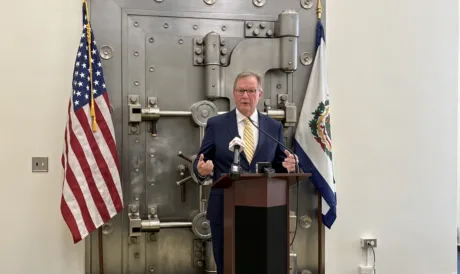
In a press conference in front of the historic vault in the State Treasurer's Office in the east wing of the State Capitol Building, Pack laid out his policy priorities for the 2027 regular session of the West Virginia Legislature beginning Wednesday, Jan. 13.
"We’re going to work really hard to get these measures across the finish line," Pack said. "We think it’s absolutely good policy. It’s good for West Virginia. We’re going to continue to talk about big issues for West Virginia."
Pack, a former businessman and lawmaker, served as a senior advisor and Department of Revenue secretary under former governor and current U.S. Sen. Jim Justice. He was elected state treasurer in 2024, succeeding current U.S. Rep. Riley Moore. Pack also serves as the state's committeeman to the Republican National Committee.
During his press conference, Pack outlined a comprehensive legislative agenda focused on economic growth, government modernization, and educational reform. For the second year in a row, he called for guaranteeing a minimum starting salary of $50,000 for all teachers, as well as a $2,000 raise for those earning above $50,000. The estimated cost for these raises is between $60 million and $70 million.
"West Virginians are passionate about public education; they’re passionate about making sure that their children have the best education that we can provide," Pack said. "The time for one-and-a-half or a two-percent increase a year is just not getting it done. We have to attract new teachers, we have to retain the teachers we have, and we have to be competitive with those surrounding states."
Pack also called for changes to State Code to enable local boards of education to offer competitive pay to retain talent in border counties or to allow additional pay in rural counties who have issues retaining teachers in specific fields of study. Pack said lawmakers should consider removing the statutory pay raise schedule for teachers within State Code for added flexibility for county school systems.
"When you think about the Eastern Panhandle, we’re talking about that locality pay. That’s not really what they’re talking about. They’re talking about competition pay," Pack said. "We need to make sure that we’re competitive. This doesn’t fix all the problems, but that's a heck of a start."
Pack wants to see changes to Gov. Patrick Morrisey's signature legislation passed in 2025, House Bill 2014, establishing the Power Generation and Consumption Act. The law is aimed at attracting data centers to West Virginia along with microgrids to power the facilities using both fossil fuels and renewable energy generation.
Among other things, HB 2014 put in place a formula for how data center projects within districts approved by the Department of Commerce pay out property taxes: 50% of property tax collections from these projects would go to a personal income tax reduction fund, 30% would go to the county or counties where the data centers are, 10% would go to all 55 counties on a per capita basis and 5% would go to the state Economic Enhancement Grant Fund.
Pack said the law should be amended to restore property tax allocations directly to county commissions and county boards of education. He said under HB 2014 provisions, local county school system with regular levies would receive zero property tax dollars from data centers, because those property tax revenues would be diverted to the state’s general revenue fund.
"What (HB 2014) did is it reallocated property taxes from the county, from the county board of education, from the county commissions, away from the counties to the State of West Virginia," Pack said. "At a time when our school boards are struggling, why would we take money away from school boards ... Why would we take money away from county commissions? They’re on the front lines trying to make sure that their county does a really good job."
The state should also try again to phase out tangible personal property taxes, Pack said, calling on the Legislature to place another state constitutional amendment on the ballot in 2028 to phase out the business inventory tax over five years.
Pack said phasing out tangible personal property taxes each year would return an estimate $100 million to taxpayers annually, or less than 5% of total local property tax revenues.
"We’re one of even the smaller handful of states that has a manufacturing business inventory tax," Pack said. "It is a job killer. It is a growth killer. What we want, what I hear people say over and over in West Virginia, is we want our children and grandchildren to have good jobs to stay in West Virginia. We want manufacturing jobs. If we want small business to grow, we need to get rid of this business tax."
"The elimination of the West Virginia business inventory tax has been the top priority for our association for decades," said Bill Bissett, president of the West Virginia Manufacturer's Association, who joined Pack Wednesday. By eliminating the business inventory tax, you incentivize employers who are already doing business here at home to expand their operations and create more jobs, rather than pay an unfair tax on necessary inventory that they have to have to make their product."
Pack stressed that his tangible personal property tax phase-out constitutional amendment proposal is different than a constitutional amendment that failed in 2022, Amendment 2, which would have given the Legislature the authority to exempt six categories of tangible personal property taxes that counties, cities and school systems rely on.
During his second and final four-year term as governor, Justice campaigned against Amendment 2, instead wanting the Legislature to focus on phasing out the personal income tax. Amendment 2 failed, with 64.5% voting against and 35.5% voting for it.
"That proposal (Amendment 2) was for eliminating all business personal (property) taxes," Pack said. "It had about a $400 million or $500 million spend, a spend that I just don’t think we could afford today. This is about $100 million. It’s a much smaller concept. I think it absolutely makes sense for us to go forward on that."
Once again, Pack called for a state constitutional amendment placing term limits for elected members of the Board of Public Works, which include the state treasurer, state auditor, attorney general, and agriculture commissioner. While the governor is limited to two four-year terms, Board of Public Works members have no term limits.
"It’s just good conservative policy," Pack said. "No one should own these offices. Our idea is three terms is enough, 12 years, go back home and live under the rules and the laws that you passed."
Other items on Pack's legislative wish list include amending the state constitution to allow elected Board of Public Works officials to be able to appoint members to boards and commissions under their supervision, implement a five-year sunset for all tax credits for further legislative review, and pass legislation to tighten regulatory rules for unclaimed property redemption to prevent aggressive, out-of-state predatory companies from exploiting state citizens and assets.