
Morrisey eyes Harrison County as home for U.S. Space Academy
Trending
BRIDGEPORT - To boldly go ...
To Charles Pointe.
If Gov. Patrick Morrisey gets to plot the trajectory, future generations of astronauts and others associated with America's space program will do the bulk of their training at the high-end business complex near Bridgeport.
Morrisey announced Tuesday that the state has officially submitted its application to be the home of the as-yet U.S. Space Academy, an initiative fronted by President Donald Trump in August, as a way to further advance the nation's ideals beyond the surly bonds of Earth.
With its acreage, in-place infrastructure and close proximity to Fairmont's I-79 Technology Park and nearby Clarkburg's burgeoning aviation complex, the mixed-use Charles Pointe is primed for All Systems Go, he said.
So is West Virginia, which already has a history of Mountain State natives who have long been integral in NASA's reach for the stars.
There's Katherine Johnson, the celebrated "hidden figure" and human computer from Greenbrier County who gridded out the launch and splashdown trajectories of the Apollo 11 mission and once famously assured John Glenn it was OK to board his Mercury Space capsule - as the numbers checked out.
And Chuck Yeager, the combat aviator and test pilot from Lincoln County who was the first to break the sound barrier.
McDowell County's "Rocket Boy" Homer Hickam, who made key contributions as an instructor to astronauts and aerospace engineers as part of the interstellar effort in Huntsville, Alabama - where the technology to launch humans above and beyond was perfected.
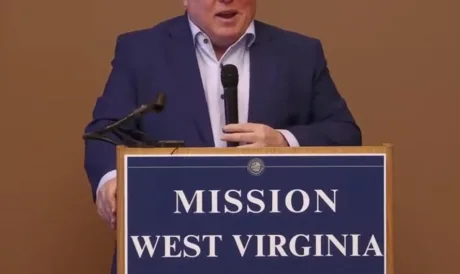
The above, Morrisey said in his remarks at the Bridgeport Convention Center at Charles Pointe, are hardly anomalies or outliers to the cause.
Instead, call them innovators who are indicative of the Mountain State spirit and desire to dream big, the governor stressed - which could come in handy in a pinch (or elevator pitch).
The gravity of perception, though, is already weighing heavy, the governor admitted.
After all, Texas and Florida, with respectively rich histories in the space business, want the academy also.
So does Colorado Springs, Colo., which is already home to the U.S. Air Force Academy.
And Dayton, Ohio, with its famous Wright-Patterson Air Force Base, where the West Virginian Yeager logged lots of hours at the rudder of experimental craft in the days after the Korean War when America was sprinting for the ozone with the Soviet Union.
"West Virginia has a lot to offer, and we didn't back down from the challenge," the governor said.
"I'm a big believer that you put your best foot forward and you keep fighting for progress."
The state has the resources, the land and the cooperation - the inaugural academy class of 300 would be housed at West Virginia University's Lyon Tower in the first construction phase, Morrisey said - with all the players poised to begin work "tomorrow."
And besides a celebrated trio of practitioners, West Virginia already has its out-of-this-world bona fides as well, Morrisey said.
North-central West Virginia, the home of Charles Pointe, specifically.
Down the road at the tech park, the NASA-run software validation facility that bears Johnson's name has made countless missions to the stars safe - from launch to orbit to re-entry.
Engineers, too, at one vendor associated with are already ensuring safe travels for the ongoing Artemis mission to Mars.
"These things don’t ‘just happen,’" said state Sen. Ben Queen, who shared the podium for the announcement.
The governor agreed.
"We have a chance," Morrisey said of the marketing effort, "because of our people."