
The First: WVU honors the original Mountaineer
Trending
Marmaduke Dent was the first.
The first of the well over a quarter-million people who call WVU alma mater.
He enrolled in the first-ever class of the brand-new West Virginia University in 1867.
He became the very first person to graduate from WVU, earning a bachelor's degree in 1870.
In 1873, he was awarded the University's first master's degree.
And Dent helped found the WVU Alumni Association, serving as its first president from 1873 to 1876 (and again from 1892 to 1894 and from 1900 to 1903).
Marmaduke Dent is the Mountaineer Nation's spiritual father. To commemorate that legacy, in 2026, WVU partnered with the City of Grafton in a bid to restore Dent's final resting place.
Making a Dent in History
The Dent family arrived in Monongalia County in 1776, when John Dent settled down near a tract of land that would be named Dents Run.
John was a captain in the frontier militia, member of the Virginia Assembly, justice of the peace, sheriff, and by the time of his death at 85, the father of 12 children.
One of those children was the parent of Marmaduke Dent's father, Marshall Mortimer Dent. Marshall was the owner and editor of a local newspaper, the Virginia Weekly Star. And as a delegate to the 1861 Virginia Secession convention, he voted against Virginia leaving the Union.
He also attended the Wheeling Convention, which marked the creation of the state of West Virginia, and proclaimed, "The whole West is on fire, and erelong the flames will reach the top of the Blue Ridge and proclaim to our oppressors ... that now, we must either be equals, or separate."
His son Marmaduke Herbert Dent, born in 1849 in Granville, was 12 years old at the time.
Names like Marmaduke, Mortimer, and Herbert - there was even a Nimrod Dent - may sound strange, but they were the Skylars, Jadens, and Liams of their day. And WVU President Michael Benson is of the firm opinion that Marmaduke had "the coolest name of any WVU graduate."
Marmaduke must have shared his father's ardor for the new Mountain State and the Union cause, for he could only have been about 15 when he volunteered for the 6th West Virginia Cavalry.
After the Civil War, he enrolled in the brand-new state's brand-new land-grant university and earned the first BA degree WVU ever bestowed. In June 1870, he graduated as the only member in his class in University Hall, now Martin Hall, which had just been completed.
Three years later, he became the first to earn a master's degree from WVU, and Alexander Martin, the University's first president, summoned him along with the other 15 WVU graduates to found the Alumni Association.
Let's Slither!
Marmaduke Dent's WVU would be nearly unrecognizable to a modern Mountaineer. So would Morgantown, which a WVU catalog from the early years described as "a remote, unspoiled village of 700, a totally undistinguished location."
When the first session opened on September 2, 1867, the 13-week term's tuition was $8. Room and board averaged $3.50 a week. A full year's estimated costs were between $187.50 and $249.
The faculty ratio was 1:1, as there were six students and six faculty members. Students could live in College Hall, which "enabled parents to place their sons under the immediate supervision of president and faculty," since Alexander Martin and the faculty lived there too.
Originally, WVU was called "The Agricultural College of West Virginia." But with other land-grant institutions starting to call themselves "universities," the rebranding to "West Virginia University" took place in 1868, "to show that we were not only a farmer's school," as WVU Professor Emeritus of History Barbara Howe explained.
There was no Woodburn Circle, since Woodburn Hall didn't exist until 1878. Dent's classes were held in a building at the northeast corner of Spruce and Walnut streets, and most of the future campus was farmland or undeveloped.
The first female student would be admitted in 1889, while the first fraternity was chartered in 1890. Not until almost a quarter-century after the University's founding was the first WVU football team formed. They were called the Snakes -- Let's Slither!
Cars hadn't been invented, so everyone walked or rode horses. There were barely any roads, and no University Avenue splitting campus. The railroad wouldn't even reach town until 1886, and the idea of the PRT would have been fantastical science fiction.
Until 1896, every student and faculty member had to attend daily chapel. There would be no live Mountaineer Mascot until 1934, and the Flying WV wouldn't be created for over a century.
The Fighter of Good Fights
After his solitary graduation, Dent moved to Taylor County, became a teacher, and served as a deputy clerk and notary public. He read law, was admitted to the bar in 1875, and opened a law office in Grafton, where he served on the city council and school board and became town clerk.
He married and had a family, and in 1892 he was elected to the West Virginia Supreme Court of Appeals on the Democratic-People's ticket. He was president of the Court in 1899, 1900, and 1902.
In 1968, John Phillip Reid wrote Dent's biography, "An American Judge: Marmaduke Dent of West Virginia," which reviewer Earl Curry described as a book about "a judge whose influence was not so great," who fit into "the great mass of middling American judges."
But there is another interpretation of Dent's legacy.
According to WVU Professor Emeritus of History Ronald Lewis, although little is known about the first 20 years of Dent's career, he had a reputation as a lawyer for the common man.
Dent readily admitted that when "there is a powerful and wealthy corporation on the one hand … and a bereaved widow and fatherless children on the other, my deep sympathies for the appeals of the helpless and needy may cause me to hold the scales of justice unequally between them."
In 1898, for instance, he wrote the opinion for a case that decided Black students were entitled to the same length of school term as white students and that their teacher was entitled to the same pay as other teachers.
However, Dent's "deep sympathies" were sometimes with himself, as in the case of a railroad company "that brought 65 great big engines right in front of my house that blew over 1,200 bushels of cinders. I had them arrested 18 times," he recalled without regret.
Curry's review of Reid's biography recognized the Mountaineer in Dent.
"Dent was an activist, 'a doer'; and while many of his crusades were quixotic, he was indeed the fighter of good fights," Curry wrote. "A democracy needs 'doers' at every level. ... This is the greatness of Marmaduke Dent."
A Life That Mattered
Marmaduke Dent died on September 11, 1909. His obituary claimed that he was inoffensive, with few enemies, and that he had lived a clean life.
He was buried in Grafton's Bluemont Cemetery, on the very top of a ridge with a view that includes green hills in the distance and, far below, the Tygart River winding its way through town.
Veterans from the War of 1812 through Vietnam have been laid to rest in the 60-acre burial ground, including both Confederate and Federal soldiers. Not far from Dent's grave is a monument to Mother's Day founder and Grafton native Anna Jarvis. And another of Dent's "neighbors" has a gravesite featuring a statue that the future resident publicly debuted, with the help of a full choir, long before she needed to use it.
Grafton City Councilman Larry Richman has proposed pursuing a National Register of Historic Places designation for Bluemont, which is still an active cemetery. "Every grave represents a life that mattered," he said.
WVU President Michael T. Benson is in full agreement. As he put it, "It's very important that we honor the sites of people who've made an impact for good on the University."
Benson visited Dent's grave in the inaugural year of his presidency, during his "Welcome Home" tour of West Virginia's 55 counties. The historic gravesite was showing its age, so the president promised action.
"If the first graduate of WVU doesn't have a befitting site, then shame on us," he said.
With the help of Vice President of Alumni Relations Kevin Berry, WVU secured Grafton's permission for repairs, and the restoration commenced.
Paying Respects
"When WVU recognizes one of its distinguished alumni, it shines a light not only on that individual but also on the community that helped shape them."
That's Grafton Mayor Diana Thompson talking, and WVU Design and Construction took her words to heart.
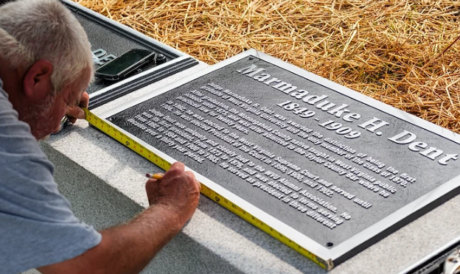
Under the supervision of WVU Construction Manager Jeff Roberts, and in partnership with Orange Construction, Mardo Masonry, Precision Signs, and Mike's Refinishing, new concrete foundations were laid at Dent's burial site in May 2026. Over the following months, the masonry was cleaned and stones were reset, the ground was graded, and cast aluminum plaques recognizing the significance of Dent's life were installed - the original Mountaineer's first introduction to the Flying WV.
For both Roberts and Benson, the restoration is part of an intentional effort to honor the places, emblems and people that make up the University's collective story.
In Benson's eyes, the relighting of Woodburn Hall for holidays, adding an electrified Flying WV to the Evansdale water tower, and bringing the Dent gravesite back to life are all about valuing the unique story of West Virginia and WVU.
Now, visitors to Bluemont drive up Marmaduke Dent Drive to a mountaintop memorial that gleams in the sun.
As Roberts said, "Since we are caring for someone's final resting place, every aspect was approached with respect, sensitivity, and attention to detail. Landmarks like this one help preserve the University's history and strengthen our community engagement. It's the kind of symbol that brings people together around WVU traditions."