
W.Va. Department of Education briefs lawmakers on proposal for new school funding formula
Trending
CHARLESTON – With student enrollment expected to continue trending downward while the estimate cost of educating rural students and those with special needs expected to rise, education officials in West Virginia walked lawmakers through a draft proposal to reform the formula before the courts mandate changes.
The Joint Standing Committee on Education met Monday afternoon on the first day of two-day legislative interim meetings at the State Capitol Building.
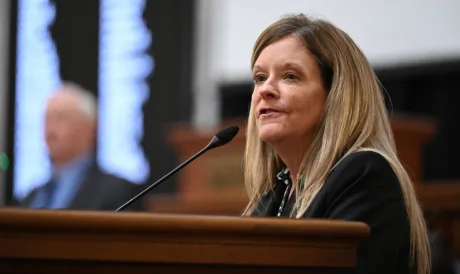
Committee members heard from State Superintendent of Schools Michele Blatt and Uriah Cummings, school finance operations officer for the Department of Education, about the department’s draft legislation to up the state’s Public School Support program, also known as the seven-step school aid formula which directs state general revenue funds to West Virginia’s 55-county public school system.
“One of the things we know is if we want a stronger West Virginia economy in the next 10 to 20 years, then we must properly invest in our public education system today,” Blatt said. “Education is truly a prevention strategy. Every child that we prepare for college, a credential, an apprenticeship, the military, or a career has an impact on the future of West Virginia. Therefore, properly funding education is an investment.”
First unveiled last month during a state Board of Education meeting, the proposal with shift the state away from distributing funds to county school systems mostly based on student enrollment and move to a new weighted formula based more on the needs of students in specific counties.
Cummings said the estimated price tag for implementing the draft school aid funding formula bill would be approximately $410 million annually on top of what is currently spent by the state, from roughly $1.4 billion to $1.8 billion.
“Really, it’s not about just asking for more money in terms of what needs exist across the state of West Virginia,” Cummings said. “It’s being able to look at the current model that we have and saying, is this model sufficient in terms of what it takes to educate a child in today’s day and age?”
“The price tag was not surprising to me,” said Senate Education Committee Chairwoman Amy Grady, R-Mason, following Monday’s meeting. “I actually was expecting a little higher, so the $402 million was a little lower than I expected. We knew this was something that they put together as ... the things they would really like to improve.”
The proposed bill introduces a funding enrollment mechanism that calculates base funding using the higher of the prior year's second-month net enrollment or a three-year average, shielding districts from abrupt revenue cliffs caused by declining enrollment. It would replace a flat per-pupil allocation with specific funding weights for special education students tiered by service intensity, low socioeconomic status/poverty, English learners, career and technical education, gifted students and rurality.
According to numbers released by the Department of Education, the fall headcount enrollment number for the current school year was 226,687 students, a 3.5% drop in enrollment from 234,957 students in the 2025-26 school year – a decline of 8,270 students.
The draft bill would modernize personnel allowances in public schools per 1,000 students: 77 professional educators, 55 service personnel, and seven student support and medical service providers. It would also establish a professional operations category for other positions, such as finance, compliance, technology, legal, transportation, facilities, data accountability, and child nutrition.
Each county would receive dedicated funding for these positions at 2.5 base positions, plus an additional .5 position per 1,000 students. School districts with fewer than 4,000 students would be required to submit an approved shared services plan to receive the full support.
The low enrollment threshold for counties would increase from 1,400 students to 2,000 students with tiered adjustments to account for enrollment declines. Smaller counties with few than 1,000 students that operate only one school building would receive explicit financial recognition.
Instead of a square footage model for funding operations and maintenance, that would change to a 90% base allocation, though allocations would be reduced for schools operating below a 50% building utilization rate. Transportation costs would also transition to a 90% reimbursement for eligible non-salary transportation costs, with adjustments for rural terrain, road networks, and population distribution across a county. Enhancements for multi-county vocational routes and qualifying alternative fuel buses would continue.
Parts of the proposal could be implemented piecemeal or phased in. For example, the cost for the special education portion of the proposed bill is roughly $190 million. Special education enrollment is projected to increase, from 43,000 in 2015 to 48,436 students in 2027, raising the proportion of students with disabilities from 15.3% to 21.4% – nearly a 40% relative increase.
“We’ll always point to special education as the number one priority,” Cummings said. “We are mandated to be able to provide these services from the federal level in terms of supporting a child’s IEP (individualized education plan). So, we can’t cut costs, nor do we want to cut costs as it pertains to supporting special education students.”
The pressure is on for the Legislature, Gov. Patrick Morrisey, the Department of Education and state Board of Education, and other state officials to fix the school aid formula this session. A lawsuit was filed recently by the ALCU-WV on behalf if Lincoln County families seeking to force an update similar to the lawsuit that created the school aid formula in the 1980s. Lawmakers and the state board are seeking to delay that lawsuit until after the 2027 legislative session beginning Wednesday, Jan. 13 and ending Saturday, March 13.
“We understand that we can’t fund all nine major components in any given year. But we have the language here. We have the proposals,” Blatt said. “We just are asking for the opportunity for all of us to sit down together. Let’s tear this legislation apart. Let’s determine what we could do this year and maybe what we want to think about for next year. But let’s set our priorities on how we can begin to address the funding formula.”
Due to the continued decrease in public school students, county school systems have had to make hard choices, including cutting teachers and staff, slashing spending and closing and consolidating schools, with nearly 140 public schools closed since 2011 according to the West Virginia Center for Budget and Policy.
“I’m not going to pretend to be any kind of expert on the funding formula because I’m far from it,” said Del. Mike Pushkin, D-Kanawha. “All I know is we see what the results are from years and years of not addressing it. And we see wider disparities between counties that are losing population and those that aren’t.”