
Jay Rockefeller: Healthcare for all, respect for all
Trending
MORGANTOWN - According to lore, then-Gov. Jay Rockefeller got out of his car himself to direct traffic on West Run Road on a rainy day back in the late 1970s.
An expanse of acreage off the narrow ribbon of asphalt near Morgantown was being considered as a site for what would become Milan Puskar Stadium.
The gridiron arena, in turn, would become the stage and backdrop for a new, marquee era of West Virginia University football - what with Don Nehlen, perfect seasons and runs for the sport's national championship to follow, as all of the above did.
Of course, people had no way of knowing that then.
What the people who were vested did know was that the thing needed to be built, and preferably in time for the 1980 season.
Rockefeller, still new on the job in Charleston, was the quarterback in the huddle for this infrastructure play-call - for better or worse.
It was raining on this particular day, as said.
And with all that precipitation, all that real estate was one big ooze.
The governor's motorcade was getting mired in mud.
Cars were spinning their wheels.
Rockefeller, who came to the state a decade before as a Volunteers in Service to America volunteer and never left, had already seen enough of that in these climes: metaphorically, politically, literally.
So, he hopped out of his car (the telling and re-telling went) and helped everyone else steer to a better purchase.
Which, said the people who were associated with the former lawmaker over the years, was another metaphor of service unto itself.
That is, as a rich guy who went to work for one of the poorest states in the nation and wasn't afraid to get his Florsheims muddy in the process.
CARPETBAGGER CONTRADICTIONS ... STILL MORE
Rockefeller died Friday at the age of 89.
He entered West Virginia's scruffy, tussling political arena by getting himself elected to the House of Delegates.
Voters then sent him to the State House in Charleston as governor.
When he retired from public life after the 2014 elections, he was West Virginia's senior senator on Capitol Hill.
Inside the Beltway, he pushed healthcare for all.
Especially, as he stressed, for the citizens of his adopted home state and other places where visits to the doctor or necessary prescription refills just have to wait.
"You're either rich - or you have Medicaid," he told a Charleston media outlet in 2013.
Translation: There's no middle, when you or someone in your family is sick and there's just not enough money coming in to pay for necessary care.
He was a lead sponsor of the Children's Health Insurance Program, or CHIP, as it’s commonly known, which provides health coverage for thousands of kids from needy households across the state.
The senator with the privileged background championed Medicare and Medicaid, while digging for improved healthcare for coal miners battling black lung and other work-related maladies.
Morgantown and WVU's Evansdale medical campus became even more of a destination in the state and region for families benefitting from Rockefeller's advocacy.
In 1999, it became personal.
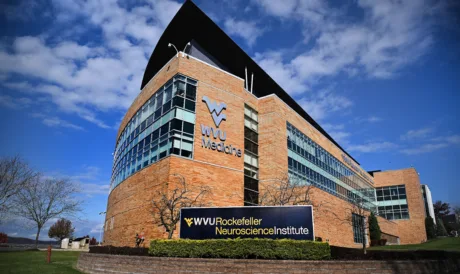
That was the year his family founded the Rockefeller Neuroscience Institute in Evansdale for the advancement and research of Alzheimer's disease and other diseases of the brain.
Memory disorders, especially.
Alzheimer's robs its sufferers first of their memories, those cognitive time-bridges, then their lives.
Blanchette Rockefeller, the senator's mother, languished 10 years with Alzheimer's before finally succumbing to it.
Today, the center in her name is a global leader in its search for quality-of-life treatments and ultimate cure.
HIS HOME AMONG THE HILLS
Meanwhile, don't look for memories of the Jay Rockefeller legacy here to fade any time soon, Sam Workman said.
Especially, the academic added, for younger generations choosing to stay in West Virginia and places like it.
"Every wave has its ebb," said Workman, who directs the university's Institute for Policy Research and Public Affairs.
"Sen. Rockefeller leaves a legacy of public service based in kindness, understanding and deep empathy for Appalachians everywhere."
Rockefeller was 27 and newly registered with VISTA when he first came to West Virginia in 1964. His first assignment barely registered as a dot on the map. It was the tiny coal-mining community of Emmons.
He was an idealistic young man, cresting the wave of President Lyndon Johnson's War on Poverty - and the experience forever informed his public life to come.
"It explains every policy I pursued and every vote I have cast," he said in an emotional farewell address to his Senate colleagues in 2014.
"It was where my beliefs were bolted down and where my passions met my principles."