
FAITH & COMMUNITY: Carrying forward our ancestors’ better angels, Dr. King’s dream
Trending
As I write this reflection, many of us recognize November as a month of remembrance and honor for our ancestors who have gone before us. I also write this before Election Day and find myself asking what those ancestors would say if they invited us to call on what Abraham Lincoln called our better angels in the days ahead.
We have probably followed the news that, for the first time, we have a pope who cast a vote in an American election. Pope Leo cast his ballot in the city of Chicago. This reminds us that participation in elections is something sacred. Pope Leo and Pope Francis remind us that the true purpose of political life is to promote the common good of all people and build a civilization of love. This understanding is rooted in Catholic Social Doctrine, which is nonpartisan and concerned with the common good of society.
There have been some rumblings that Pope Leo XIV wants to visit the United States. When that might be remains uncertain, but the last time a pope visited the United States was in 2015, when he chose to speak at our Capitol and called Congress to remember our ancestors who are now deceased but who tried to build a better republic.
Speaking not only to Catholics but to all people of goodwill, Pope Francis began with Moses, reminding us of the need to preserve unity through just laws and to recognize the transcendent dignity of every human person. He then named three sons and a daughter of this land and four dreams: Lincoln, liberty; Martin Luther King Jr., liberty in plurality and non-exclusion; Dorothy Day, social justice and the rights of persons; and Thomas Merton, the capacity for dialogue and openness to God.
As we seek to build a better republic, let us remember these ancestors and dreams. Let us also recognize that there are forces of greed and violence, often backed by great power, that seek to divide us.
I find myself returning to Martin Luther King’s final speech to the sanitation workers before his assassination. He recognized that when people unite against forces that polarize and divide, they can take real steps toward building the Beloved Community.
I believe one of the best ways to study West Virginia history is through the movie “Matewan.” It shows how those with money and power sought to divide immigrant and minority workers. Yet workers learned that if they united, they could stand up for their basic human rights.
Let us think honestly about our history. We are a nation of immigrants, yet we have also experienced periods of discrimination against those who came to this land. The movie “Cabrini” illustrates how Italian immigrants were treated when they entered our nation.
One historian told me that we may someday look back on this period of immigration policy as one of the darkest chapters in our nation’s history. As Bishop Evelio said in a recent interview, "They see groups of Hispanics who came to work, maybe in building an energy plant, which is common here, and suddenly they stop showing up." I recently celebrated Mass in a city where, not long before, people had been arrested at a local Mexican restaurant. It led me to ask: Do we recognize when people are no longer in our pews? Do we wonder what happened to them?
The other reality is that our democracy is built upon formal authority. I have a friend who is a priest who counsels those in the military and knows the reality of moral injury. I know people who remain in these jobs because they are trying to do the right thing and do not want to be replaced by someone who may act in even more harmful ways. Others are simply trying to provide for their families and should not be asked to violate their consciences or harm those they love.
History teaches that problems do not simply disappear; they grow. How will we, in the days ahead, build a civilization of love? Evil often seeks to remain hidden. This is why vigilante groups wear masks, and why societies sometimes try to hide difficult parts of their history. Yet the spiritual task is not to conceal these realities, but to bring them into the light and face them honestly so that we can find a better way forward.
When we look at our political system, there is plenty of blame to go around. Yet I am reminded of a wise rabbi who recently quoted Abraham Heschel: "Not all are guilty, but all are responsible." The challenges facing our society call us to embrace that responsibility.
Pope Francis once said, "How can it be that it is not a news item when an elderly homeless person dies of exposure, but it is news when the stock market drops two points?" I heard a similar insight during a committee discussion on homelessness. A man shared that what changed his perspective was getting to know homeless people personally. He came to realize that each person was someone’s son or daughter.
As Dorothy Day said, if we say we care about the poor, do we know their names? Mother Teresa has been quoted as saying that we have forgotten that we belong to each other. Perhaps, if we are going to correct our injustices in the days ahead and make real strides up that mountain toward what Dr. Martin Luther King Jr. called the Beloved Community, we must recognize that these are not simply problems to solve, but people with names and faces, members of our community. If we can truly remember that we belong to each other, then perhaps we can move toward what Dr. King saw from that mountaintop and take steps closer to the dream.
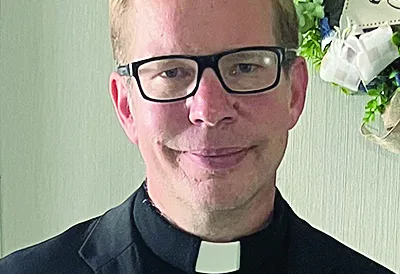
Father Andy Switzer, Delegate for Ecumenism and Social Justice and Liaison of Catholic Community of Appalachia, has been newly appointed pastor of St. Agnes Parish in Shepherdstown. Switzer writes as part of the Morgantown Faith Leaders Network.