
‘A little more of a hassle’: Young voters navigate elections while in different states
Trending
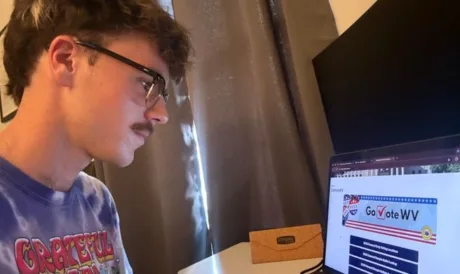
MORGANTOWN - Ben Ashmore is from West Virginia but had to apply for an absentee ballot to vote in the state's 2026 midterm elections.
Ashmore, who grew up in Wheeling, is a student-athlete at the College of Charleston in South Carolina.
"At first, I didn't really know how that process worked because I had never done it before, but I was able to look it up and figure it out pretty easily," he said. “But being out of state definitely made voting a little more of a hassle than it would have been if I were living at home."
Voting gives citizens the opportunity to have a voice in who represents them and the direction of local or national government. Ashmore said he thinks democracy only really works when people choose to participate in it.
"Even if the person I vote for doesn't win, I still had the opportunity to make my voice heard. If I have that right and opportunity, I think it's important to use it," he said.
Ashmore's peers don't all share his attitude about voting.
Young adults have very low voter turnout rates. In 2020, 35% of eligible voters from ages 18 to 24 voted. College students, in particular, have traditionally voted at one of the lowest rates of any group in the United States.
But it's not only a question of will.
According to Tufts University Center for Information & Research (CIRCLE), transportation and being far from home are significant barriers for young adults wishing to vote.
A CIRCLE analysis found that 33% of college youths who did not vote said being out of town was a factor, compared with 22% of non-college youths. Additionally, 23% of college youths said they did not receive an absentee ballot in time to vote.
Madison McClean, a biochemistry student at WVU, is now living in West Virginia but is originally from Uniontown, Pennsylvania. She said it was difficult to determine how and where to register to vote.
"Since I go to college in a different state than where I am from, I was not sure whether to register in West Virginia or my home state," she said. "After some research, I came to understand what 'dual residency' was and ultimately decided to register in my home state of Pennsylvania."
Dual residency makes it easier for people living in two different states to decide where to vote, but the U.S. Vote Foundation suggests choosing just one of the two states and sticking with that same one for future elections.
Youth voter turnout varies by state. According to CIRCLE, 31.7% of eligible voters ages 18 to 29 voted in Pennsylvania in the 2022 midterm elections, compared to 14.2% in West Virginia. Pennsylvania's youth voter turnout increased slightly from 2018, but West Virginia's declined.
Robert Speel, associate professor of political science at Penn State Behrend in Erie said that for the 2018 election, young voters were mostly voting against President Donald Trump. He said that knowing a major race is competitive also boosts turnout.
Pennsylvania's 2022 midterm election was the first since former Gov. Tom Wolf passed Act 77 in 2019, allowing any voter in the state to request an absentee ballot without an excuse. Speel said this change likely made it easier for college students from Pennsylvania attending school in different states to still vote while away from home, potentially contributing to the state's increase in youth turnout. However, he said West Virginia continued to require voters to meet an approved eligibility requirement to vote by mail.
According to the National Conference of State Legislatures (NCSL), states maintain their own voter registration lists, and there is no official national voter registration database.
WVU political science professor Erik Herron said young people have to be very forward-looking when it comes to registering to vote and changing their address for their registration because it takes time and research to ensure a voter's address is aligned well before the voting registration deadline.
He also had some advice for young voters.
"I was in Ireland doing some elections-related research a couple of years ago and I met the director of elections for the country of Ireland," Herron said. "He said something unfortunate but valuable for everyone when it comes to elections. He said 'you have to treat every day like it's April Fools Day.'"
Herron said that on April Fools Day, you might check something before repeating it to not fall for somebody's trick. Unfortunately, he said, every day is April Fools Day, and voters should resist the temptation to repost or tell their friends something if they haven't verified that source.
Herron said voters should verify all election-related information before sharing it, but that finding reliable sources is a challenge for young adults around election time. He recommends young adults navigating voting requirements while attending college out of state refer to sources like NCSL and vote.gov.
Ashmore said he agrees, and that dependable information should be more accessible.
"I think one reason young adults don't vote as much is because voting isn't advertised enough on the platforms they actually use," Ashmore said.
He said he thinks people his age should be seeing information about voting regularly on social media and other platforms they use every day, especially information about how to register, when to vote and why participating matters.
Dave Hauser, teaching associate professor of political science at WVU, said it's important for everybody to vote, regardless of age range, but specified the importance of being informed on what each campaign is running for.
"Laws don't force people to be informed," he said.
Hauser mentioned past statistics that show taller candidates winning over shorter, and that many voters were choosing favorites based on aesthetics instead of policies.
"People can make up whatever reason they want to vote," he said. "I would rather they research the issues and figure out which candidate is going to more likely convey their opinions appropriately."
McClean said that while her education is her priority, she is lucky enough to have access to important information and issues on her phone wherever she is. She said there is no reason for someone to not educate themselves on elections before heading to the polls.
But McClean said she thinks her perspective on voting would've been entirely different had she been raised in a different socio-economic background.
"I grew up in a town where local elections were very important, and every yard that you drove past had at least one candidate's face on a yard sign," she said. "Someone who grew up in a different area might not have had the opportunity to experience just how important voting is and how much it can impact a smaller community."
McClean praised her college experience for providing her with the opportunity to share her own beliefs with others, provide new perspectives and hear from people who grew up looking at voting differently than she did.
A young adult living away from his or her home state does not need to travel back home to vote. Absentee ballots and online resources can be used as methods for understanding the importance of midterm elections from afar.
While Ashmore is a day's trip from his hometown, he still makes the effort to research and refine his voting options.
"I think voting is important because it is a right we have as American citizens. Since I had the opportunity to have a say, I felt like I should take advantage of it," Ashmore said.
The push to get young adults to the polls for the 2026 midterm election continues.
College students, both in and out of state, continue to show how their votes matter, and that the time and energy it takes to research elections is essential in shaping the future.