
MOUNTAINEER SPOTLIGHT: WVU professor reflects on 25 years of striking gold in the blue
Trending
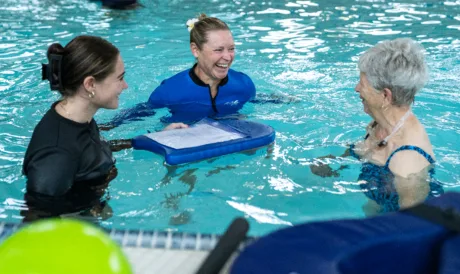
West Virginia University professor Lori Sherlock hasn't had a job that didn't require her to wear a bathing suit. So, when an opportunity to work at the nation's only undergraduate aquatic therapy emphasis program arose at WVU, she dove right in.
For the Morgantown native and WVU alum, the only thing better than the job itself was the location. Sherlock studied exercise physiology as an undergraduate and continued to earn a doctoral degree in curriculum and instruction.
Her passion for exercise and love of water led her to the Student Rec Center after the University opened its doors in 2001. Twenty-five years later, she's consistently found herself involved with the facility in some capacity, as both an educator and student.
While in college, Sherlock joined the rowing team and felt the growing pains of the transition from a club team to an NCAA Division I varsity team. Initially, there were no designated training facilities on campus for student-athletes on club teams. But all that changed pretty quickly once rowing became an officially recognized varsity sport.
The initial excitement of heading into graduate school having the option of a brand-new, air-conditioned facility to train in is one that Sherlock hasn't forgotten.
"Towers used to have this workout facility that we called 'the boiler room,' because that's where it was located," Sherlock said. "It was hotter than Hades, and we would lift there or at any other gym we could get into. So, when the Rec opened, it was just incredible."
It wasn't long after that Sherlock found her home within the Rec's Aquatics Center and began teaching fitness and aquatic classes.
"I was teaching and doing aquatic therapy as a student getting to work with high-needs clients that experienced strokes or spinal cord injuries," said Sherlock. "My favorites were pediatrics, we'd have kids with cerebral palsy, that were nonverbal, not walking, and it was just amazing to see what the water could do."
Of all that may have changed throughout Sherlock's 25 years at the Rec, her passion for teaching others and the strength of water has never wavered.
"Water is a powerful medium and it can be impactful for meeting people where they are, whether you're a fit athlete or somebody who's unable to walk. Everyone across the spectrum can use water in some capacity and see benefits."
Just as the COVID-19 pandemic made waves across the globe, its ripple effects were felt in the Rec pools. Sherlock's students needed more enrichment opportunities, which led to aquatic therapy clinics.
"At first, I wasn't sure if I'd have enough clients for my students, but we had a waitlist almost immediately. In the first semester we had 60 clients sign up, last spring we had over 100 clients, and to think I'm doing this with my students, it's powerful."
Sherlock is credited as the sole developer of the aquatic therapy emphasis program, a standalone jewel on the necklace of the Rec Center.
"The Rec has always been a positive and popular place to be, and now I feel like it's not just a resource, but an expectation. There's also a lot more integration of classes in here. When this place started that wasn't the case and now, that's part of the foundation for this facility."
As for the next 25 years, Sherlock has no plans of going off campus just yet. She said she hopes for growth and prosperity in the little corner of campus she calls home, as it continues to reach students like it did for her.
"The Rec is a family and it's a friendship, but like water, it's able to meet you where you are. It served me in college, it serves me now, and I think it'll serve me when I'm 70. Maybe I'm taking a course, or I'm leading it, but I'll hopefully be participating at the Rec in my 70s and 80s when I’ve long retired from the University."