
Judge to hear free speech concerns to W.Va. AG climate probe
Trending
CHARLESTON - A federal judge will hear the merits Thursday of a request by two environmental advocacy groups to halt a consumer protection investigation by West Virginia Attorney General J.B. McCuskey they say is meant to silence their right to free speech and other constitutional rights.
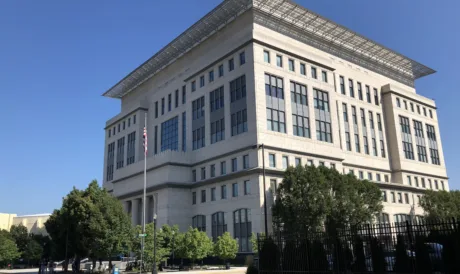
Representatives of the West Virginia Rivers Coalition, national grassroots environmental group 350.org, and the state Attorney General's Office will be before U.S. District Judge Joseph R. Goodwin Thursday afternoon at the Robert C. Byrd Federal Courthouse in downtown Charleston.
Goodwin will consider a request by the environmental groups for a temporary restraining order to stop a West Virginia Consumer Credit and Protection Act (WVCCPA) investigation into the these and other environmental advocacy groups by McCuskey.
The West Virginia Rivers Coalition and 350.org, both non-profits, filed suit last Thursday in the U.S. District Court for the Southern District of West Virginia following subpoenas issued on Sept. 16 to as many as six environmental groups.
The subpoenas - issued by Zachary A. Viglianco, director of Strategic Litigation for the Attorney General's Office - ordered these environmental groups to turn over 10 years' worth of records. The investigation is seeking public statements on climate change, internal communications, donor and funding sources, coalition dealings, regulatory submissions, and shared governance with renewable energy entities. The groups had until Monday, Nov. 3, to comply.
Both the West Virginia Rivers Coalition and 350.org claim the subpoenas violate the 1st Amendment and represent retaliation for the groups' views, their freedom of association, their right to petition their government, viewpoint discrimination, and the groups' ability to fundraise. They also state that the subpoenas are overly broad and represent an unreasonable search under the 4th Amendment as well as 14th amendment equal protection and due process rights.
In a video message posted on social media last week, West Virginia Rivers Coalition Executive Director Jennie Smith said the Attorney General investigation would have a chilling effect on the rights of environmental advocacy groups to speak out, fundraise, seek grants, and would harm the financial viability of other non-profits.
"We believe this subpoena is a serious overreach that threatens our constitutional right to speak up for clean water, protected public lands and healthy communities," Smith said. "As you know West Virginia Rivers has spent more than three decades standing up for our waters. We have always believed that protecting West Virginia's waters is something we all have a part in ... We're pursuing necessary actions to protect our organization, our partners and the constitutional rights of everyone who believes in speaking up for West Virginia."
In a response filed with the court on Monday, Viglianco said the motions for a temporary restraining order was brought too soon before the Attorney General's Office could address the concerns of the subpoenaed environmental groups.
"Plaintiffs have rushed to this Court seeking emergency relief without ever engaging with the Attorney General about the concerns they have regarding the subpoenas' scope, the timeframe to comply, and any alleged interplay with the First and Fourth Amendments," Viglianco wrote. "In short, the Plaintiffs contend that these subpoenas – and any related investigatory efforts- are 'illegitimate.' That simply isn't so."
Viglianco said the Attorney General's Office had every right to use the WVCCPA investigate claims by environmental groups which could negatively affect West Virginia's fossil fuel industries.
"The WVCCPA empowers the Attorney General to investigate – and when circumstances warrant, enforce – the WVCCPA's prohibition against 'unfair or deceptive acts or practices' that impact trade or commerce in West Virginia," Viglianco wrote. "False, materially misleading, or otherwise deceptive speech can qualify as an unfair or deceptive act or practice. Because the Attorney General has probable cause to believe that a violation has occurred, his issuance of investigatory subpoenas was an ordinary and proper exercise of his consumer protection authority."
In its court filings, West Virginia Rivers Coalition and 350.org point to past statements by McCuskey over the last year. In February, McCuskey signed a letter with several other state attorneys general asking the U.S. Department of Justice to investigation more than 150 environmental advocacy groups, including 350.org.
In May, the Attorney General's Office accused the West Virginia Rivers Coalition of relying on “slanted,” “cherry-picked,” and “deceiving” data in separate federal lawsuit in the 4th Circuit Court of Appeals over West Virginia's underground carbon sequestration program.
"The subpoenas were not issued for any legitimate governmental purpose but are a political action by the Attorney General that is intended to stifle speech that he does not like and to otherwise harass and retaliate against groups to which he and his allies are politically opposed," wrote Derek Teaney, an attorney with Appalachian Mountain Advocates representing West Virginia Rivers Coalition and 350.org.
FIRE, the Foundation for Individual Rights and Expression, is an organization that advocates for free speech and instances when government infringes on 1st Amendment rights. In an email Tuesday, FIRE Vice President for Public Advocacy Aaron Terr said the Attorney General's investigation of environmental groups appears to be reframing "political advocacy as consumer fraud."
"These subpoenas look like an abuse of regulatory power to suppress speech on one side of a public debate ... But advocacy on public issues doesn't lose First Amendment protection just because a state official thinks it's misleading or will harm an industry," Terr said.
"States can go after actual fraud, like a nonprofit knowingly making specific misrepresentations to donors about how their money will be used. But that's not what's happening here," Terr continued. "The subpoenas focus on climate projections relied on by the groups and statements they've made that are a matter of political and scientific debate. The arena of public debate is exactly where those disputes should play out. That’s how it works in a free society. The state shouldn't be trying to rig public debate with burdensome investigations that intimidate advocates into silence."
The leader of an In-state conservative advocacy group also came to the defense of West Virginia Rivers Coalition and 350.org. Jason Huffman, president of the West Virginia chapter of conservative advocacy group Americans for Prosperity, said in a social media post Monday that the actions by the Attorney General's Office were a step too far.
"While we disagree with the environmental left's rhetoric, there's one thing we should agree on: they have a right to say it," Huffman said. "Government has no prevailing interest in leveraging state-led investigations to put a thumb on the scale of a fight over policy or politics. The freedom of speech and of peaceful assembly are sacrosanct. And actions by government that, however well-meaning, chill free speech are antithetical to those unalienable rights. The principled approach to pushing back against speech with which we disagree is more speech, not less."
Terr cited a U.S. Supreme Court decision from earlier this year, First Choice Women's Resource Center v. Davenport, that allowed a New Jersey faith-based pregnancy center to challenge in federal court efforts by New Jersey Attorney General Jennifer Davenport to order the organization to turn over certain records.
"These tactics are unconstitutional no matter the politics involved," Terr said. It was just as wrong for the New Jersey attorney general to subpoena donor information from a religious organization that provides pregnancy counseling and allegedly made misleading claims about abortion ... The same concern applies here."