
WVU purchases former sorority house targeted for recovery facility
Trending
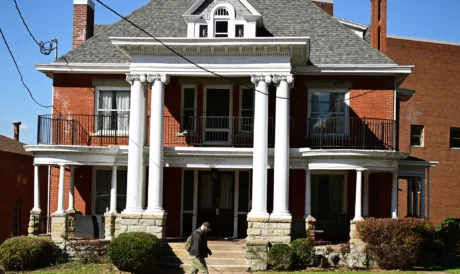
MORGANTOWN - The former sorority house at 1493 University Ave. that Abundant Life Recovery Housing Network hoped to purchase for use as a recovery housing facility has been acquired by West Virginia University.
According to a university spokesperson, the sale closed on Oct. 5.
The property made headlines in July, when a Morgantown Board of Zoning Appeals meeting on Abundant Life's request for a "halfway house" conditional use for the 11,492-square-foot building drew an overflow crowd. That crowd included representatives of WVU and the neighboring St. John University Parish, all of whom were on-hand to speak in opposition to Abundant Life's request, which was ultimately denied by the BZA on a 2-1 vote.
During the meeting, it was stated that both WVU and the church had made backup offers to purchase the property after learning of Abundant Life's interest.
Having been denied by the BZA, Abundant Life founder and president Matt Johnson reapplied through the city's revamped "reasonable accommodation" administrative process under the Americans with Disabilities Act, the federal Fair Housing Act and the West Virginia Fair Housing Act.
That, too, was denied.
Johnson said the nonprofit initiated the appeal process but has since abandoned that effort.
Abundant Life was working with the Federal Home Loan Bank of Pittsburgh to line up funding through its affordable housing grant program.
"We had a contract on the property, but when our reasonable accommodation process did not pan out, we lost the contract," he said, explaining any potential appeal became moot when WVU's backup offer was accepted.
Because the funding was property specific, Abundant Life was also forced to withdraw its grant application, which had received favorable scoring from the bank and appeared in line for approval.
Abundant Life Recovery Housing Network is a faith-based recovery housing nonprofit founded in 2021 that currently operates facilities offering 25 beds in the Morgantown area - 15 for men and 10 for women.
Johnson said the agency has a waiting list with nearly 100 names on it.
The University Avenue property would have housed 30 program residents, plus one house manager and two senior residents according to the reasonable accommodation application.
"It was incredibly disappointing because we saw that we had a good opportunity to both increase our housing capacity and also to really increase the long-term financial sustainability of our organization. And so, to lose both those things due to what I would consider to be stigma and concerns that are not based in reality or data is incredibly frustrating," he said.
As part of the July BZA discussion, WVU Vice President and Chief of Staff Erin Newmeyer explained that after learning of Abundant Life's request, the university reached out to the nonprofit with an offer to take over the purchase agreement on the property and collaborate with the agency on what future programming would look like.
At the time, Johnson described the offer as “not at all appropriate.”
While WVU confirmed its ownership of the property, a university spokesperson did not address questions about future plans for the site, stating only that the purchase agreement could be obtained via a Freedom of Information Act request, which has been submitted.
Johnson said he's walked away from this situation both disappointed and frustrated.
"We weren't talking about letting people run wild," he said. "One of my very specific frustrations with the city is that the city's zoning code doesn't establish opportunities for recovery housing. And so, the city's zoning code uses language around halfway houses. That's very stigmatizing, and it's old language," he said. "It's antiquated language that most folks don't use anymore because of the stigma it carries and because of what that specific kind of housing looks like. Halfway housing is often less structured, less supported. It's not certified."
He also reiterated his frustration in hearing the city and WVU speak about their support for individuals in recovery.
“I mean, I expected more of the city. I expected more of the university. I thought that we were living in a community that was more well-informed about the work that people in recovery do to rebuild their lives and become productive members of society. So I was very disappointed in that,” he said. “And I really struggle with anybody that says, ‘We want to be supportive, but we’re not supportive in this location.’ No, then, you’re not supportive.”