
Trending
CHARLESTON - West Virginia's 55 county public school districts saw their largest combined drop in student enrollment since the period spanning the worst of the COVID-10 pandemic.
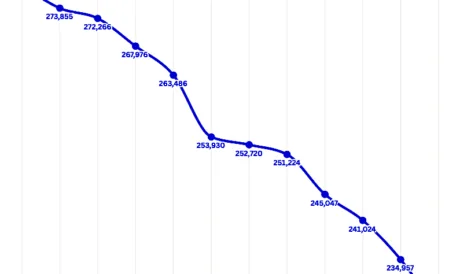
According to numbers released Tuesday by the West Virginia Department of Education, the fall headcount enrollment number for the current school year (2026-27) was 226,687 students, a 3.5% drop in enrollment from 234,957 students in 2025-26 school year - a decline of 8,270 students.
This year's fall headcount represents an 18.3% drop in student enrollment over an 11-year period beginning with the 2015-16 school year when there were 277,452 students, a decrease of 50,765 public school students over that same period.
It also represents the second largest year-to-year drop in public school student enrollment in the last 11 years since the 3.6% drop in students between school years 2019-20 and 2020-21 during the COVID-19 pandemic.
Schools were shut down at the end of the 2019-20 school year to slow the spread of the virus. During the first half of the 2020-21 school year, public schools had to follow a color-coded system to determine whether to open, have hybrid learning or go full virtual during peaks of high COVID infections. During that time, enrollment dropped from 263,486 students in 2019-20 to 253,930 students by 2020-21, a more-than-9,550 decrease.
While county school systems receive local funding through property tax revenue, bonds and levies, the seven-step school aid formula plays a large role in setting their budgets. That funding formula relies heavily on student enrollment numbers for each county, which are finalized every October. That formula determines how much money from the general revenue fund is distributed to each county school system, which sets its own budget based on those funds.
Due to the continued decrease in public school students, county school systems have had to make hard choices, including cutting teachers and staff, slashing spending and closing and consolidating schools.
According to a tally by the West Virginia Center for Budget and Policy which advocates for increased education funding, nearly 140 schools have closed in West Virginia since 2011, with one school closes and 12 schools up for closure/consolidation in Logan, Mingo, Boone, Raleigh, Nicholas and Taylor counties this school year. Only 20 counties have not had to close a school during the 15-year period.
State education officials and some lawmakers have been raising the alarm about the school aid formula, created after a 1982 decision by former Ohio County Circuit Court Judge Arthur Recht when a parent brought a class action lawsuit in 1975 against Lincoln County Schools arguing that poorer rural counties were being disadvantaged over larger, wealthier counties.
During last week's West Virginia Board of Education meeting, State Superintendent of Schools Michele Blatt and Uriah Cummings, school financial operations officer for the Department of Education, unveiled a draft of legislation to reform the school aid formula that would weight funding on additional factors other than just enrollment, tiered by service intensity, low socioeconomic status and poverty, English learners, career and technical education, gifted students and rurality.
"There have been a lot of discussions over the past two to three years on the various pieces of the school aid funding formula," Blatt said, "We started discussing with Uriah Cummings, our finance officer, what would it look like to put together a comprehensive piece of legislation that addressed all of the concerns, needs, accountability requirements, fiscally responsible kind of requirements in there for some of our smaller counties, our rural, our poverty, special (education) and all those components."
Among other features, the proposed bill introduces a funding enrollment mechanism that calculates base funding using the higher of the prior year's second-month net enrollment or a three-year average, shielding districts from abrupt revenue cliffs. The full cost for implementing the proposed bill will be determined in phase two. But implementing changes to special needs funding could be as high as $190 million.
The draft bill addresses some of the concerns raised last year by a RAND Corp. study commissioned by the House of Delegates, which stated while overall state education spending is near the national average, the system fails to adequately account for the higher costs associated with low-income students and those with disabilities.
The RAND analysis recommended implementing a student-weighted funding system to direct more resources to counties with higher-need student populations. The report also proposed increasing total state aid to ensure no county loses resources during the transition.
The ACLU of West Virginia filed a petition at the end of September over the school aid formula, seeking an order from the state Supreme Court asking the justices to determine that the Legislature, members of the Board of Public Works, members of the Lincoln County Board of Education and state education and tax officials have violated their constitutional duty to maintain a “thorough and efficient” public school system. The state board adopted a policy position last week siding with the ACLU's complaints raised in the lawsuit.
While pre-dating much of the state's enrollment decline, another factor for counties is the number of former public school students who have left their county school systems to receive the Hope Scholarship educational voucher program.
Passed by the Legislature in 2021, the Hope Scholarship began in 2023 and was limited to children eligible to be enrolled in a county school system's kindergarten program the year the parents are applying, public school students who were enrolled full-time during the school year prior to applying, or public school students enrolled for at least 45 days during the current school year. But beginning July 1, eligibility opened to all children in the state.
The Hope Scholarship, administered by the State Treasurer's Office, is an educational voucher program that gives parents the option to use an equivalent portion of the per-pupil expenditure for their children from the state School Aid Formula for educational expenses such as private or religious school tuition, home school, tutoring and learning aids.
This year's full allotment was $5,435.62 per student if their families applied by a July 1 deadline for 100% funding. More than 25,000 students are participating in the program so far for the 2026-27 school year, with more than 12,000 new participants.
A class action lawsuit was filed by Mingo County parents in September to block further implementation of the Hope Scholarship program, with attorneys for those parents arguing that the Hope Scholarship’s rapid growth has caused fiscal distress in public schools, leading to potential school closures and a failure to maintain “a thorough and efficient system of free schools” as required by the state Constitution.
A majority of the Supreme Court issued an order in October 2022 dissolving a previous injunction blocking the Hope Scholarship from being implemented. The Hope Scholarship is funded in the current fiscal year general revenue budget at $297 million for universal implementation, up from about $12.9 million during the program’s first year.