
WVU will work on physical play in practice
Trending
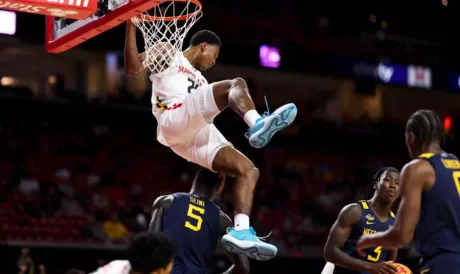
MORGANTOWN - In the old days - otherwise known as early in Tom Izzo's coaching career - what transpired in West Virginia's 90-81 overtime exhibition loss against Maryland on Sunday would have been met with the gridiron experience.
Putting it simply, when Izzo's Michigan State teams decided it wasn't enthusiastic about rebounding the ball or battling in the paint, out came the shoulder pads and helmets and his basketball players would look the part of gladiators in practice, banging into one another until the point was made.
WVU head coach Ross Hodge certainly wasn't pleased with his team's rebounding effort against the Terrapins, who came away with a 48-36 advantage on the glass. Half of Maryland's rebounds were offensive rebounds and seemingly so many of those came on missed free throws.
Those extra possessions led to 26 second-chance points and what seemed to be an early glaring shortcoming from WVU's roster.
"We just didn't execute well enough from a physicality standpoint in the second half," Hodge said. "That was the difference in the game.
Rest assured, Hodge said he wasn't expecting to make a withdrawal of shoulder pads and helmets from the WVU football team, but there would be plenty of work at toughening up his defense around the rim.
"Some of it is technique and some of it is the ability to play through fatigue," Hodge said. "That's a big part of it. It's a little easier to (block out) someone when you're fresh and you're fresh mentally. A big part of it is fundamentals and we'll practice those fundamentals. The other part of it is an attention to detail and your competitive stamina has to increase. As the game went on, their competitive stamina was able to keep going on and we didn't quite match that. It was a learning experience."
It would be easy to lay the blame at WVU forwards and centers, but there were other factors in play.
Among them: Maryland power forward Pharrel Payne is just that good. Payne, who missed most of last season with a leg injury, finished with 26 points and 13 rebounds. Of those 13, 10 were offensive rebounds.
Don't let Payne's size fool you. While he is a beast of a young man, he also has the ability to move like a point guard.
"He's a guy that you better hit him first," Hodge said. "We're not far from Baltimore here, so if you're a Ravens fan, you better hit (Derrick) Henry in the backfield before he gets a full head of steam. If he gets a full head of steam and you try to hit him, you're going to have major issues.
"It's no different with (Payne). You've got to hit him first and you better be the low man. If you don't, you're going to have problems. I don't know if there's a better offensive rebounder in the country at this point than Payne."
The other issue Hodge pointed to was WVU's overall defense. As the game wore on, Maryland had more success driving the ball out on the perimeter, which created a ripple effect.
"So much of offensive rebounding can be a product of not being able to keep the ball out of the paint with some physicality," Hodge said. "The first four-minute segment coming out of half time, I don't think our ball pressure and our defensive intensity was good enough. (Andre) Mills did a good job of driving the ball. Our defense collapsed and now you're not in great rebounding position to begin with and then you have to go and try and block out elite offensive rebounders."
WVU forward Mouhammed Sylla finished the game with just three rebounds, which isn't going to cut it. Hodge also pointed to his guards. Finley Bizjack had two rebounds. Miles Sadler had none.
"It's easy to put it on your forwards," Hodge said. "Miles played 27 minutes and didn't have one rebound. That isn't good enough. When the ball is bouncing around on the floor, you better go get it."
The final issue, and maybe what concerned Hodge the most, was there were too many moments when Maryland just seemed more interested in going after the ball.
"Then there's the other times where the game just broke you down so bad that a shot went up and you didn't even bother to look to find somebody," he said. "We have to reinforce good habits and lengthen those habits. It's a great way to learn from it. We can say, 'When you do it right, this is what happens. When you do it wrong, this is what happens.' "