
Remediation work to begin at White Hall at coal seam fire, mine subsidence site
Trending
WHITE HALL - This is the kind of shifting Jarrod Petersavage doesn't mind one bit, he said Monday.
"Well, they made a promise to buy my mom's place, and as long as that happens, I'll be happy."
Petersavage is referring to a certain ranch house atop Nellie Lane in the White Hall community near south Fairmont that suddenly found itself on shaky ground over the summer.
That's when the sloped front yard began a downward slide.
That's when cracks began appearing in the walls and foundation of the house Petersavage's mother bought two years ago.
She was going to move to West Virginia to be closer to her son and grandchildren.
Virginia Petersavage, 76, who still lives and works as a nurse in the family's native Pittsburgh, was readying for retirement.
Jarrod, an engineer, did extensive remodeling on the place and had just called his mother to tell her it was move-in ready - when the driveway began moving.
A subterranean coal seam fire that has plagued Nellie Lane and the surrounding area for decades is believed to be the ultimate culprit.
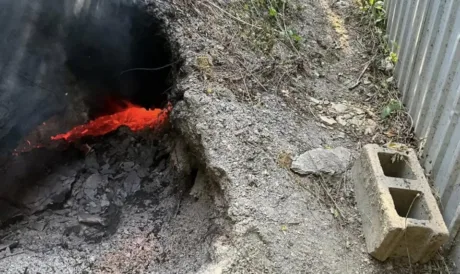
The incendiary simmering broke through again in July 2025 when neighbors and business owners reported seeing smoke tinged with sulphuric odor.
Flames could be spied from a fissure at the corner of the parking lot in one of those businesses, and the volunteer fire crew responding to the call recorded temperatures of up to 700 degrees Fahrenheit, which is hot enough to melt lead.
More than 1,000 gallons of water, plus layers of flame-retardant foam knocked it back - but only for about 30 minutes.
Cutting back trees and vegetation as a way to prevent the danger of a brush fire or forest fire didn't help, Petersavage said.
The latticework of old-growth root systems anchoring the hillside, he said, are now forever gone.
And that means the terrain is now forever subject to erosion from heavy rain, snows and freeze-and-thawing cycles, he said.
In the meantime, construction has begun on a retaining wall at the crest of the Petersavage home and another neighboring residence - which Guy Ward said should have commenced months ago.
Ward, a member of the House of Delegates and former White Hall mayor, began contacting the state Division of Environmental Protection and its Abandoned Mine Lands arm, looking for some relief for the residents as the earth began to go.
"The DEP just needs to buy the houses and start over," he told The Dominion Post previously.
Which may be happening.
Thaxton Construction of Charleston submitted the winning $11.6 million bid two weeks ago for the retaining wall project.
Heavy equipment began rolling up last week for the work, which should take around 90 days to complete.
And Thaxton, Petersavage said, has already made a "tentative" promise to buy his mother's house.
"We're hopeful," he said. "We'll see what happens."
According to DEP archives, the coal fire is believed to have originated in the former Kuhn Mine No. 1, one of many coal operations dotting the area during the industry's boom years.
The Kuhn Mine was tapped into the Pittsburgh coal seam, which is layered beneath 53 counties in three Appalachian states.
With that geology, Ward is not 100% hopeful, he said, of the flames being extinguished anytime soon.
Coal seam fires - long-burning coal seam fires - are common in Appalachia and other places where the energy is extracted from the earth.
One such fire in now-abandoned Centralia, Pa., has been smoldering since 1962.
Another underground fire in Boulder County, Colo., was finally extinguished in January 2025 - after burning for 100 years.