
A hive of activity: ‘Bee Lady’ advocates for honeybee education in Mon County
Trending
MORGANTOWN – Jennifer Turner, Mon General nurse and Monongalia County Fair Board president, never thought she would be best known as the “Bee Lady” when she saw a live demonstration at the fair four years ago.
"They had a gentleman come and he did what they called a 'bee beard,' so he took the bees and put them on his face," she said. "I was just blown away. I thought that was the neatest thing, and I was like, 'Okay, this is something I can get into.'"
Turner is Morgantown born-and-raised and is the operator of Hasenpfeffer Farms, a rabbitry and livestock farm. She met with Mike Lamp, West Virginia Beekeeping Association President, to mentor her on the new craft.
"Typically, each brand-new beekeeper will have a mentor to help them through the process because there's definitely a learning curve. It's not something that you pick up," she said.
She took classes through Mission Beelieve, a veterans and first responders beekeeping organization, to continue improving, even after losing a hive that first winter.
"That first year, you really don't know what you're doing, and so over winter, I learned what I did wrong, so that's when I was like, 'I'll do whatever to start fixing this process,'" she said.
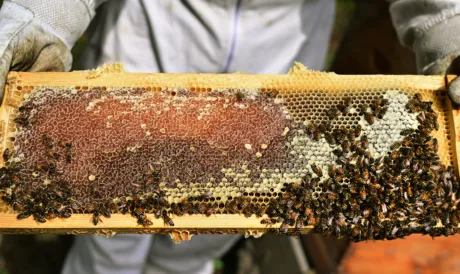
Years later, Turner is now a proponent of honeybee education and hopes to spearhead a permanent apiary at the Monongalia County Fairgrounds to encourage agricultural entrepreneurship for students and community members.
Through her self-education process, Turner learned about the lifespans of honeybees and the importance of their work in our ecosystem.
"If we don't have bees, honeybees and different pollinators, we don't survive. That's what makes our food. That's what pollinates our fruits, all our vegetables, pollinates our trees....We don't have them, we don't live," Turner said.
Last year, 1.6 million honeybee colonies, or 62% of commercial bee hives, were lost between June 2024 and March 2025. According to the West Virginia Department of Agriculture, the state alone lost 40% of its hives from 2024 to 2025.
Turner stressed that unpredictable West Virginia weather, varroa mite infestation, farm pesticides and genetic disabilities are responsible for these statistics. To keep home hives safe, she stressed that beekeepers have proper insulation blankets for winter, alter their food supply depending on the season and inform your neighbors about spraying pesticides.
The Monongalia County Beekeepers Association, Mission Beelieve and the West Virginia Beekeepers Association are asking for grants to establish an apiary at the new, permanent Monongalia County Fairgrounds at 72 Adena Drive. Their goal is to plant six traditional Langstroth hives by spring 2027.
The initiative will provide hands-on learning to local FFA members, students and Morgantown residents about beekeeping, pollination, environmental changes, hive management, harvesting, new technology, improving survival rates and marketing hive products.
Products include bow wax, candles and, of course, honey. As a wound nurse practitioner, Turner sees firsthand the recovery powers of honey.
"It helps heal the wounds through natural properties of what bees make," she said. "I use it in my day world as a treatment for my patients, but I use it in this world just for fun because I want to learn more about it."
Turner hopes the apiary will be beneficial for local tourism, in addition to education, career development and honeybee sustenance. She is proud to be a part of the initiative and make beekeeping education "part of her legacy."
"We're going to go out of this world the same way we came in. We're going to take nothing with us. What we leave behind is our memories. The other thing we leave behind is our legacy," she said. "I want this to be part of my legacy."
For more information about the Monongalia County Fair and upcoming education programs, contact Monongalia County Fair at info@moncountyfair.org. Keep up with Turner and Hasenpfeffer Farms on Facebook.