
House Republicans summon Flock Safety to hearings in November
Trending
CHARLESTON - Not satisfied with the information provided since August legislative interim meetings, Republican members of the House Government Organization Committee want representatives of Flock Safety to return to Charleston for questioning.
In a Monday letter sent to Flock Safety Chief Legal Officer Dan Haley, four members of the House Government Organization Committee – Chairman Chris Phillips, R-Barbour, and committee members Tristan Leavitt, R-Kanawha; Patrick Lucas, R-Cabell; and Ryan Browning, R-Wayne - invited Flock to send a representative to testify under oath next month when the House of Delegates gathers for its own set of meetings.
"In light of your commitment to meet at our convenience for an on-the-record briefing to the Committee, please plan for Flock Safety to testify under oath at our next public meeting, November 9, 2026, at 2 (p.m.) at the West Virginia Capitol," the lawmakers wrote.
In an Oct. 5 letter, the lawmakers threatened to use the committee’s subpoena powers to obtain answers to a series of questions submitted to the company in August and September following a meeting of the Joint Standing Committee on Government Organization during a legislative interim session where a Flock representative provided testimony to lawmakers.
Flock was given an Oct. 9 deadline to respond to the committee members. In a letter that same day, Haley pushed back on claims that it wanted to meet with lawmakers privately to answer written questions.
"Flock has worked in good faith to answer your questions," Haley wrote. "Before attempting another pass, I'd like to address a point of apparent confusion. We have seen public statements suggesting that Flock requested an 'off the record' meeting, or one held 'behind closed doors.' That was not our intent. We did not make any such request or set any such condition."
The GOP lawmakers referred back to statements made by Kevin Kane, the director of government affairs for Flock Safety, during the Aug. 9 legislative interim meeting, who offered several times to meet with specific joint committee members outside of the committee meeting structure to answer specific questions about its automated license plate reader and surveillance technology.
"'Briefing[s],' 'discuss[ing] further,' and 'sitt[ing] down together' are not ways this Committee would typically characterize public proceedings," the lawmakers wrote. "Given that you have still failed to provide in your letters information such as how many employees have ever been found to have improperly accessed customer data, what 'non-U.S. vendor' Flock Safety sends customer images to, and false positive data prior to July 2026 for license plate readers, please forgive our strong impression that Flock Safety was avoiding putting this information on the record."
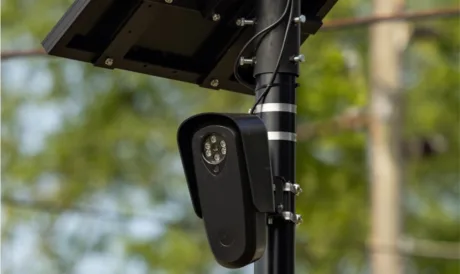
ALPR systems – such as those used by Flock, Motorola Solutions and Axon among other companies - utilize cameras and software to analyze motor vehicles and collect license plate information and other vehicle features. The systems, often mounted to utility poles, are used by several in-state law enforcement agencies, most recently with Monongalia County and Huntington contracting with Flock.
Georgia-based Flock has become the focal point of criticism by civil liberties groups, such as the ACLU of West Virginia and the libertarian law firm Institute for Justice. Opponents of Flock have pointed to critical vulnerabilities in its hardware and cloud architecture, undisclosed cybersecurity breaches, potential employee misuse of live surveillance streams, data sharing with federal agencies, foreign vendor involvement and historical accuracy metrics.
While Flock Safety maintains that its core cloud infrastructure has never been breached and uses the most robust security protocols, the House committee members have pointed to evidence of physical hardware vulnerabilities, leaked encryption keys, exposed device location maps and specific instances of employee access to sensitive customer camera feeds, such as playgrounds and youth sports facilities.
"Your letters have made no attempt whatsoever to answer this question," the lawmakers wrote. "Your witness(es) should answer this question in detail, including how many employees have ever been found to have accessed data outside authorized technical duties, how many have experienced any form of access revocation or reduction, how many have experienced personnel sanctions for such conduct, and how many have been terminated for such conduct."