
Benson discusses history, partnership with descendant of founding family
Trending
MORGANTOWN - George Washington was a teenager employed as part of a surveying party when he first laid eyes on the land that would become Jefferson County, West Virginia.
He was immediately struck by both the beauty and quality of the land, as well the abundance of natural resources.
So much so that he successfully encouraged his siblings to start investing in land, and, at 18, purchased his own tract of roughly 1,000 acres.
In the years that followed, the Washington family accumulated about 10,000 acres of modern-day Jefferson County, relocating their farmsteads from the Virginia tidewater - depleted by generations of tobacco farming - to the promise of the lower Shenandoah Valley.
In 1770, George's younger brother, Samuel, built a house. A decade later, another brother, Charles, followed suit, building his own home nearby and, in 1786, founding Charles Town.
Those two homes, Harewood House and Happy Retreat, respectively, are today the anchors of the Washington family presence in the eastern panhandle.
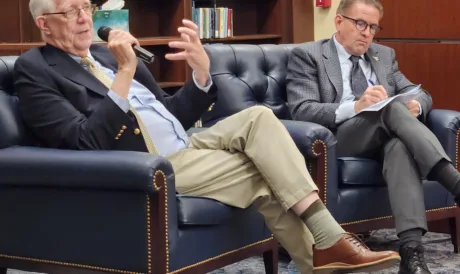
On Monday, Walter Washington, a direct descendant of Samuel and the current inhabitant of Harewood House, sat with WVU President Michael Benson to discuss America's preeminent Founding Father, his family's ties to West Virginia, and a partnership between the university and the preservation alliance working to make Happy Retreat an example of "accessible history" for years to come.
In 2015, the nonprofit Friends of Happy Retreat partnered with the city of Charles Town to acquire, restore and preserve Happy Retreat for public use.
As part of that collaborative effort, the city bought 10 surrounding acres to incorporate into a park while FOHR bought the mansion, outbuildings and two central acres of land to be restored for use as a center for history, tourism, scholarship and culture.
"I think it's important to be in a historic place to really feel it and get to understand it - get the dimensions of the house. I remember going to Williamsburg when I was growing up and you got a sense of how people actually lived there; the size of the yards, the way the streets ran. So, I think it's important to understand, you know, you can read about it in a book, but to actually go to a place and see where it happened is so important," Washington said.
Benson said the partnership with the university and Happy Retreat "will ensure access to history for future generations," explaining the Hardy Family Hospitality and Tourism Management Program, the Eberly College of Arts and Sciences Department of History, government relations and outreach and the office of the president will be involved.
“It is remarkable how much history is within our own state’s borders,” Benson said, later stating, “If you haven’t been to Charles Town, it’s like history on top of history on top of history, everywhere. For a historian, it’s like Christmas morning.”
Monday’s event, held in the Milano Reading Room located in Wise Library, was part of the university's celebration of America's 250th Anniversary.
It included displays featuring heirlooms tied to the Washington family, including a cookbook dating back to the 1840s as well as George Washington's surveyor compass and rules.
The discussion touched on everything from Walter Washington's thoughts on modern television and film depicting his famous ancestor, to what he holds as the man's most admirable quality.
"His perseverance. What he went through in that war - defeat to defeat to defeat," he said of Gen. George Washington's losing record in Revolutionary War battles. "It was just perseverance. Sticking with it. How he kept going through all of that, I have no idea."
He went on to say that he's always been profoundly moved by inspiration behind the Founding Fathers. He believes that is why the Washington surname is so commonly used both in the United States and around the world.
A brief Internet search suggests the name is carried by some 30 counties, 600 schools, thousands of roads, streets and boulevards, and one state in the U.S. alone.
"The Revolution, we take it for granted. But what an amazing accomplishment. To have a country without a king? Without aristocracy? To overthrow that whole system that everyone had lived in for centuries. We take it for granted, but it was pretty amazing back then," he said. "I think the fact that he sort of epitomized that accomplishment is, to me, the reason why."
The conversation also delved into the Washington family's ties to slavery.
Walter said there has been extensive research into the enslaved people at both his home estate as well as Happy Retreat. Through the national Coming to the Table initiative, Washington said he's hosted two gatherings of "linked descendants."
Continuing to tell that story for Happy Retreat, he added, is part of what he would like to see out of the partnership with WVU.
"It makes you realize, my home was lived in by two races for over 100 years. It was a complex relationship. It's something that needs to be dealt with and recognized and understood," he said. "It's part of the history of the family and the house."