
Ace Parsi: Congressional candidate holds democracy dear (while remembering what it’s like to live without it)
Trending
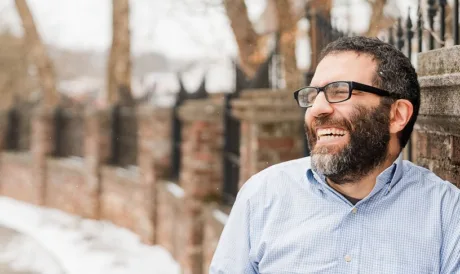
MORGANTOWN - Ace Parsi was a little, little boy then ... but memories are long.
He still remembers huddling with his parents and other family in windowless rooms in Tehran, when the very air outside would growl, with the ordnance of oppression.
Bombs.
Shelling.
The revolution.
He still remembers the lines of worry that etched his mother's face and his dad's, too, when they didn't realize he was watching.
His pro-democracy uncle was already in jail.
And his older brother was furtively awaiting inevitable conscription into the military.
In Pittsburgh, where the family eventually settled after fleeing the Iranian regime, his mother took in washing and sewing, before finding work as a caregiver for the elderly.
His father, who had been a computer programmer in Iran, got a job loading luggage onto the giant passenger jets at the airport, which was a backbreaker for a diminutive, middle-aged man, his son said.
His brother, who would have been a soldier in that endeavor to which the family was morally opposed, was bagging groceries - grateful for the minimum-wage paycheck that was a boon for the struggling household.
And Ace, who was 8 years old, undersized and without one word of English, was soon taken into the system, in a good way.
Neighbors and church groups helped.
Caring teachers in English as a Second Language programs gave him a new lexicon in his new country.
It was hardscrabble, and heartful, at the same time.
These days, you'll see him out and about in West Virginia - where he always speaks first.
He'll smile and extend his hand.
"Hi, I'm Ace Parsi. I'm running for Congress. Tell me who you are."
'YOU CAN'T BLAME THEM'
Parsi has been a familiar face in Morgantown for at least a decade, as an organizer and facilitator of forums and marches in the social justice and political arenas.
The candidate for West Virginia's 2nd Congressional District sat down with The Dominion Post on a rare, downtime morning last week.
Parsi, a 44-year-old Democrat, holds degrees from Penn State University and the University of California at Berkeley, where he was an AmeriCorps worker, which helped pay his way through graduate school.
After several years of organizing and laboring on policy issues from California to Washington, D.C., he and his wife settled on her hometown of Morgantown, where they decided they would build their lives following the birth of their daughter.
In Appalachia, the disenfranchised are easy to spot, he said.
Especially, he said, in the Appalachia of West Virginia.
That's why he announced his candidacy on Martin Luther King Day last year.
Said district takes in several north-central towns and rural counties, plus the metropolitan reaches of its Northern and Eastern panhandles, also.
Morgantown, Fairmont, Clarksburg.
Parkersburg, Martinsburg, Wheeling, Moundsville and Charles Town, too.
Places, he said, that can all claim, to varying degrees, of their best days now in the rearview mirror while wrapped in the gossamer gauze of aforementioned memory.
Voters next month will decide between Parsi, with his immigrant background from the war zone, and Riley Moore, the Republican from a political family here who is completing his first term in office.
Moore's grandfather was twice-elected West Virginia governor Arch Moore.
And his aunt (and the governor's daughter), Shelley Moore Capito, is a longtime Washington incumbent who currently serves as the Mountain State's senior senator on Capitol Hill.
While Parsi doesn't always name-check his opponent on the stump, he does draw on the above pedigree of privilege.
He makes note of what that may imply, in places such as West Virginia.
Especially, he said, when he rolls up to a roundtable or dinner or meet-and-greet - and someone else isn't there.
"This is why people are losing faith in our system and why you can't blame them," Parsi said.
"They've grown too used to big corporate interests that are buying their elected officials," Moore's challenger continued.
"And of those same elected officials," he said, "never showing up to answer their questions."
NEIGHBORS - NOT SERVERS
Parsi has already announced what would be his first piece of legislation if elected: The proposed "Neighbors, Not Servers Act" would directly take on data centers, a literally big byproduct of the digital age.
Data centers are those massive, AI storehouses with their own interlocking networks and infrastructure systems that require lots of land, and lots of electricity and water sources, given their geographic footprint.
With rural regions such as West Virginia suddenly coveted as choice, data center real estate, it's time - Parsi said - to get in front of the digital, boomtown mentality.
That's because the grid and the very environment here, Parsi said, simply can't handle the load.
"Neighbors, Not Servers," its legislative author adds, would put on hold the construction of any new data center requiring 20 megawatts of power - or more - to operate.
Developers proceeding in defiance of the moratorium, meanwhile, would face fines up to $1 million a day under the legislation, with additional penalties to any and all parties signing non-disclosure agreements to such construction.
"Real people need to have a voice in this," he said.
'I'M LIKE VELCRO'
Real people, real voices are the infrastructure of his campaign, he said.
He puts out a call for those stories on his official website, even, which is www.aceforcongress.com.
Parsi wants input from entrepreneurs, in his call to repurpose abandoned buildings in the Mountain State, for a 21st century recast of a blue-collar factory age, long gone.
As said, he desires to hear your story and what you may be thinking, for your vision of a new West Virginia.
"I've talked to thousands of people and that's no exaggeration," he said.
"I'm like Velcro with their stories - they stick with me," he said.
Parsi is constantly moved, he said, by what he calls "the inherent honesty and decency" of the West Virginians he's met on the campaign - even the ones who tell him straight-up they aren't voting for him.
"I always say, 'That's OK. I'm still going to support you, if I'm elected.'"
Parsi's main pledge if elected, at least one of many main pledges, is to never take a meeting with, say, a healthcare executive - without a local patient advocate in the room.
Or an agribusiness session, perhaps, without a working farmer from the 2nd district seated at the same table.
It's all part of the dialogue and discourse, he said, as he looks back - even if it is with a child's memory - of being in a place with no such ideals or foundations.
"American democracy is beautiful, but there's nothing that says it always will be," the candidate asserts.
"That's why I'm out here. It's a blessing to be able to do this."