
What’s blooming at the WVBG?
Trending
Fall is here, yet the blooms at the West Virginia Botanic Garden on Tyrone Road in Morgantown keep coming. It is the annual culmination of the season, dominated by members of the Asteraceae, including many of our native daisies, perennial sunflowers, and goldenrod. The coming fall colors will complement these blooms; it is a great time to get out in nature, take a long walk and energize the soul.
While our garden beds are still in bloom with zinnias, dahlias and more, the WVBG is also a place where nature is allowed to run its course. One of the best places to see nature in action is along our Pixie Cup Trail that bisects the former reservoir that provided Morgantown with water from 1920 to 1969. Today, the sandy soils along the Pixie Cup Trail support a great range of mosses, lichens and ferns. The dominant plant, however, is the sourwood, a slow-growing native tree.
Sourwood, Oxydendron arboreum, has narrow-toothed, glossy leaves that turn orange, yellow and red as it matures through the season, culminating in a rainbow of fall colors. Along the Pixie Cup Trail, it frames the setting. As you take in all the beauty, you notice the mosses, lichens and ferns.
The lichens include pixie cups and British soldiers, thus giving the trail its name. Both lichens are small in size and unique in structure. The team at the WVBG has included a custom-designed sculpture by Michael Loop, completed in steel, fiberglass and paint. At the other end of the Pixie Cup Trail, you will find a sculptural and functional bird blind created by Dylan Collins and Jo Nelson. Each adds an artistic yet natural element to a walk on this special trail.
Also blooming along the Pixie Cup Trail are some native perennials unique to the WVBG, one in the goldenrod genus Solidago, and another, an orchid.
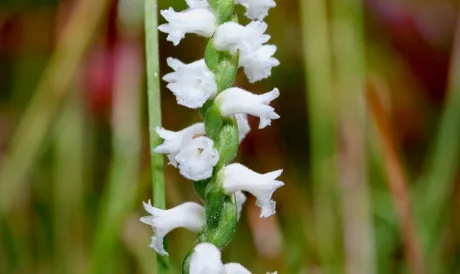
Solidago bicolor does not have golden flowers, but silver-white ones; it has been given the common name silverrod. With stalks raising about 1-2 feet, this member of the goldenrod genus has white blooms radiating along its stalk. The diminutive orchid, Appalachian Ladies' tresses, Spiranthes arcisepala, is just as unique. This small orchid has multiple bright white blooms that seem to be braided up its 6-inch stalks.
When the horticultural staff of the WVBG established the Pixie Cup Trail, they recognized the old basin was a very sensitive habitat, which you will see noted at the trail entrance. As always, stay on the trail and nurture nature with us at the WVBG. Check out more at WVBG.org and enjoy fall!