
Night of Recognition to celebrate survival, recovery and those who make both possible
Trending
MORGANTOWN - The WVU Medicine Jon Michael Moore Trauma Center will host its 15th Annual Night of Recognition on Oct. 15, at the Morgantown Marriott at Waterfront Place.
The annual event honors the first responders, healthcare professionals and community members whose work helps save and rebuild the lives of patients who experience traumatic injuries, like Aneesh Nagireddi and Jaxon Arbogast.
There are months of his life that Nagireddi, 19, cannot remember. For Jaxon, 14, there are moments he remembers all too clearly.
Their stories are different, but both ultimately led to WVU Medicine J.W. Ruby Memorial Hospital and the medical teams who helped to save their lives.
Missing time
One evening in May 2025, Nagireddi was returning home to Ashburn, Virginia, from college in Indiana with two friends when their vehicle crashed near the West Virginia-Maryland border.
He remembers the drive. He remembers being about an hour and a half from home. Then, nothing.
"It's almost like you're just sitting in a car and then there's a time skip," he said. "You just skip a season of episodes of a TV show. You don't know what happened."
Nagireddi arrived at Ruby Memorial's Emergency Department unconscious with a severe traumatic brain injury, including bleeding in multiple areas of his brain. He also suffered facial and spinal fractures and an arm injury.
Securing his airway was one of the trauma team's first critical challenges, and Nagireddi required mechanical ventilation while teams worked to stabilize his brain injury and address his other injuries.
James Bardes, M.D., the trauma surgeon who cared for Nagireddi, said treating a patient with injuries involving multiple parts of the body requires coordination among many specialties.
"Trauma is a team sport," Dr. Bardes said.
The teams involved in Nagireddi's care began with EMS, the Emergency Department, Trauma, and intensive care. Specialists from Neurosurgery, Plastic Surgery, and Orthopaedics worked together to decide which injuries needed to be addressed first.
Nagireddi has little memory of his two weeks in intensive care. Despite the severity of his injuries, "WVU Medicine did a great job of just making me not realize there was anything at all," he said.
Getting back up
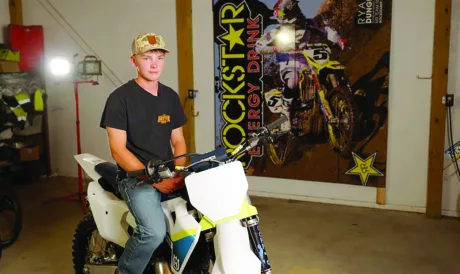
For Jaxon Arbogast of Carmichaels, Pennsylvania, being outside and staying busy has always been part of life. So have dirt bikes.
In May 2025, Arbogast crashed while riding, breaking his wrist and collarbone. He was treated at WVU Medicine Golisano Children's Hospital and released the same day.
During that first visit, members of the pediatric trauma team talked with Arbogast about dirt bike safety, including the importance of wearing a helmet. He recovered, saved money from working with his father, and bought another bike.
That July, after spending a hot summer day working with his father, Arbogast met up with friends to ride trails near his home. While riding down a road, he hit a sewer cover, lost control, and struck a mailbox.
Arbogast immediately knew this accident was different than the last.
"I thought I was paralyzed," he said. "I couldn't move my legs at all or couldn't move my back or anything."
But this time, Arbogast was wearing his helmet.
His friends called 911. A responding police officer stayed with Arbogast and called for a medical helicopter. Jaxon was transported by ambulance to the landing area and then flown to Golisano Children's.
Patrick Bonasso, M.D., pediatric surgeon and pediatric trauma medical director, believes Arbogast's helmet may have saved his life.
"It was that conversation when he was in the Emergency Department the first time to wear a helmet," Dr. Bonasso said. "He actually had it on the second time, and it potentially saved his life."
Jaxon suffered serious injuries, including fractures of his pelvis, femur, and a severely damaged artery in his lower leg. His parents, Whitney and Travis Arbogast, were told his bones could be repaired, but infection remained a major concern.
"A big team helped take care of that first night," Bonasso said.
Travis said confidence in the team helped ease some of the uncertainty.
"It was definitely reassuring when the doctors came in and said, 'Hey, this is what we got, this is what we're going to do,'" he said. "You believe in them because it's your son's life in their hands."
Arbogast spent about two weeks in the hospital. When he returned home in a wheelchair, that eventually gave way to crutches, which eventually went away, too.
A chance to say thank you
For both families, the Night of Recognition is an opportunity to reunite with people who entered their lives under circumstances none of them expected.
Nagireddi continues to return to WVU Medicine for follow-up appointments, and when he does, he makes a point of visiting the people who cared for him, including nurses he doesn’t remember meeting the first time.
The Arbogasts share that gratitude to the teams involved, from the first responders who reached their son on the roadside and the flight crew that transported him to the teams waiting when he arrived at Children's.
Nagireddi has returned to college, and Arbogast is back to the active life he loves. Both will take center stage at this year's Night of Recognition to celebrate life and the care that brought them to WVU Medicine.