
Capito hits campaign trail after wins on permitting reform, NIL
Trending
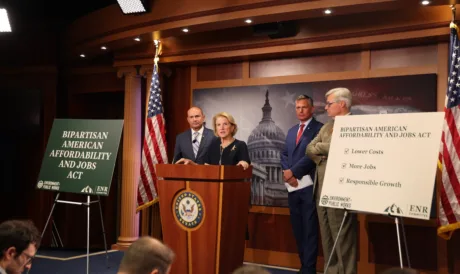
CHARLESTON - The U.S. Senate adjourned Wednesday night for a recess prior to the Nov. 3 midterm general election, with Sen. Shelley Moore Capito hitting the campaign trail with a pending deal on permitting reform and the passage of the college athletics bill.
After months of bipartisan negotiations between Republican and Democratic senators and the White House, Capito and lead negotiators announced a deal on language for a permitting reform package that will be considered by the Senate when they return after Monday, Nov. 9.
"This is a major step towards making it faster and more efficient and easier to build infrastructure projects, certainly without giving up any of the strong protections for our environment,” said Capito, R-W.Va., during a press conference Wednesday.
H.R.2347, the Survivor Justice Tax Prevention Act will be the legislative vehicle for the permitting reform package when lawmakers come back to Capitol Hill next month for a lame-duck session of Congress. The package is being called the Bipartisan American Affordability and Jobs Act.
This bill introduces systemic reforms to key statutes, including the National Environmental Policy Act, the Clean Water Act, the Endangered Species Act and the National Historic Preservation Act, alongside specific directives for electric transmission and energy leasing.
Capito, the chairwoman of the Senate Environment and Public Works Committee, said the legislative framework is designed to modernize federal environmental reviews, streamline infrastructure permitting, reduce economic costs and accelerate project deployment across energy, transportation, water and commercial sectors.
"For far too long ... America has had a permitting system filled with delays, expenses, red tape, uncertainty, you name it. ... And we’ve seen projects that should be finished more quickly, going decades, and even worse," Capito said. "The way I look at it is we are meeting the moment. We cannot meet this moment with a permitting system that is stuck in the past. The status quo will not hold."
The Senate negotiating team included Capito, EPW ranking member Sheldon Whitehouse, D-R.I.; Senate Energy and Natural Resources Committee Chairman Mike Lee, R-Utah; and ENR ranking member Martin Heinrich, D-N.M.
"The agreement we’ve reached today represents something that has become increasingly rare in Washington: Republicans and Democrats sitting down, identifying a problem, and, in this case, a problem that has festered for at least a decade and more, that impacts all Americans, and for us to sit down and work together to solve it," Capito said. "The American people sent us here to do big things, to really take the big steps. This is a big thing. It’s monumental, and it’s legacy setting."
Among other things, the package establishes a one-year statutory deadline for environmental assessments and two years for environmental impact statements, modernizes the National Environmental Policy Act permitting process, limits certain Clean Water Act restrictions, reduces Endangered Species Act consultation timelines from 90 to 60 days, limits how federal agencies can revoke or suspend projects with valid permits, gives the Federal Energy Regulatory Commission the authority to approve certain transmission line permits, and standardizes a 150-day statute of limitations across NEPA, CWA, ESA and NHPA claims.
The permitting reform package still must get to 60 votes to be fully considered in the Senate and has a more difficult path in the U.S. House of Representatives during the lame-duck session between November and December. But the deal received praise for bridging divides between Democrats and Republicans.
"This bipartisan permitting reform bill is better than I could have expected," said Xan Fishman, vice president of energy at the Bipartisan Policy Center. "This bill would fix our permitting process so that we can review and build efficiently, reducing costs, improving quality of life, growing our economy, and improving environmental outcomes. It's truly a win-win."
Earthjustice Action President Abigail Dillen released a statement Thursday that praised the deal for including provisions on electric line transmission and grid modernization, but said other parts of the bill make unacceptable trade-offs.
"This bill would further incentivize and entrench dependence on gas at the expense of cheaper, cleaner resources. And it would leave communities facing more polluting infrastructure with less influence over decisions that bear very directly on their health, livelihoods, and future," Dillen said. "It eviscerates bedrock protections for water, wetlands, endangered species, and the most basic expectations for transparency and responsible environmental analysis. And it does all of this in the most anti-environmental administration in modern history.”
Earlier this week, the Senate passed S. 4668, the Protect College Sports Act, of which Capito was a co-sponsor. The act passed in a 77-22 bipartisan vote.
The bill, which now heads to the House, would set standards for name, image and likeness rights for college student athletes, establish a public database, and mandate disclosures for substantial endorsement deals. The act introduces standardized national rules for athlete mobility, restricting players to a single uncontested transfer before requiring a sitting-out period. The bill also requires universities to provide extended medical coverage, mandates catastrophic injury funds and protects the continuation of women’s and Olympic sports.
"I have been proud to support the Protect College Sports Act and this effort to bring structure and stability back to college athletics," Capito said in a statement Tuesday. "This legislation serves as an updated playbook to repair a fractured system by preventing the exploitation of student athletes, holding agents and coaches accountable, providing certainty through needed guardrails, and putting education first."
Capito, who marks 25 years in Congress this year after first being elected to the House in 2001, is seeking re-election to a third six-year term in the Senate, where she also serves as the fourth ranking member of Republican leadership. After winning her May GOP primary by a landslide over state Sen. Tom Willis, R-Berkeley, Capito faces Democrat Rachel Fetty Anderson, a Morgantown attorney and former city council member, in November.