
Annual Native American heritage event proves ‘peace is a possibility’
Trending
MORGANTOWN – In a world of Division, Equity and Inclusion controversy and partisan politics, Max Flomen, West Virginia Native American Studies Program coordinator, is asking for harmony.
"Peace is critical to humanity's survival, regardless of anyone's background or politics or feelings about the sort of issues of the day," he said. "The question of peace and how to bring people together and create peace, not just in a diplomatic, United Nations sense, but peace between individuals and communities speaks to everyone of all ages, all times, all cultures, all backgrounds."
Flomen, along with professors, students and Morgantown residents gathered to honor this concept at the 34th annual Peace Tree Ceremony.
The event began with West Virginia University's land acknowledgement statement, read by junior and Weirton-native Kiana Luevano, who is Native American Studies minor.
The speech was followed by Danny Trejo, Morgantown Human Rights Commissioner director, who sang the "Lakota Four Directions" song to ask for a message from "Grandfather" or "The Creator."
Flomen took to the podium to explain the history of the original Peace Tree planting, which took place over 600 years ago in north-central New York, according to ancient Haudenosunee oral tradition. The tree served as a mediator to unite the Seneca, Cayuga, Oneida, Mohawk and Onondaga tribes, who formed the Haudenosaunee Five Nations Iroquois Confederacy.
Flomen explained that prior to the tree planting, the world was filled with "conflict," "destruction," and "intense division between communities." This led to the miraculous birth of Peacemaker "Tekanawita," who devoted his life to sharing the "Great Law of Peace" and bringing together the five nations based on three pillars: justice, health and responsibility.
Flomen praised the Peacemaker's devotion to forgiveness and his power to gradually unite the people, despite decades of conflict between tribes. He is proud to continue telling Tekanawita's story today.
"The power of this condolence ceremony is basically to clear people's minds and clear people's eyes and clear people's hearts, so that they're finally able to come to a place, an emotional state, in which they are able to forgive themselves for what they've done, and also be in the process of forgiving others for what they may have done to them," he said.
WVU's Peace Tree was planted on Sept. 12, 1992, on the 400th anniversary of Christopher Columbus' voyage to the Americas, or Indigenous People's Day.
In 1996, the tree was vandalized and cut down, but quickly replaced in October of that year. The tradition has continued ever since, with a new, annual keynote speaker.
This year's guest of honor was Professor Cedric Woods, founder of the Institute of New England Native American Studies at U-Mass Boston and a member of the Lumbee Tribe of North Carolina. Woods reiterated the Peacemaker's strength to rely on his faith during tumultuous times, not dissimilar to today's society.
"As I stand here today before this Peace Tree, it resonates with me those same themes. Out of a time of chaos, warfare, confusion, an enlightened being, 'Peacemaker,' was called forward, was trained, prepared to do very hard work to create peace and establish justice out of disorder out of confusion," he said. "I think some of that may resonate with us now."
Wood discussed his calling to serve, meeting with tribes across the United States and being welcomed with open arms. He noticed a universal theme of respect, reciprocity and relationships across the Native American communities.
He urged the crowd to observe the tree as a symbol of perseverance over animosity.
"The tree was planted in a good way. It was cut down by vandals, those who did not value peace. But, it was replanted because the commitment to peace is stronger than that commitment to hate or to ignorance or to misunderstanding," he said. "I want to encourage you to look at this tree, to look at one another, and to recognize and to be renewed in spirit and in heart and in mind that peace is a possibility. It is a choice, and it's also hard work, but I am convinced that we are equal to that."
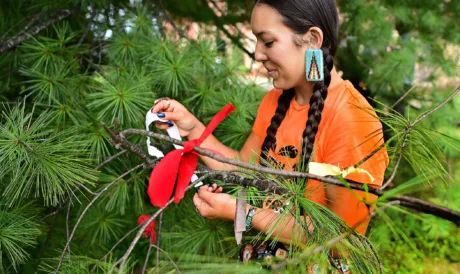
The crowd scattered sacred tobacco and tied ribbons on the tree at the conclusion of the ceremony.
Ellesa High, retired WVU English professor and founding member of the university's Program for Native American Studies, has attended the ceremony yearly since 1992. She said she views the tree as being a safe haven for good-natured people and the epicenter of campus.
"I think of this being the heart of campus, at least the downtown campus, and at the center of that is planted 'The Tree of Peace,'" she said. "Students can think of this as their home, and so anytime they felt stressed or missing home, they could come and get shelter under the tree."
She is proud to see the tree's growth as a symbol of how Native American culture respects their elders. She hopes to continue to return to campus for as long as possible.