
Reliability vs. Affordability: Regulators hear opposing visions for West Virginia’s energy future
Trending
CHARLESTON - A packed hearing Monday before the West Virginia Public Service Commission saw two different arguments presented regarding proposed rules dealing with coal-fire power in the state connected to the 2025 bill meant to attract data centers.
The Public Service Commission (PSC) held a public comment hearing Monday morning at its downtown Charleston headquarters over proposed rules required by House Bill 2014, the Power Generation and Consumption Act.
While the bulk of HB 2014 – introduced on behalf of Gov. Patrick Morrisey and passed by the Legislature in 2025 - deals with the creation of data center districts and microgrids that some data center projects might utilize, part of the new law requires the PSC to develop rules for coal-fired electric generation capacity.
The West Virginia Legislature amended (State Code), which added certain requirements regarding the regulation of electric generating capacity and provided that the Commission proposed rules regarding those new requirements," said PSC Chairwoman Charlotte Lane at the start of Monday's hearing. "We’re on a pretty tight time frame to get an order out with our rules."
Some of the proposed PSC rules include requirements for electric utilities with coal-fired power plants to maintain their thermal baseload generating units in order to achieve a minimum 69% capacity factor calculated over a 12-month rolling period, provided doing so does not increase rate charges above published electric tariffs.
The PSC issued an order several years ago that set an expectation that coal-fired power plants need to achieve at least a 69% capacity factor in order for in-state electric companies to self-generate power and reduce reliance on purchased power, though that capacity factor was never mandated. Some Republican members of the state Senate attempted during the most recent legislative session to make this a mandate, though the GOP-led House of Delegates rejected these efforts.
The 69% capacity factor requirement is supported by the West Virginia Coal Association, who submitted written comments to the proposed rule. West Virginia Coal Association President and CEO Chris Hamilton called the proposed rules an important "first step" in to ensuring coal-fired power plants operate at the levels they are designed to operate, improving efficiency and stabilizing electric prices.
"Previous proceedings before the PSC and other agencies have provided abundant evidence that coal-fired generating assets were not utilized to the maximum benefit of ratepayers, impacting not only utility bills but also the general economic health of surrounding communities, the mining operations that supply fuel to the plants as well as the workforces of both, Hamilton wrote.
"With the passage of HB 2014 the West Virginia Legislature and the Governor clearly articulated their intent that the state's coal-fired power plants be upgraded and operated at the highest capacity factors," Hamilton continued. "Finalization of the proposed rule, and including provisions regarding required upgrades, will move the PSC closer to fully implanting HB 2014."
The 69% capacity factor rule is also supported by the United Mine Workers of America, who brought 11 members to Monday's hearing. Brian Lacy, UMWA District 17 vice president, said setting a concrete goal for coal-fired power plants to meet would help keep coal miners working.
"West Virginia’s coal-fired power plants provide much more than electricity. They support power plant employees, coal miners, transportation workers, maintenance crews, contractors, and many other workers and businesses throughout our state," Lacy said. "I urge the Commission to consider regulations that protect these livelihoods by allowing existing coal-fired power plants to continue operating at their maximum capacity."
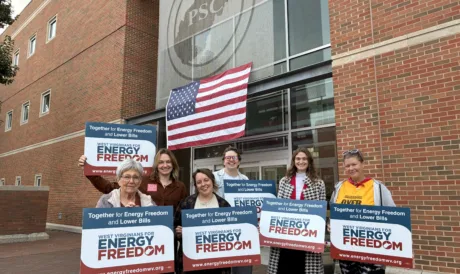
But not all of Monday's public speakers supported the 69% capacity factor. Prior to the hearing, representatives of West Virginians for Energy Freedom held a gathering outside of the PSC building raising concerns that operating coal-fired power plants at higher capacities versus allowing PJM to dispatch the power it needs from the least costly sources would force ratepayers to shoulder the burden while also facing higher rates of air pollution.
"West Virginians need reliable electricity, but reliability and affordability have to go together," said Leah Knicely, an organizer with West Virginians for Energy Freedom. "... These proposed rules could encourage utilities to run their own power plants even when less expensive, reliable electricity is available elsewhere. When that happens, those additional costs can ultimately fall on the people who pay the bills."
"The PSC must protect customers instead of exploitative utility companies from unnecessary power generation costs and reject rules that encourage plants to operate at a loss," said Lani Wean, the West Virginia field organizer for Mom’s Clean Air Force, during her testimony Monday.
"West Virginia families and ratepayers are asking the PSC to use its authority to protect the public interest, protect customers from more unnecessary costs, support reliable electricity, and ensure the decisions about our energy future account for the pollution and health impacts of families and communities as we are being asked to bear them," Wean continued.
According to the U.S. Energy Information Agency, the average capacity factor for coal-fired power plants nationally is between 42% and 50%. PJM typically dispatches the energy it needs for the regional grid based on the lowest cost source, which is often nuclear, then natural gas, and then coal. According to a 2025 analysis by financial firm Lazard, coal-fired power costs consumers $122 per megawatt hour compared to $78 per megawatt power or natural gas.
Rebecca McPhail, president of the Gas and Oil Association of West Virginia (GO-WV), also raised concerns about the 69% capacity requirement and urged the PSC to not implement any rules that unfairly benefited coal over other forms of energy, such as natural gas-fired power.
"We believe there’s a seat at the table for everybody. Instead, we just don’t think that regulation should put its thumb on the scale of the market," McPhail said. "Those choices should be judged by reliability and cost to consumers while leaving room and providing an open door for new investment in the state."
Dani Parent, the executive director of West Virginia Citizen Action Group, agreed.
"The Commission’s rules should not encourage plants to run when cheaper options are available," Parent said. "No single resource should receive special treatment, especially not if it costs customers more money. Coal, natural gas, renewable energy, battery storage, and energy efficiency resources should all have to compete to serve customers at the lowest cost."
Other proposed PSC rules would require detailed reports from electric utilities, including monthly dispatch reports, coal inventory level reports, and reports 28 days prior to submitting capacity bids to PJM Interconnection, the regional grid that serves West Virginia and 12 other states and Washington, D.C. Randy Feucht, the director of regulated commodity sourcing for FirstEnergy subsidiaries MonPower and Potomac Edison, said these requirements would be hard to meet.
"The requirement to have that 28 days in advance is difficult," Feucht told commissioners. "There are many, many layers of approval that we need to work through before our offers are submitted. I know how tight our executive schedules are, and it would be difficult to have all those meetings 28 days in advance. Many times, we are fine-tuning right up to the days prior to the auction."
The PSC ordered that any amendments to their proposed rules be filed with the commissioner by Monday, Oct. 5.