
Come rain or shine: Anderson campaign highlights discontent with Capito’s record
Trending
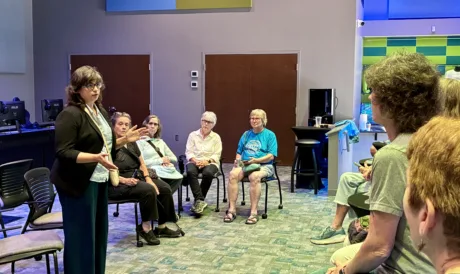
CHARLESTON - It was a rainy day on Charleston's West Side, but that didn't stop a group of largely women volunteers from coming out Wednesday afternoon to meet Rachel Fetty Anderson, the Democratic challenger to Republican U.S. Sen. Shelley Moore Capito.
Meeting at The Element Edge, a community empowerment hub created by Element Federal Credit Union, Anderson laid out a vision for her campaign against Capito, who has been in Congress for 25 years and is West Virginia's senior senator, completing her second six-year term after succeeding former Democratic senator Jay Rockefeller in 2015.
Anderson understands the stakes, challenging an incumbent Republican from an entrenched political family with significant support from corporate political action committees.
"I know that I’m the best candidate to represent the State of West Virginia because I live here," Anderson said after Wednesday's meeting with campaign volunteers. "My kids live here. I send my kids to their schools. I go to the hospitals. I see the doctors. I work with men and women and children all over every day. And I am committed to doing that, and I haven’t been bought out by anybody else."
Capito's most recent campaign finance report filed with the Federal Election Commission shows her with more than $4.3 million in cash on hand. More than $2.7 million of the more than $5.9 million in contributions raised election year-to-date came from PACs and other political committees.
In comparison, Anderson has raised $49,913 in total contributions to date while only taking $100 from the political committee of Eleanor Chavez, a Democratic member of the New Mexico House of Representatives. Anderson told volunteers during an hour-long meeting Wednesday that she has sworn off accepting PAC donations or donations from groups advocating for foreign nations, such as the American Israel Public Affairs Committee.
"We’re running a very unusual (campaign)," Anderson told volunteers. "The bold move that we made was to run without corporate financing and industry financing and funding from any group that is supporting a foreign government. ... We’re really excited, but we understand the responsibility of that. ... Because to us, the most important part of the campaign is you.
"The challenge is explaining to people that they have a choice, that they have a choice even just to elect somebody who just works for them instead of a corporation. To me, that’s a big deal," she said. "I don’t want somebody who raises millions of dollars from a corporation anymore. I don’t want it. I don’t want to have a senator who is the best senator for another country. I don’t want that. I want the best senator for the State of West Virginia."
Anderson is an attorney and a former Morgantown City Council member who still sits on the Morgantown Civilian Police Review and Advisory Board. Her legal practice has involved representing children, victims of domestic violence, students with special needs, parents in custody cases and recipients of Medicaid, Medicare and Social Security. Anderson and her husband have four adult children, including an adopted foster child and a nephew they raised.
During the May Democratic primary, Anderson came in first in a five-person race which included former state Senate President Jeff Kessler, whom she beat by more than 5,700 votes. Anderson received 33.2% of the vote, or 30,930 total votes, according to the Secretary of State's Office and carried the lead in 28 out of 55 counties.
By contrast, Capito received 80,376 votes in her six-person primary, carrying 66.5% of the vote. Her closest competitor, state Sen. Tom Willis, R-Berkeley, received 18.9%. But Anderson did not have to contend with a closed primary, being able to receive votes from registered Democrats and those with no party affiliation.
Anderson is hoping the frustration of independent voters - now the state's second largest voting bloc behind registered Republicans - will bring her new voters wanting to see a change in their congressional representation.
"What we got to see on our end was that there’s a tremendous hunger for a say-so over who is going to govern me in the future," Anderson said. "Who has my values? It is a specific value set if you vote for me? ... We’re really focused on families, making sure that this is a place where our kids can live and do more than survive."
Anderson has a platform she is presenting to voters focused on working-class empowerment, public accountability, and human-centered governance. She is a supporter of single-payer healthcare and rolling back changes to Medicaid and the Affordable Care Act put in place by the One Big Beautiful Bill Act, which Capito supported.
"We just cannot handle cuts in Medicaid. We cannot handle people getting kicked off the ACA," Anderson said. "We’re in the thrall of health insurance corporations, and people cannot afford it. You cannot afford it here. You can’t tell people, well, you’re going to make less than anybody else in the country. And oh, by the way, you’re lazy because you can’t pay your health care insurance. This is impossible."
Highlighting that West Virginia ranks 51st in median income and teacher pay, Anderson attributes low wages to right to work laws, union suppression and corporate deregulation. She supports strengthening labor unions and raising wages so young people can afford to stay in the state.
"What I believe has happened to us over time is that our leadership has consistently voted away our wages, voted away our union representation, given away our capacity to organize and basically trampled on our constitutional rights under this mythology that somehow folks who are poorer, less organized and less able to make a living will somehow be more attractive to corporations and industries then to hand down jobs," Anderson said.
"That just can’t be true. Because if we look at the hot spots all around us that are constantly luring our kids out of the state ... it’s always for higher wages. It’s always for a better standard of living. It’s always for better schools," she continued. "So, I think at the heart of our problem is that our wages are too low, and that’s because of union suppression, and that’s because of just the horrific things that industries have done here under this Right to Work Act."
Handing out postcards and posters that show a data center octopus and its tentacles gripping the state, Anderson opposes the fast-tracking of data center legislation that removes local county authority. She criticizes the use of eminent domain for power transmission lines and rejects the use of artificial intelligence to replace human workers or erode privacy.
"The president issued an executive order three days after he was elected," Anderson said. "The State of West Virginia passed this law in April (2025) ... And then voila, you have a data center being built in your county, right? And there’s very little you can do to stop it. We have to stop that right now because once these data centers are built, they are there."
Anderson identifies clean water, education and healthcare as the essential priorities for West Virginia communities. She also argues that taxpayer dollars should fund domestic needs - such as Social Security, infrastructure, and public services - rather than foreign military conflicts, spyware overreach, or corporate tax breaks.
The volunteers with Anderson's campaign were mostly members of the Kanawha County Democratic Women, but most had positive things to say about Capito's tenure in the U.S. House and her early Senate years. Their main criticisms of Capito have been going along with President Donald Trump's second-term agenda and not speaking out against the president's controversial decisions, such as tariffs and the Iran war.
Anderson urged her supporters to not count out any voter. Acknowledging the low voter turnout in the May primary, which was 21%, Anderson said to think about those voters as non-violent protesters.
"If non-voting is non-violent protest, we have about 60% of West Virginia protesting," she said. "They are protesting because they don’t think there’s any difference between the parties. They don’t think there’s any difference in the outcome. And they don’t think that it’s going to affect their lives in a way that’s meaningful enough to get them out the door."
Win or lose, Anderson told her supporters that getting out and engaging with voters and making her case has made her happier than simply staying at home and doing nothing. She hopes her happiness spreads to voters who then head to the polls knowing they have a choice to make in November.
"I am so much happier since I started running for Senate because I don’t ever have that helpless feeling," Anderson said. "I don’t ever have that sad feeling like I’m doing nothing and nothing can be changed. Oh no, I’m 100% sure that I am doing a lot. I’m doing everything I possibly can to make the world better for myself and my kids and my community and my state.
"People who are engaged are happier. They will vote," she said. "They will vote when they believe that we can make a difference and that we’re putting up candidates that are fighting to make a difference, fighting to make things better for them. So, somehow, we just have to convince them that that’s the case."