
A desire for ‘trusted messengers’: The future of local news explored
Trending
MORGANTOWN – Local news in West Virginia and the United States has changed for good.
Forty percent of all newspapers have disappeared in the last 20 years, accounting for at least 50,000 jobs, and there are 50 million people living in "news deserts" across the United States, according to West Virginia Broadcasting Hall of Fame member Hoppy Kercheval.
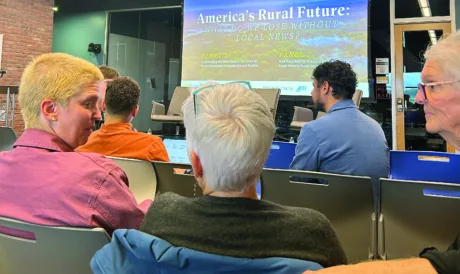
West Virginia University professors and students, government officials and journalists came together to discuss these statistics and the future of localized news outlets in small town America at "America's Rural Future: What do we lose without local news?" The event took place Wednesday evening at the Media Innovation Center on WVU's Evansdale campus.
WVU, as well as The Brookings-AEI Commission on U.S. Rural Prosperity and Ogden Newspapers, sponsored the event.
The first panel, "From News Deserts to Democratic Deficits: What Rural West Virginia Reveals about America," was moderated by Kercheval. He spoke to Professor of Journalism and "100 Days in Appalachia” co-founder Dana Coester, Charleston Mayor Amy Goodwin and Chris Stirewalt, senior fellow at AEI and host of 'The Hill Sunday' on NewsNation.
Panel two, "Rebuilding Local Information Ecosystems: Innovation and Resilience in Appalachia," was moderated by Stirewalt and included anecdotes from Ordinary Times managing editor Andrew Donaldson, West Virginia Watch Investigative Reporter Amelia Knisely and the director of Policy for Rebuild Local News, Matt Pearce, who discussed which directions they believe news is heading.
Coester discussed the trajectory of newspapers statewide and nationally in the last two decades.
"We used to have much more robust weekly and dailies in counties all across the state," she said. "They have been closing down. We had efforts to help weeklies and dailies transition, but that has not been successful, and a lot of them are closing down as the families who own them are aging out, and younger people don't want to take them up."
According to the West Virginia Secretary of State's Qualified Newspaper List for Fiscal Year 2027, there are 69 newspapers in the state. A "Qualified Newspaper" is defined as allowed to publish legal advertisements under West Virginia Code § 59-3-1. Of those 69, there are 15 daily papers and 54 weekly papers in the state for Fiscal Year 2027.
According to the document, two West Virginia counties do not have primary newspapers: Wyoming and McDowell.
Thirty-seven counties have one primary newspaper based in the county it reports on, and 14 counties have two.
Coester called the shutdowns "heartbreaking," but explained that West Virginia doesn't have the economic stability or manpower for these outlets to continue operating, especially in competition with national papers or social media influencers.
"The larger issue that we have...is we do not have a functioning economic model for local news right now," Coester said. "That is not something we've solved. I know all the experiments we've done. We work with innovators across the country. There is not a functioning economic model, and now we have a new disruption that we have to navigate. ...It is a failure of imagination."
Stirewalt blamed the decline of state newspapers for the "Ring of Gyges" philosophy, in which a man is given a ring that grants him the power of invisibility, leading him to abuse his power and question the morals of human beings given great responsibility.
"What happened in communities across West Virginia and what is happening in rural communities across the country is local leaders have been given the power of invisibility, the Ring of Gyges. ...The cost of borrowing for governments in places that have a news outlet closed is substantially higher, so we're talking about a billion and a half dollars a year that communities are paying in extra borrowing costs because of the death of local news coverage because no one is there to keep them accountable."
Goodwin explained that more businesses are hiring private "communications directors" and "public information officers" to fill in the gaps caused by a lack of journalists.
While many West Virginia counties are referred to as "news deserts," there is no clear definition to that term, the panel agreed.
"It's definitely subjective," Stirewalt said. "For me, it is a place where there is no dedicated news outlet that provides regular coverage. So, I take it pretty extreme, my map would be a little bit smaller than some of the other maps."
For counties without primary papers or a trusted news source, Knisley recommended that residents cross-reference as many sources as possible when investigating a subject.
"I think it's about getting as many legitimate news sources as you can, but also in most communities where there are no reporters, who in the community can you trust, and that may not be a journalist, and that's okay," she said.
Goodwin addressed that despite the decline in local news coverage, residents are still getting information from national outlets. However, this leads to distress and opinions over events happening across the country, not on what happens in their backyards.
"They're consuming, maybe not news, but they're consuming information. It may not be the correct information, but it's information. So that gap, that void happened, and that large sucking sound when those 50,000 jobs went out the door, had to be filled with something, and then people took an opportunity to fill it, and then be entertained by it and monetize it," Goodwin said.
The internet and national news access satisfies a false need for small outlets, the panel agreed. Many residents in West Virginia still do not have reliable broadband access, with an average of 86.1% of residents having access to the internet statewide.
The panel also discussed the difficulties newspapers have in keeping themselves afloat.
"With every advance in technology, instead of seeing that moment where we're going to see a flourishing of the new business model emerge, instead we tend to see a lot of conditions getting harder and worse for people who are trying to provide accurate information," Pearce said. "The basic problem if you're talking about cities, communities, counties in West Virginia or anywhere, that the cost of employing a journalist who's going to cover your city hall, the local school board, your local communities, the cost of hiring and paying that journalist to do that work is going to be more than the revenue that they are bringing it through subscriptions, through advertising, through events and through philanthropy. ...It just doesn't make economic sense."
Pearce said he grew up in a small town of 500 in Missouri, and while he dreamed of reporting in his home state, he left for Los Angeles, as it "wasn't possible" for him to stay.
"The problems of local news economically reflect just many of the rural problems of life in this country, which is that you may have many talented young people in your communities who are very talented and ambitious, and they love where they live, but they may not see an economic future for themselves in those communities. I would have loved to stay in Missouri and cover Missouri and the people that I grew up with and cover the kind of community that I grew up in. The reality is, I could see that that was not going to be possible for me for long....I became a statistic."
Pearce said he doesn't blame young people for leaving the state and "doesn't expect them to self-sacrifice themselves out of a noble sense of purpose" for consistent money and job opportunities. According to the West Virginia Center on Budget and Policy, West Virginia's population will decline by 3.5% from 2025 to 2040.
There are many correlations between the presence of a newspaper and loneliness, education and public participation in rural West Virginia.
"The decline of local news is fueling the death spiral we are talking about," Kercheval said. "Without local news, you have decreased civic engagement. So, you want all these people to participate in democracy and be great citizens, it's their responsibility. But, wait, wait, wait...If they aren't getting information, if there's no paper, if there's no TV stations covering the locality, and they don't really know what's going on, it's not completely their fault."
Of the 55 counties in West Virginia, McDowell and Wyoming – the counties without a newspaper – had the lowest high school graduation rates, with McDowell at 75.5% and Wyoming at 77.9% in 2025, according to the U.S. Census. The state average is 89.3%.
The top 11 counties with the highest bachelor's degree education rates in the state either have a daily newspaper or two primary newspapers based within countylines.
McDowell and Wyoming counties were also among the counties with the lowest voter turnout percentage rates in the 2024 presidential election. McDowell had the state's lowest turnout at 32.14% of their population, and Wyoming was the fifth lowest at 38.21%.
Coester explained how the young generation has an urge for "trusted messengers" in a world of information overload.
"Our students are constantly...yes, they're using all the apps, they're following all the creators, but they are constantly talking about a desire that they have for trusted messengers, and they will voluntarily bring up the local newspaper from where they grew up, and I see a lot of hope in that," Coester said. "I feel very strongly about how national media, especially for our region...external, national media have condescended to many of our communities, my neighbors, people that I know, and that translates into a generalized distrust for journalism."
Stirewalt explained that news seekers are often looking for confirmation bias from national outlets rather than current events. He recommended that neighborhood journalists rebuild trust in their constituents by localizing national issues and providing a face with the articles they write.
"It has to be rebuilt from the ground up," he said. "I think it will depend on the people closest to the story reporting on it in an honest and accurate way that can build trust in their audience to say, 'Yep, 'The Intelligencer' was right. That was true. That happened, and I did that,' that's where the trust comes back."
Pearce agreed that news is more likely to be trusted when consumers recognize the name attached to the byline.
"There's a lot of different things that are recommended practices, from the journalists themselves having longer bios and explaining where they went to school or where they worked before this job...just being more transparent about the process. I would say a lot of it is just being there in the community."
Knisely felt proud her constituents feel that they can message her at any time, and she will investigate how to best serve them.
"On Friday, I was in bed watching 'Real Housewives,' and I got a DM on Instagram, and someone had sent me screenshots of a Republican House candidate who posted some of the most racist tweets I've read in quite a while," she said. "I got two different DMs on two different social media platforms from residents of rural Berkeley County that said, 'We've talked to our paper and our TV station, and nobody will write about this, and I was like 'Well, I'll do it.'"
Nonprofit, watchdog newsrooms are currently popping up nationally and statewide, providing investigative reporting on government policy and corporate accountability and how these actions directly affect citizens. These organizations are funded through reader donations, philanthropies and state grants.
"You're seeing increasingly commercially organized news outlets mixing in some grants from philanthropy to cover socially important beats," Pearce said. "The people who are trying to make this work are lifers and very passionate fans of news, and so we do it even if the numbers don't make sense."
West Virginia’s nonprofit newsrooms include 100 Days in Appalachia, West Virginia Watch, The Real WV and West Virginia Press Association. While these organizations provide unbiased coverage in underrepresented communities, they require financial assistance not every investor is willing to contribute, the panel said.
Upcoming journalists were encouraged to continue reporting for the love of the job, rather than its financial benefits.
"It's rough out there," Donaldson said. "You have to treat it like yes, this is your passion, but it's almost going to be your side hustle for a little while."
Stirewalt explained his calling as a journalist to report the truth, even if unpopular, and was proud to report in a free country.
"I am obliged as an American journalist to use the tools that I have and the freedom that I have and to use the privilege of getting to work in a safe space," he said. "I can do my work free of fear. I am obliged to meet a certain standard of my work. I can’t earn my bread by doing something that hurts this country or hurts my community. ...Journalism is a vocation, not a profession."