
Justices hear arguments in case challenging education rule-making law
Trending
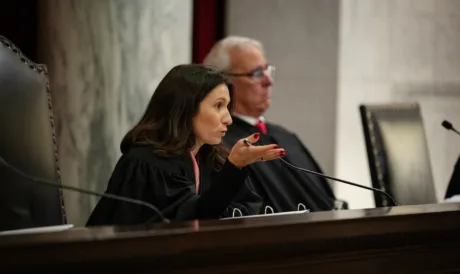
CHARLESTON - Justices of the West Virginia Supreme Court of Appeals asked pointed questions of both sides in a case that will determine whether the Legislature can reject rules developed by state education officials.
Attorneys representing the state Board of Education and Department of Education presented their case Tuesday afternoon against Secretary of State Kris Warner, whose office serves as a repository for proposed and emergency legislative rules, over the implementation of House Bill 2755.
The law, passed by the Republican-led House of Delegates and state Senate last year during the 2025 regular session, requires that all legislative rules enacted by the board must first be authorized by the Legislative Oversight Commission on Education Accountability (LOCEA). The proposed rules would then be submitted to the full Legislature for review, which could result in approval, amendment or rejection.
The state Board of Education and State Superintendent of Schools Michele Blatt filed a lawsuit against the Secretary of State's Office on Oct. 3, 2025, after the Secretary of State's Office rejected submitted Policy 4334 in May 2025 - dealing with regulations for public school transportation – for not being in compliance with HB 2755.
Christopher Smith, an attorney representing the state education officials, argued that a 1988 decision by the Supreme Court in West Virginia Board of Education v. Hechler determined that a 1983 law requiring legislative approval of state board rules was unconstitutional. In both 1989 and 2022, the Legislature adopted joint resolutions to place on general election ballots constitutional amendments to give education rule-making approval to the Legislature, but voters rejected both.
"It stated that any statute that interfered with the board’s rulemaking power was unconstitutional under Article 12, Section 2. The legislature understood that," Smith said. "Two times it proposed constitutional amendments seeking to carve back the board’s power. Both times, West Virginia voters declined. Under House Bill 2755, the legislature seeks to impose the very interference that this court held was unconstitutional in Hechler."
State education officials are seeking a writ of mandamus from the Supreme Court to compel the Secretary of State’s Office to publish the state board’s proposed rules in the State Register and to declare House Bill 2755 unconstitutional.
Smith cited Article 12 of the West Virginia Constitution, which states that “the Legislature shall provide, by general law, for a thorough and efficient system of free schools,” and placing the supervision of the school system with the state board “…which shall perform such duties as may be prescribed by law.”
"It states that the general supervisions of the schools shall be vested in the Board of Education," Smith said. "... This court held that the legislature, through its statutes, cannot limit, reduce, transfer, or reassign from other constitutional offices the ability to perform the inherent constitutional functions of that office. That’s exactly what’s going on in this case. The legislature has given itself a veto over the board’s rulemaking powers."
"Your arguments are awfully broad," said Chief Justice Haley Bunn. "Doesn’t there have to be at some point where these powers give way? We have a legislature with clearly the power of the purse. So, don’t we have to look at what we’re dealing with in this particular case rather than making broad sweeping arguments that the legislature can’t ever do anything as to the supervisory power?"
"This is not a case saying the legislature can’t do anything or that the legislature has no powers. This is a case saying that the legislature cannot wrest from the Board of Education its rulemaking powers," Smith responded. "The legislature has a tool in its toolbox, and that’s the legislative tool. If it doesn’t like a particular policy passed by the board, then it can go enter into its legislative session, pass a bill ... and pass a particular educational initiative that it wants to see done."
Solicitor General Michael Williams, representing Secretary of State Kris Warner, argued that HB 2755 was different from previous efforts to supersede the state board's independent rule-making authority.
"Under House Bill 2755, if the legislature does nothing, the board’s rule takes effect word-for-word as the board wrote it," Williams said. "House Bill 2755 thus doesn’t seize the board’s rulemaking power but merely gives the legislature one regular session to decide whether to ... legislate."
Williams said HB 2755 still allows the state Board of Education to approve or reject rules developed by the Department of Education. LOCEA would still only review education rules, only providing recommendations to the legislature. If the legislature takes no action, then the education rule would take effect. HB 2755 also allows rules to go into effect for up to 15 months, allowing time for at least one legislative session.
"Article 12, Section 2 says that general supervision shall indeed be vested in the board," Williams said. "We concede as much. But what’s important here is that the board, quote, shall perform such duties as may be prescribed by law. Prescribed by law has traditionally meant prescribed by statute."
Justice Charles Trump pointed out that there is a history of carved out independence for certain state government institutions, such as the Department of Education.
"It may have been the (1940s), but when West Virginia, among other states, started to venture into the legislative delegation to executive branch agencies for rulemaking authority, the original statute exempted the State Board of Ed from legislative rulemaking review ... along with the Public Service Commission and Board of Parole," Trump said.
In 1958, the state Constitution was amended to transfer the general supervision of West Virginia's 55-county public school system from an elected superintendent to an appointed nine-member Board of Education, making the state superintendent position a role appointed by the new board.
"Even after the 1958 amendment, it's still clear in Article 12 that the primary responsibility for a thorough and efficient system of public education in this state is the legislature," Trump said.
"This is not an attempt to aid the board. This is an attempt to give the legislature a veto power over the board," Smith said in rebuttal. "What the Constitution giveth, the legislature can’t taketh away ... The legislature is trying to take the board’s rulemaking power, and this court should hold that the law that does so is unconstitutional and issue a writ."